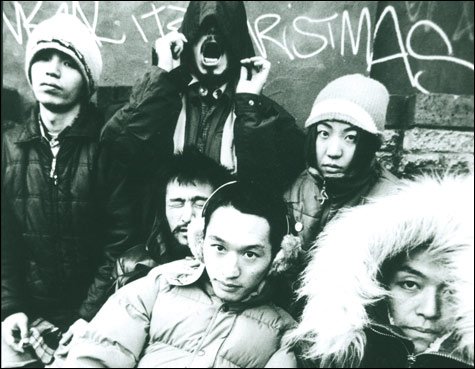
1998: Boredoms - "Super Going"

Listening to any of their albums, it’s easy to think that the entity known as Boredoms might have invented a genre or two, perhaps even some tones unheard by human ears up to that point. This, of course, is mere speculation on a subject that gets resolved on a person to person basis; yet there’s one song that seems universally monumental to this day. That’s “Super Going.”

For eight of it’s 12 minutes and 24 seconds, the song lurches in a motorik rhythm, propelled by various percussion instruments and keyboard chords that bounce in a relaxed manner while Yamatsuka Eye repeats the words “shine on” every once in a while in a plain sing-song voice. If the track consisted of just this, it would be a fantastic ode to Can with a modern twist – a major accomplishment in musicality considering early Boredoms work, which was often a cacophonous mess of hilarity and violence that barely made sense but still felt like true art channeled without commentary. “Super Going” is the band actually playing music instead of wallowing in their own creative juices like savage animals, as satisfying as that was.

Around the song’s 8:30 mark, glitches appear out of nowhere. The track skips with a scream from Yoshimi P-We that yields to music similar to the first part of the song but with faster changing chords, sounding just a little more desperate and frantic. In two words, more alive. Everything just feels vivid and euphoric, a kind of energy that seldom gets captured for posterity in the studio. Like an explosive, prolonged orgasm. It’s a simple change, but it sounds like a fucking earthquake.

Within the vast, often incredible oeuvre by the Boredoms, there are points where things aren’t what they appear to be: guitars get confused with keyboards, post-production sampling mistaken for live tracking, and voices attributed to different people. Somehow, “Super Going” is exactly what it seems: a happy, simple yet heavy musical head rush interpreted by noise terrorists who had just discovered that playing as a unit could be more devastating and empowering than destroying ears with feedback and retching noises.

1978-1987: Snakefinger

A number of months ago, one of my fellow Delorean writers wrote an excellent piece on The Residents. While I am definitely not “offended” by The Residents, I will say that despite my multiple attempts to delve into the group’s art I can only respect what they did from a distance. They seem focused on creating a concept and visual work, but musically they miss the mark for me.

Despite my misgivings of The Residents, their record label, Ralph Records, was a consistent source of great music in its early 80s heyday. Situated comfortably alongside records by groups such as Tuxedomoon and Yello was one of the label’s most memorable and overlooked acts: Snakefinger.

Phillip Charles Lithman had long been an associate of The Residents, reportedly receiving the nickname “Snakefinger” while visiting the group in the early 70s due to his abilities with a guitar. Upon Lithman’s arrival back in the States he began collaborating with the group; rumors abound that Lithman was even a touring member for their “classic period.” Throughout the late 70s Lithman and The Residents continued their collaborations under the name Snakefinger.

I sometimes refer to Snakefinger’s Greener Postures and Chewing Hides the Sound as “The best albums by The Residents that weren’t by The Residents.” That assessment may be unwarranted – The Residents are a major part of the records, sharing a number of songwriting credits and acting as the backing band, but Snakefinger remains completely different mutant. The squirrely synthesizer that dominates a lot of The Residents’ recordings takes a back seat to Snakefinger’s minimalistic avant-blues guitar and ability to write simple yet catchy music. Lines can easily be drawn from the bizarre psychedelic blues of Beefheart and the speedy pop punk of the Ramones to the emerging new wave and avant-garde of the early 80s. The music that Lithman created, even when he leaned more towards his blues rock background in the mid to late 80s, was never easily placed in a definable category.

Snakefinger didn’t rely heavily on concepts to drive his records; he instead took the eccentricity that was so charming about The Residents and distilled it into a more approachable form. Snakefinger’s history, although intrinsically linked to the Resident’s mythos, doesn’t have to be known to appreciate the music.

1993-97: Yo La Tengo Kick Out the Jams, Motherfucker!

Life must be busy for Yo La Tengo. Between being one of the quintessential bands of the 90s, a walking encyclopedia of cover tunes, and the group your friends have been billing as the only “mature” indie rock band that matters for the last two decades, its hard to believe they’ve had time to act out Seinfeld episodes on stage (seriously, look it up). So maybe that’s why they sound their best when things are slowed down and dragged out; when song structure is tossed to the wayside and four chords is all that’s needed to mesmerize an audience with relentlessly building waves of geeky, noisy bliss.

Starting with 1993’s Painful, Yo La Tengo created a tradition of closing their albums with extended guitar meditations, slowly easing listeners out of their world and back into reality with some of the most explosive jamming to ever emerge from Hoboken. It’s tempting to just shut up and let another jammy masterpiece fry your brains… so I will.

A lot can be said for the sheer quality and depth of YLT’s quieter, sustained meditations like the handful of songs from I Can Hear the Heart Beating as One and the entirety of And Then Nothing Turned Itself Inside Out, but these final dying roars are what I always come back to in the end. Does that make me a shallow Yo La Tengo fan? Maybe, but with crunchy, skronky noise this beautiful how can I say no?

2005: Merzbow - Dust of Dreams

Merzbow’s Masami Akita and his fans had a great year in 2005. Well in the midst of his “digital era,” Akita’s best work that year amounted to a trifecta of stylistically contrasting records: the jazzy Sphere, the brutal Bariken, and the tribal and psychedelic Dust of Dreams, a personal favorite. The only record Merzbow released for the Portuguese label Thisco, Dust of Dreams consists of three tracks in just under an hour and features some of Akita’s most evocative music of the period.

The bookending “1339” and “0716” provide respective intros and come-downs to the absolutely stunning title track, which takes up the majority of the album’s runtime at just over 37 minutes. The length of “Dust of Dreams” can be intimidating, but listeners should not expect a full-on noise assault. It all begins with a confident, loose drum beat. Akita gradually adds distorted synths and effects while keeping the drum loop untouched, providing a steady foundation while he weaves an arsenal of sounds in and around the pulse. So much of Merzbow’s work begins abruptly – no context, you’re just thrown into it – which makes the incredibly atmospheric 20-minute build up in “Dreams” feel so rewarding. After an all too brief ambient interlude Akita begins the process again, now with a new drum pattern that is more insistent and aggressive. During this second movement the synths really start blaring, the bass tones are more distorted; everything gets more chaotic in less time. The track’s collapse gradually brings the drum loop back into focus as everything else falls away and soon, just as it began, that is all we’re left with.

Merzbow is overwhelmingly prolific – so prolific that little consensus has built around his essential work aside from the popular 1930. Dust of Dreams is by no means an “easy album,” but it finds a great middle ground between something accessible like Merzbeat and the really brutal material found on records like Pulse Demon. Featuring a brilliant title track, it is an album worth listening to if you have any interest in the so called Godfather of Noise.

1998: Oneida - "Best Friends" single

Listening to Oneida’s earliest material is a bit astounding. Frankly, the long-running Brooklyn psych band’s beginnings on Turnbuckle Records sound like the work of a different band; in some ways it even is, at least in that 1997’s A Place Called El Shaddai’s is the only Oneida record to sport the band members actual names (that, and the album was essentially just Pat Sullivan and Kid Millions plus whomever was guesting on each track).

I’m struck by the growth from El Shaddai’s to the “Best Friends” single, released one year later. Listening to El Shaddai’s now, it just sounds like a mess. Some of its tracks make me think of the tongue-in-cheek riff-rock the band would later explore on Come On Everybody Let’s Rock (albeit in embryonic form), but mostly El Shaddai’s sounds like a collection of ideas that hadn’t quite materialized into songs – only the restrained feedback spikes of “Go There” stick with me. Regardless, the Oneida credited on the “Best Friends” single – Kid Millions’ real name aside – was the core four-piece in place until Pat Sullivan’s departure in 2002. Comparatively, the single still sounds unique from the rest of Oneida’s discography, with a newfound cohesion that El Shaddai’s mostly lacked.

“The Land of Bugs,” embedded above, is the most quiet and reflective song that Oneida would issue until 2005’s The Wedding. The track opens with disorienting, echo-laced electronic sounds that give way to a hushed guitar line and a reflective, lightly spoken vocal, fading out with the lyric “I want to replace myself with you.” “Best Friends,” comparatively, is more indicative of where Oneida would develop for the next few years, with its big noise-rock dynamics marked by drum breaks and a wistful vocal hook. It’s a good track, but I spin the single’s b-side more often – something about how the lightly strummed guitar meshes with chiming harmonics hits, and Oneida have rarely sounded so introverted.

The sounds explored on this single were abandoned about as quickly as they’d been found – Oneida’s follow-up, Enemy Hogs, quickly shifts into a new phase for the band. As many Oneida fans would be quick to point out, however, that constant shift in creativity seems to be the point.

1983: Hüsker Dü - Metal Circus

Anarchy in punk rock is bullshit. It doesn’t take much to rail against governments, institutions, or even that asshole who roughed you up for looking like a freak when, at then end of the day, you can go home and count the money you got from that fat major label check. Yell, scream, cut yourself onstage; none of it means anything when you don’t follow through on the outrageous shit everyone is so willing to spout for a moment in the spotlight. That’s why I say thank god for Hüsker Dü.

Hüsker Dü, and Bob Mould specifically, just got it. They understood that the people listening to punk and hardcore in the early 80s weren’t looking for someone to tell them to light fires and destroy shit but rather as an outlet for the frustrations faced by millions who just felt stepped on and worthless at every turn. And the brilliant part was they weren’t afraid to call the hardcore purists out for their hypocrisy. The songs from their 1983 EP Metal Circus illustrate this beautifully, with Mould skewering pointless anarchists and overzealous protesters with biting assaults of equal parts wit and sonic mayhem.

But the thing that really makes me respect Hüsker Dü is best encapsulated in the picture at the top of this piece. This was just three guys playing harder and faster than anyone else and not giving a second thought to what others expected of them. Greg Norton spent much of the 80s with the most ridiculous mustache since Ted Nugent and Grant Hart looked more like a chubby stoner than the drummer for one of the most vicious hardcore acts ever. Metal Circus catches that band at a time before major label contracts and infighting stretched them to their limits and shows how punks can be both fierce and reasonable; thought provoking without sacrificing the danger that drew so many in the first place.

News

  • Recent
  • Popular

There's a lot of good music out there, and it's not all being released this year. With DeLorean, we aim to rediscover overlooked artists and genres, to listen to music historically and contextually, to underscore the fluidity of music. While we will cover reissues here, our focus will be on music that's not being pushed by a PR firm.