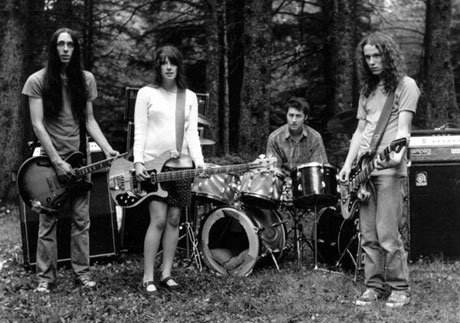
1995: Eric's Trip - "Smoke"
I live in Calgary, a city of one million people that’s fairly isolated in the vast prairies of Western Canada. A few weeks ago we had our first snowfall of the season. Winter is bitterly cold here, and it lasts for months — last year it got cold in September, and it didn’t let up until late April. There was snow on the ground for roughly a third of the year, with windchill temperatures regularly going below -30 Celcius (that’s -22 Fahrenheit). When it’s so cold outside, it takes a lot to convince any sane person to leave the house. In the coldest days of winter, there’s quite honestly nothing to do but get as warm and cozy as possible, often in isolation from friends and socializing — and that, at least for those of us up here with a penchant for introverted 90s indie rock, is where Eric’s Trip comes in.
Eric’s Trip, from Moncton, New Brunswick, experienced their share of winters. The majority of their discography is laced with lo-fi tape hiss, the mark of extensive 4-track recording done in basements and bedrooms — the sorts of isolated recording locales the Canadian winter tends to force upon a person. I’ve never experienced winter in the Maritimes, but I can imagine the chilly ocean air makes something comparable to the snowy wastelands I’ve grown up with in the west. This is part of why I like the song “Smoke” so much — somehow, it finds beauty in the winter life.
“Smoke” comes from The Road South, a three-song 7” that Sonic Unyon released in 1995. Much of Eric’s Trip’s music is as 90s as one can get, often warranting comparison to Sebadoh/Dinosaur Jr./etc. — but “Smoke” strikes me as distinctly their own, lightly psychedelic and reserved. Put simply: “Smoke” is a winter mixtape staple.
Rick White opens the song by quietly singing, “snow outside is only in your eyes.” After the first verse, however, a beautiful harmonized vocal line fills out the recording space, sounding as enveloping as a fresh coat of snow. The tremolo-soaked guitar notes are as brittle as ice, and the cavernous, echoed vocals that fade in during the last minute are as cold and airy as a winter breeze. I feel that songs like “Smoke” can only be crafted in the heart of winter, so let’s ignore that this single was originally released in July 1995.
Eric’s Trip wrote other winter songs. Both Rick White and Julie Doiron continue to write their fair share (The Unintended, a band that’s essentially Rick White with the Sadies, put out a distinctly cold album in 2003). It’s “Smoke,” however, that does it for me: in just over three minutes, Eric’s Trip crafted a quintessential 90s indie rock track for the coldest — but vaguely optimistic — moments of winter.

1971: İlhan Mimaroğlu - "Wings of the Delirious Demon"
Can you imagine what exactly a delirious demon might sound like? Maybe the closing scene of Disney’s Fantasia pops into your head, where a towering black god conjures dead spirits to the tune of Mussorgsky’s Night on Bald Mountain, but even that moment doesn’t approach the shear sonic chaos I assume would accompany a full scale breakout from the underworld. In all likelihood, no other piece of music ever written will encapsulate the absolute terror of these unknown evils like Turkish composer İlhan Mimaroğlu’s masterwork “Wings of the Delirious Demon.” “Wings” is the fifteen minute centerpiece of Mimaroğlu’s 1971 album of the same name that to this day remains one of the most captivating and utterly bewildering works of electro-acoustic manipulation laid to tape, and considering he was a contemporary of men like Edgard Varèse, that’s saying something.
The full length of this track consists of heavily manipulated clarinet playing that Mimaroğlu twists into squawks, metallic pings, deep growls, ear-splitting static, and literally every frequency in between. It really is hard to describe how many completely off the wall noises Mimaroğlu coaxes out of his clarinet, but I’m not exaggerating when I say nearly all of the bleeps and bloops crammed into this track have become staples of many respectable electronic manipulators active today. No words can quite describe the insanity, both audibly and creatively, of this piece, so do yourself a favor and check out this lost classic of electronic madness.
1964: Raymond Scott - Soothing Sounds for Baby
Raymond Scott is not much of a household name. Usually when people do recognize him it’s for the many soundtracks Carl Stalling adapted from his material in old Warner Bros. cartoons (Scott himself never directly wrote music for cartoons). In spite of this, Scott is without a doubt one of the most influential people in all of electronic music. In the 30s he began work in the field, inventing early electronic instruments such as the Clavivox and Electronium; Bob Moog – as in Bob “invented-the-fucking-Moog-Synthesizer” Moog – called him an important personal influence.
The greatest of Scott’s work can be found in the midst of a three disc collection, Soothing Sounds for Baby. It is exactly what it sounds like. Scott worked with the Gesell Institute of Human Development to create an electronic music album that could help soothe babies to sleep. The pieces consist of playful melodies, lullabies, and some more abstract moments (“Tic Toc” simply simulates a ticking watch). The best of all the pieces, “Little Miss Echo,” is one of the most breathtaking pieces of early electronic music ever recorded. It is a hypnotic, dreamy, and effortlessly beautiful synthesizer piece that becomes even more stunning when you realize it was released more than a decade before Eno’s Music for Airports. Simply put: nobody was making music like this in 1964.
“Little Miss Echo” builds over seven minutes with various looping electronic chirps, blips, and beeps. The entire piece is carried by a warm pulsing beat while other melodies seem to dance around it. It may have been intended for babies (“Little Miss Echo” in particular was intended for babies 12-18 months) but this music works for everyone. The particular timbre of Scott’s instruments triggers something in the brain that truly does relax and soothe. It is unbelievable how similar some of these tracks are to the ambient and electronic music of the late 70s such as Kraftwerk, Tangerine Dream, and of course Brian Eno, but on the other hand I’m not surprised ─ Scott was so ahead of his time it simply took everyone else a decade to play catch up.
1969-: It's Absurd to Be Offended By The Residents
If you ask me, a great part of The Residents’ appeal stems from their absurdity; the way they channel surrealism and playfulness in ways that make you reflect on existential ennui. They lead you to scary territory, making you realize everything is really futile and it’s all just a big race to see who dies first. At least that’s what happens when I start to bob my head to the grooves of Commercial Album and Third Reich N’ Roll. Sure I love The Residents, and so does Steven Stapleton, the MOMA, and most humans who can spot sarcasm a mile away, but I have grown increasingly disappointed with each of their releases, especially the more narrative albums in their catalogue.
The straw that broke the camel’s back was when I saw them earlier this year. Anticipation was high in general since the show was sold out and scalpers were rampant with overpriced tickets. And then the lights went out, the crowd roared, the three masked men appeared and things weren’t surreal as much as they were didactic, pedestrian, and highly condescending; all done in the cheapest, least involved way. Whenever they addressed the audience, they talked to us as if they were playing for little children. In comparison, a live Sesame Street act would have been more avant-garde than presenting lame projections and laptops doing playback while a guitarist did his best Steve Vai imitation. Ugh. Just ugh.
Whenever I listen to The Residents, I end up wondering if they intended to make me think about something deeper or if they thought all of this was just something cool to do; perhaps they are mocking us for thinking they wanted to achieve something beyond simple sound-making. Yet I think we live in a time completely suited for The Residents. When they started in the 70s the sociopolitical environment was absurd, bordering on the scary. In my appreciation, they were ridiculous and unreasonable, “out of tune” like the root of the word “absurd” in Latin, not because they were stupid or dissonant (well, sometimes they were); they understood what Antonin Artaud once said about theater being a bloody and inhuman spectacle to exorcise the audience’s latent criminal behavior. At least that’s what they used to be; now they’re as safe as Cirque Du Soleil, without the bigger-than-Jesus budget. The times we live in can’t be any more absurd. I mean, just look around! I’d hope for The Residents to make some great art based on these idiot times, because someone should say something.
Perhaps the joke is on me and their ultimate work is doing things halfway so people can talk and write incessantly about them and that’s all they really want. I can’t blame them for that. Anyway, this song from their glorious Duck Stab album makes me feel things inside and in places I might tell you later, if you’re interested.
Sept. 16, 1973: The Death of Victory Jara
On Sept. 16 1973, Victor Jara was murdered. Five days earlier, a military-led coup had taken the life of Chilean President Salvador Allende and installed a new regime. Jara, a singer and political activist, had aggressively campaigned in favor of the democratically elected president.
Jara was seized on Sept. 12 at the University of Santiago. For four days, he and thousands of other political prisoners were brutally tortured at the Chile Stadium in Santiago.
On the morning of Sept. 16 Chilean soldiers singled out Jara and beat him mercilessly. They broke his hands. They mocked him, telling him to play the guitar with broken fingers. In the face of death, Jara sang “Venceremos” (We Will Win), the rallying cry of Allende’s political party.
An attending military officer loaded a single bullet into his revolver, spun the chamber and pressed the pistol against Jara’s head.
He squeezed the trigger once. Nothing. A second time. Still nothing. On the third attempt, a gunshot echoed through the stadium, and Jara’s body dropped to the ground. Two subordinates machine-gunned his body, leaving 44 bullet wounds to ensure that Victor Jara would never sing again.
1967-1972: The Tenth Dymensions - "My Love for You is Growing Wild"
The Tenth Dymentions barely exist in the vast world of the internet. I’ve been hooked ever since I first heard their midtempo soul masterpiece “My Love For You is Growing Wild.” Recently, I tried to find out more information about this band – one of many soul bands who deserved fame but never found it.
Searching through the scant pages that reference them, I haven’t learned much. There’s little to no information about their record label Sapphire. A search for the arranger/writer Vern Ryan at least brings up some details. Ryan is associated with another band called the Fabulous Dimensions as well as a bizarre mysterious 70’s funk band called Von Ryan’s Express. One soul collector places the Dymentions/Dimensions in a Chicago suburb (Robbins). This Chicago connection is confirmed by the inclusion of Joe Savage, an arranger/producer for a handful of Chicago’s independent soul bands in the late 60’s.
The song is featured on three compilations as far I can tell: The Get It! Vol. Raw Funk of ’67 to ’69, Gangster Soul Harmony Vol. 3, and Mayor Hawthorne Presents: Soul With a Hole Vol. 1 (the Stones Throw compilation where I first heard it). The image of the “Bush Man”/”My Love For You” seven-inch above places the song in 1972, confusing the exact date of the recording. There’s no band members listed. No bios or photos. There’s only really great soul music with an impossibly warm horn section and a vocal intensity practically sweating off sexuality.
The scarcity of information about the band speaks to a larger issue that’s been on my mind lately. If you don’t know already, there’s been an ongoing internet debate that streaming music capabilities will make having a music collection obsolete. The theory is that a majority of people will simply take whatever they can conveniently get. Critics argue that forgotten soul songs like this one, indie labels, and artists who choose not to opt into these services would be pushed further into the ranks of obscurity if they don’t make themselves available on Spotify, iCloud, etc.
I hope it seems obvious though that cloud lockers and streaming subscription companies will never be able to offer exposure for forgotten artists as effectively as people working at independent record labels and record stores (Aquarius Records and Numero Group I’m looking at you). They will never tap into the same passion as people writing on blogs, posting on message boards, and commenting on YouTube videos. The companies might offer me convenience, but that’s not quite the same as putting a personal investment into everything a label does and being rewarded by finding an obscure gem on a CD (that’s since been deleted from the label). I’m glad that I’ll never be able to find this song on Spotify and the only way to find information about the band requires heavy digging. There still needs to be room for musical discoveries that require effort. The Tenth Dymentions might not be a featured artist on iTunes any time soon, but they will live on in the peripheral glory of a few devoted internet pages – this one included. Is that such a bad thing?
