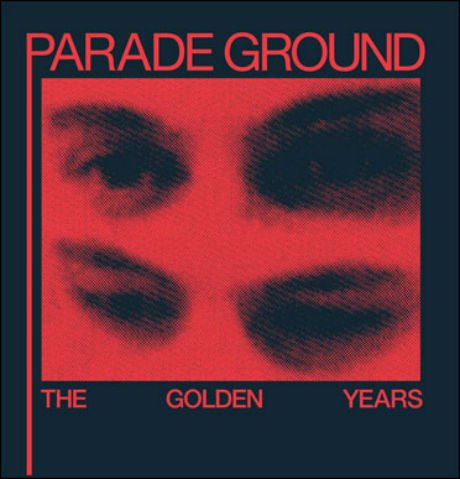
1982-1988: Parade Ground - The Golden Years
There’s nothing better than receiving a record and finding that more research is needed. I like to be pushed, and Dark Entries’ output has been shoving me around like kids used to on Idaho’s finest playgrounds. Hell, I might even start delving into those old Level 242 LPs I got from COUG radio’s downsizing. And that super-old, dance-era Ministry stuff? BACK IN THE FOLD, friendo! Those choice latter Talk Talk LPs? Let’s… let’s just not go there, for now, okay?
Hearing a record like Parade Ground’s The Golden Years — a collection of singles and rarities — for the first time, decades after the music was released, feels like more of a celebration than a traditional listening experience. With proper commercial considerations long passed for the Brussels, Belgium, duo and a limited, vinyl-only pressing propping it up, for me it’s encouraging to know albums like Golden Years are being unearthed like ancient artifacts — hey, a few decades is like a few-thousand music years — first and foremost. So, tip of the cap.
When delving into the audio itself, the mood is lukewarm — as in not as frosty/bleak as many — and almost spiteful. Parade Ground specialized in synth-driven coldwave with an inherently German feel, post-punk through the lens of the usual suspect of the era (Joy Division), albeit with random instances of sparkle that fracture and frustrate the facade of canned beats and synth bloops.
And what’s that I hear? Yep — that’s could’ve been a HIT: “Retired” whips it real guuuud; why didn’t a few stations pick this shit up? It’s got the mega-hypno beat that keeps the flow on the flo’ — replete with double-time hi-hat — addictive synths presets, and a bassline radio programmers used to cream corn in their pants for back in the day. It’s damn luscious, a track that would draw a lot of heat if only more people could HEAR the damn thing. But what I admire most is the flexibility of Parade Ground, as you don’t have to venture far to find antidotes to all-out bangers/mashers like “Retired.”
“Fall Incognito,” for example, follows “Retired” on the tracklist and couldn’t be more astray from the catchiness of the latter. A dominating, foggy wash of synthsterisms cloud the composition as confrontational, combative vocals eject spittle seemingly inches from the listener’s face. And dig these snippets: “You call love what’s only physical/ And the word love is fake… But I guess I’m always gonna fall incognito/ On your battlefield body.” Ouch.
In reality, these are but a few highlights plucked at random. If you want to feel the icy tingle of 1980s-borne, post-pfunk, colder-than-you-wave synth magic, you’ll have to take the plunge by seeking this out. Much like a lot of the presskits of the era (and there’s a great one included with The Golden Years), which were plain, black-and-white, and to-the-point, these simplistic early strains of synth-pop are direct and economical. They ring as true now as they did in their day, if not more so. Why can’t we replace the 80s hacks of today with the true gods of the movement? Until that question is answered, we have albums such as this to fill the void.

1992: The Orb - Blue Room
In the wake of The Flaming Lips’ success in completely fucking with song duration, I can’t help but be reminded of The Orb’s classic ambient techno single “Blue Room.” The story goes that Alex Paterson and Kris Weston extended the song to its famous, epic 39 minutes and 57 seconds after they learned that a song 40 minutes or higher could not be classified as a single on the UK Singles Chart. So at three seconds below the limit, “Blue Room” was released and bizarrely became a top ten hit. But regardless of length, one can’t help but be swept up in this song’s alien groove.
“Blue Room,” in its many forms, has always been a fabulous techno song. Although the edited album version on 1992’s U.F. Orb (less than half the length of this one) stands as nearly perfect, the full-length song is such an achievement because The Orb use length to their advantage. The song gains a tremendous amount of power by being so lengthy alone, giving listeners the option to space out to its druggy beats or sit and admire all of the subtle sonic detail. While it drifts and shifts into different sections, the track overall remains surprisingly focused. With the foundation of a massive pulsing bass line, “Blue Room” manages to take you to another world.
The particular timbres and rhythms Paterson and Weston use on the track are powerful, but never intrusive, fitting for the ambient house style they had developed. In other words, perfect come-down music. The song’s hypnotic rhythms are equally relaxing and engaging, and for the drug-fueled synesthesia crowd, it genuinely sounds blue (which comes primarily from the dark, icy synths that dance in and around samples of rushing water). Perhaps most importantly, “Blue Room” works as a house song that didn’t use the 4/4 beat as a crutch. The classic house beat recurs throughout, but the song goes on many psychedelic tangents as The Orb explore countless textures and rhythms. All of this adds up to a fluid hypnagogic rave that, regardless of its length, always seems to end too soon.
1991-1996, 2005-present: 108
All humans long for spirituality. That’s how we’re built. We can ask, “Why are we built like this?” but it won’t shut us up for days, weeks, and decades. I don’t think we, as a species, ever stopped discussing it.
Of course, the easy solution to the quest for soul satisfaction is religion, and many of us have been born into one. That said, religion doesn’t equal spirituality; not always, anyway, and not for all of us. There are some who say that they’re devoid of spirituality, that it’s all bedtime stories to scare adults away from achieving something and leaving their wallet to the guys at the churches, mosques, synagogues, etc. Most of these people are ready to testify in the name of science and technology, telling you that astronomy proves there may be life in other planets, that math could one day help us reach the speed of light to step into a black hole and experience the event horizon.
Spiritual unrest happens to all of us. To some, all the time; to others, once every couple of years.
Hardcore is a suburban home, to borrow a title from The Descendents. It gives kids who don’t fit anywhere a place where they can crash, have fun, hurt themselves, cry, and smile a lot with people who feel the same way (coexisting with some complete headcases who just want to bust heads and start fights). It’s a place where they can live. So no one’s really surprised when you see spirituality enter the picture — although, it might be surprising if you don’t think about it. That and some free vegan meals is how the Hare Krishna became a serious thing for the NY contingent of that scene.
I rather not bore you with the history of krshnacore, as this piece is not concerned with that. We are talking about a specific band called 108, who are one of the most intense bands in the history of a very intense musical movement. Born from the ashes of such groups like Beyond, Resurrection, and Inside Out (with young Zach de la Rocha), 108 started because the members wanted a Krishna-centric band; they were contemporaries of Ray Cappo’s post-Youth of Today vaishnavist sensations Shelter and in fact had guitarist Vic DiCara before forming his own numerical band. The members had actual hindu names — but not for show; some were actually monks.
Their music was a mixture of I Against I-era Bad Brains with the weight of Cro-Mags circa Age of Quarrel. It could be slow and furious or fast and angry (unlike, say, Shelter who weren’t pissed off the way YOT were, let alone 108), but always with interesting rhythms and destructive yelling. Singer Rob Fish was gruff and screamy but left his voice a little out of control for an added effect, joined occasionally by the nicer stylings of then-bassist Kate Reddy in the album Songs of Separation, which is considered their finest hour. Their secret weapon was, without a doubt, guitarist DiCara. On “Mantra Six,” off Threefold, the band conjures a groove and dark metallic funk that wouldn’t feel out of place on a Rage Against the Machine album, with the exception that Vic doesn’t resort to his pedals to make his riff sting the way Tom Morello did.
It’s music like this that makes me want to not only punch walls or bang my head and scream along, but also ruminate on the intangible, the ineffable. I’m not saying that this music makes me want to go krishna. I’m talking about the sensual pleasures this music provides, the visceral effect that it has on me. It puts me at ease while providing me fodder for questions and possible answers that make me conscious about my existence and spirit. It’s a role that my favorite music fills in me, and it’s probably a similar kind of search that led the members of 108 to their particular path to faith.
Listen to their heaviest krishna-testifying track, “Solitary”:
2000: The For Carnation - "Moonbeams"
Slint’s Spiderland is one of those referential holy grails of 90s indie rock, a work so defining to its genre that it can’t really be separated from its looming shadow of influence. After disbanding by 1992, the members of Slint went on to form and/or contribute to several other projects, including Tortoise, the Breeders, whichever variation of Palace that Will Oldham felt like using that week, and The For Carnation.
The For Carnation was vocalist/guitarist Brian McMahon’s post-Slint project. McMahon formed the band in 1994, though it was more of a solo project – for much of its existence, there was a revolving door’s worth of members surrounding McMahon. Regardless, in their existence, The For Carnation released two EPs in 1995-96 on Matador, and a lone, self-titled album in 2000 on Touch & Go.
Their self-titled effort was a dimly austere record, atmospherically stark and paced like a snail. The time between Spiderland and The For Carnation was nearly ten years and, in that time, numerous bands picked up on Slint’s foreboding post-rock, possibly to the point of referential redundancy — along with the volume dynamics, McMahon’s spoken style of vocals became coded into the genre’s DNA, giving us everything from June of 44 to Drill For Absentee; early Cerberus Shoal to Codeine.
The For Carnation weren’t picked up on the same way as Slint, however — despite some ties of similarity, such as a quietly spoken vocal approach and David Pajo’s presence on the band’s debut EP Fight Songs, The For Carnation’s music was perhaps too sparse to be recognized in the same way. Spiderland set the blueprint for 90s post-rock; by the time of McMahon’s resurgence, 90s post-rock was quite literally tired — its glacial offshoot slowcore had since entered the public consciousness, and perhaps what McMahon and co. were offering was just too low-key.
Still, The For Carnation were every bit as moody as Slint, though tracks like “Moonbeams” operate in a wistful, somewhat resigned manner. There are no “Good Morning, Captain” screams or distorted sections, just nine minutes of sparse, steadfast dead-of-night darkness. When “Moonbeams” does get louder, it’s very gradual and feels earned, not jagged or fractured. Some of its electronic flourishes (notably a brief series of vaguely sci-fi electronic bleeps that pop up throughout) may sound a bit dated, very much placed within the late-90s/early-00s period, but they’re hardly distracting — given the numerous examples of contemporary acts trying to nail that vintage 80s sound, it’s actually somewhat refreshing to revisit a different style of dated electronics.
Much of The For Carnation is delicately labored over, often feeling creakingly frail. Its scope as an unrelentingly sparse and forebodingly dark record is impressive, not unlike The White Birch-era Codeine or early Low. “Moonbeams,” however, is The For Carnation’s crowning finale, a sprawling beauty of quiet, middle-of-the-night introspection. Its simple, understated guitar motif is one of the most beautifully restrained instrumental hooks (using the term “hook” very loosely) within pre-cinematic post-rock (as in, before “post-rock” started to mean “predictable cinematic climaxes”). Every sound in “Moonbeams” is distinct and delicately arranged within a deep and spacious atmosphere — this is darkness in the isolated sense of night, wind echoes and all.
1960-1986: Pietro Grossi: Do Androids Dream of Electric Beats?
Pietro Grossi was an Italian composer who saw the future of music before it happened. His work in computer programming, digital music production, and generative algorithms paved a new dawn for music, even if his work still seems centuries ahead. A classically trained cellist, Grossi did not simply utilize computers as tools for transcription or recording, but for generating music. For example, his 1961 piece “Progretto 2-3” consists entirely of high-pitched tone loops, directed solely by a computer algorithm. Such a process sparks a debate that humans could only even conceive within the past 50 years: what makes music human? Scholars and Romantics the world over praise music as a genuinely human innovation. The manipulation of sound for the sake of human expression couldn’t be tailored to the cold-hearted stoicism of a machine… could it?
Grossi proved that machines could not only dream, but also expand upon what the music world had already seen. His 1969 work “Collage” created music that would be regenerated and rearranged each time it was performed. In 1980, his “Computer Music” transcription project transcribed and performed improvised elaborations upon the work of Bach, Chopin, Satie and more. The genius of the masters was boiled down to nothing more and nothing less than cold, hard computation, an array of numbers and symbols that could be analyzed and reinterpreted by something as “dull” and “lifeless” as a computer. It’s certainly odd to realize that a construct so valuable to so many can be boiled down to one big math problem. But then again, isn’t it a bit comforting to know that one of humanity’s most valuable and mysterious achievements is to a certain degree simultaneously completely rational and brilliantly magical?
1974: Jorge Ben Jor - A Tábua de Esmeralda
I find it really awesome that Jorg Ben Jor successfully sued Rod Stewart for stealing the melody of his song “Taj Mahal” for the “Do Ya Think I’m Sexy” chorus. (He also allegedly changed his surname from Ben to “Ben Jor” after American smooth R&B king George Benson started receiving the Brazilian singer’s royalty checks.) Ben Jor is one of Brazil’s most prolific musical legends, having released over 30 albums in the last 50 years, many of which are out of print. Aside from being a musician with an immensely talented sense for melodies and soul-infused grooves, Jorge Ben Jor fascinates me because he doesn’t fit the mold of the Tropicália musicians that have been recently exported so seamlessly into the arms of American independent culture.
Ben Jor predated the psychedelic modus operandi of Tropicália by a few years, gaining more exposure because he was actually allowed to play concerts. His less overtly political lyrics didn’t warrant as much censorship from the dictatorship at the time. In the 1970, when Brazil’s musical palate expanded, he distanced himself from bands within the youth-based Joven Guarda genre because they often dismissed the Brazilian aspect of their music (samba/bossa nova roots) in favor of borrowing too much from Western rock ‘n’ roll. He became a figurehead in MPB (musica popularra de Brasil), but by the mid 70s, he headed further and further from traditional samba into the territory of African soul/funk samba fusion.
The 1974 masterpiece A Tábua de Esméralda (translated as “The Emerald Tablet”) showcases Jorge Ben Jor’s lifelong love for theosophy, mysticism, and, above all, alchemy. He frequently lists Aquinas (one of Christianity’s most famed alchemists) as an influence. The cover of the LP borrows drawings from Nicholas Flamel, a manuscript seller who was historically immortalized as a great alchemist for his work on the philosopher’s stone. “O Homem da Gravata Florida” is indebted to Swedish renaissance botanist/occultist/alchemist Paracelsus. The hit single from the album was “Os Alquimistas Estão Chegando” (The Alchemists are Coming) and was even featured in a 1980 Brazilian movie during a memorable drug-induced scene.
Part of what I find really charming about Jorge Ben Jor is that he seems comfortable existing inside and outside genre, expectation, and philosophy. While he writes songs influenced by dense mystical texts, he’s perfectly okay writing songs about soccer teams. From A Tábua de Esméralda, he doesn’t shy away from political messages during standout track “Zumbi,” honoring Zumbi dos Palmares, leader of a runaway slave colony in 17th-century Brazil. Another album track “Errare Humanum Est” talks of space, gods, and astronauts. He has an understated style with a commitment to his complex identity. And the production is lively and the music is beautiful too. Fusing personality with an amalgam of musical styles, A Tábua de Esméralda is a great entry point into Jorge Ben Jor’s alchemy and artistry.
