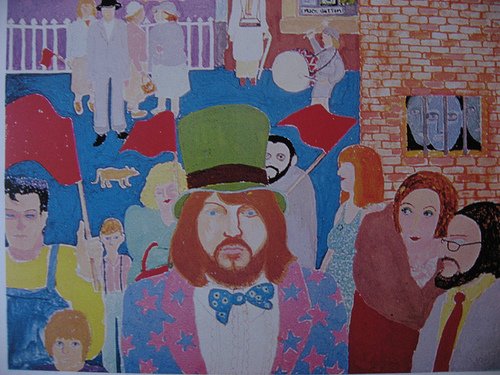
1974: Robert Wyatt: "Little Red Robin Hood Hit the Road"

Stepping out into the world with headphones on can be a strange experience, like deciding to swim under water for a couple of strokes — especially if you’re listening to the weirdo strains of Robert Wyatt’s 70s masterpiece Rock Bottom. Maybe it’s alienating and irresponsible to disengage with the everyday even on the most quotidian stroll to the park or shop — there are probably many members of your community willing to chat, swap houseplants and stories; Grandmas needing help with their bags etc. Ah, Pa, people don’t care! Most ordinary days involve more humbug than hobnob. The underwater world of Rock Bottom is thus a most suitable companion for a walk to the park on a dry hot day, but also a weird one — a school-skipping dope carrying companion. The way in which the music deviates so gloriously, so shiftily, from the ordinary really kicks in on the final track “Little Red Robin Hood Hit the Road.”

There are two movements, the first of which is a dirge-heavy presentiment of the second, beginning with Robert Wyatt intoning “In the Garden of England” in true prog style, and ending with the most amazingly evil-sounding electric guitars, played by Mike Oldfield. The second opens with a wall of intensity: harmonium and viola descending like a heat haze. The harmonium belongs to Ivor Cutler, the Scottish eccentric — poet, humorist, and children’s author — who recites a nonsense poem over the music in a flat, hypnotic voice, his uncompromising Scots delivery at times bizarrely resembling a Jamaican accent. See, for instance, “I reflect on the life of the highwayman, Yum Yum Yum” and “I fight with the handle of my little brown broom.” The effect of these obscure ruminations — bordering on village idiocy — is to bind a homely, peaty darkness with a bloodshot menace, both of which are perfectly set off by Fred Frith’s scratchy viola. Cutler got three record deals on the back of this ‘little’ poem: probably the most amazing, unsettling finale to an album I’ve ever heard.

-

2007: Electrelane - No Shouts No Calls

Despite the trappings of being an all girl group, Brighton’s Electrelane rise to the challenge indie rock issues from time to time to a chosen few — that of being pure and staying that way. Androgyny is one of the pillars upholding this aesthetic, and the girls seem willing to lend their support — they dress up in Joan of Arc costumes, sing like choirboys, and make their guitars snarl, outdoing the angriest of young men.

Ultimately though, the various elements on No Shouts No Calls (2007) — twee vocals, Farfisa organs, and revving guitars — are combined in a way that is genteel rather than aggressive. The skillful manner in which these elements are layered recalls the deft hand of the pastry chef rather than the chubby paw which No Shouts No Calls’ occasional mud-pie-sculpting simplicity suggest was the shaping force behind the album.

“Cut and Run,” for instance, is a track that seems designed to stoke the wan flames of journalistic cliché. Viewed purely as an accomplishment, it’s your typical ‘refreshing slice of summery indie pop,’ but what is much more important for the endeavor/quest being undertaken on the album is that its heart is open and in the right place.

The girls are at their most girly on “In Berlin,” which opens with the melancholic diary entry lyric “there is thunder in Berlin” and a sad little rocking horse melody picked out on the upper reaches of an electronic organ. “Between the Wolf and the Dog,” by contrast, is an electric guitar snarlfest which allows the band to enjoy a mosh, shaking their mid-length pageboy haircuts for all they’re worth.

“No Shouts No Calls” was recorded at least partly in Berlin, and one of the things that makes the album not just smart but sophisticated is the way its urban backdrop meets and interacts with its indie rock ambitions: the result is a hopeful vision of the city (which in the last couple of years has been enjoying a ‘moment’ among young hipster expats) that is more primary colored than gritty. Thrifty, plucky East Berlin plays the role of new band member on songs like “Tram 21,” which begins with the clanging approach of a tram and morphs into a lazy reverie that unfolds in the capable hands of the reliable Euro public transport system. “Tram 21” manages to be modern in the spruce manner of a Swedish kitchen and in doing so it recalls one of Electrelane’s major influences, the sometimes blandly European electro-pop band Stereolab.

“No Shouts No Calls,” however, manages to mostly avoid the Euro influences of Stereolab, Neu, and the English whimsy that leaps out from the nautically themed album cover. So Electrelane stay clean not only through a good work ethic and curtailing their prog-out inclinations, but by avoiding overly hygienic electro-pop on the other end of the spectrum. Their 2004 album Power Out was released on “Too Pure,” but though Electrelane manage to elevate themselves to the state of grace Lou Barlow of Sebadoh sings about (in his case an ideal reached through chemicals), they thankfully avoid becoming holier than thou along the way.

1982: Charanjit Singh - Ten Ragas To A Disco Beat

Charanjit Singh found himself in an interesting position back in the early 80s. Working as a session musician in the Bollywood films industry, he was exposed to a wide variety of electronic musical devices. Two of the instruments he used, which would not have been made so readily available otherwise, were the Roland TB-303 and TR-808 synthesizers — the very same synthesizers that later generated all of those drippy sounds you hear on your acid house records. During the time he spent away from his work, Singh sought to re-contextualize the ancient music of his nation — the Indian ragas — using the most technologically up-to-date methods. So no, Ten Ragas To a Disco Beat isn’t some abstractly titled avant-garde record (which is what I initially thought); it’s actually ten ragas played over a disco beat. And no, it’s not one of those corny gift-shop albums marketed to rich tourists — it’s 10 hissing artifacts that represent an aurally flexible ancient culture.

Now, ‘hissing’ isn’t usually the word one uses to describe what happens when folks attempt to re-record old cultural music. Usually you’d call it “world music,” and usually you wouldn’t listen to it. But don’t be averted. Ten Ragas To A Disco Beat was originally released in super-limited quantities in 1982, but it’s recently been re-released by the Bombay Connection label, and it couldn’t be better. The melodies mesmerize, the rhythms pulse relentlessly. And the synthesizer… Oh lord, Singh’s synth makes sound that modern electronic producers should envy. Ten Ragas doesn’t come off gimmicky like one would expect from reading over its history, rather, it’s minimal and potent beyond measure. So get your ass over to the Bombay Connection, they’ve got a gift waiting for you.

-

1999: S - Sadstyle

Critics and commentators across musical lines all agree, and it’s certainly hard to dispute: the internet has made it easier to seek out obscure music. And yet there are still some artists whose music is difficult to uncover, precisely because their name defies easy Googling. Case in point: Jenn Ghetto. Best known for her membership in the beloved, soon-to-reunite Seattle band Carissa’s Wierd, Ghetto records under a solo project called S, making for a nice outsider touch, the 21st-century version of eighth-page ads in the back of MRR or HeartattaCk. While such an alias makes the music made by Ghetto harder to find on the internet, it’s certainly worth the extra steps.

Sadstyle was recorded from 1997 to 1999, during a time when Carissa’s Wierd was still an active band, and it has somewhat of a side-project feel. Listen for long enough and you’ll hear found-sound collages (as on “Iterlude”), tape manipulation (“Lemonade Sweetheart”), and unexpected covers (an abbreviated take on Metallica’s “Welcome Home (Sanitarium)”). This album is indeed a four-track project from the 90s, but it’s also a reminder of exactly why the home-recordings aesthetic works. These songs can feel messy at times, but that mirrors the messiness of the lives documented in them, something Ghetto’s lyrics and (especially) her vocal delivery makes clear.

-

-

While S’s subsequent albums have adopted a fuller and more distinctive sound — see the incorporation of programmed beats on 2004’s Puking and Crying or the cleaner approach of 2010’s im not as good at it as you — parts of Sadstyle overlap stylistically with the emotionally raw sweep of Carissa’s Wierd. Both the rapid, rhythmic “Everyone Else” and the stream-of-consciousness delivery of “Up & Down” would seem equally effective played by a full band as they would in the stark, solitary versions heard here.

Elsewhere, the intimacy of home recordings feels essential. Ghetto’s voice can turn sharp, but here it’s mainly a whisper, imparting a sense of isolation as it sketches minute portraits of fractured relationships. What endures about Sadstyle is the way emotionally raw sentiments rise, bristle, and sting. On “Another X-Mas W/Out You,” Ghetto sings, “We can just be friends/ Guess it’s my turn now/ Let me buy you a drink/ I’m glad we figured this all out,” the last word elongated to show the stress. Another fragment that drifts into rapid focus comes in “I Love You Too…”: “Can’t even breathe in here/ Can’t even look at you/ Tell me how it feels when they all start to laugh at you.” It isn’t the lyrics, per se, but Ghetto’s delivery that’s hard to shake. The same could be said for this album; over the course of its hour-long running time, it establishes a mood that stays with the listener for much longer.

1991: Talk Talk - "Ascension Day"/"After the Flood"

Would you believe that I only recently heard Laughing Stock for the first time? I had, of course, unjustly written Talk Talk off as tawdry 80s electro-rockers, due largely to the greatest hits collection I had stumbled across in my lady’s iTunes library. Zero of the songs on that compilation were from Laughing Stock, and only two (“I Believe in You”, “Desire”) were taken from Spirit of Eden, generally considered to be the band’s other masterwork. You can see how I was misled.

“Ascension Day,” the second track from 1991’s Laughing Stock, is a stunningly tight six-minute song that manages to singlehandedly foreshadow much of the post-rock output of the next couple decades, including, yes, Radiohead’s later career phase (specifically In Rainbows). Lee Harris’ spacious drumming is the song’s backbone — the spirit guide for the band’s warm, textural noodling and frontman Mark Hollis’ charmingly disheveled Peter Gabriel-esque vocals. By the conclusion of “Ascension Day,” the song has split open and become a snarling beast, wide-lensed and feral.

-

-

That conclusion is a little confusin’: “Ascension Day” stops abruptly in the middle of a measure — the first time I heard it, I thought I’d gotten a bum copy of the track, but no. The teeth-gritting tension of that song leads abruptly into the beginning of the loping, spacious “After the Flood.” At almost 10 minutes, it is the undoubted centerpiece of Laughing Stock, a gem even amidst so many great tracks. Weird atmospherics abound as Harris rides an unswerving rhythm through snaking organ lines and calm guitar feedback. The melodic themes in “After the Flood” reveal themselves deliberately, laconically — all steady peaks and drugged valleys.

As a swan song, Laughing Stock is one hell of a lasting statement. Rumor has it Hollis turned the recording studio into a den of meditation, complete with incense and candles. And though it sounds kind of Enya-cheesy, you can almost sense the Nag Champa wafting through the headphones. It smells just about perfect as it sounds.

-

2000, 2007: Shellac, Subtle - "Prayer to God"

For Doseone of Subtle, covering Shellac’s “Prayer to God” was an appropriate way of dealing with feelings about an ex-fiancée who had taken up with someone else while he was on tour. Ending the lives of the two parties involved, as the songs’ lyrics suggest, was not. Writing a new song must have seemed unnecessary when Shellac’s ode to jealous murder already existed.

Because songs about situations usually bear no more than a family resemblance to the intense emotion that gave birth to them, a soundtrack to difficult times seems more comfortable for artists than a fresh stab at greatness. If one were to respond completely insensitively to Doseone’s ‘situation,’ “Prayer to God” is the perfect wounded karaoke number because it isn’t something shiny and new; it’s old, borrowed, and blue. And as well as serving up the requisite jilted lover’s blues, it also turns the air blue with a sweary chorus of “fucking kill him.” Doseone really cranks up the demon/voodoo motor of the song, scrunching up his body and flattening his voice to its most nasal and nasty.

The story behind the performance can be verified in an interview he gave to Pitchfork, which — as they might have said in the olden days — was candid, an understatement in fact: As Doseone tells it, “Prayer to God” was prophetic — when an unusual soundcheck was played (the first time he heard the song), he knew something was up back home. I don’t know whether Steve Albini sold his soul to the devil by the roadside to make this song, or whether it was inspired by a real-life kitchen-sink drama, but whatever conspired to make it, ‘tharr be demons’ now somewhere in the mix. The song is eminently useful for angry people the world over — perhaps if put forward, it would steal the UK Christmas No. 1 from Simon Cowell a second time. Which would really piss Albini off.

-

-

News

  • Recent
  • Popular