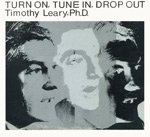
1966: Timothy Leary - Turn On, Tune In, Drop Out
The times, they have a-changed. When this spoken word recording was released in 1966, it was seen as a collection of radical concepts that pushed culture in amazing, dynamic, and even scary new directions. It came at a time when people held a deep belief in unavoidable and necessary change, arguably running deeper than Obamania with its many slogans and t-shirts. In the years leading up to the great acid wave, a fantastic rift existed between the conservative, loyal, noble Greatest Generation and the consciousness-expanding, peace-loving Me Generation.
Tension between adults (middle-age plus) and youth came to a head. Everyone tripped over the gap between those who barely survived the Great Depression and World War II, and those who were collectively sparked to life after the assassination of President JFK, who would peak at Woodstock, vigorously protest Vietnam, usher in lasting women and civil rights movements, and fizzle out in a blaze of coke and disco after Watergate. Throughout the 60s, a new cultural footing was being established, a changing of the guard, as the youth walked away from the seemingly archaic ideals of their parents, refusing to fight their wars and follow their rules any longer. It was one of the most exciting periods in recorded history, with Western culture reaching maturity alongside the concept of a real global village.
A lot has happened since then. While Timothy Leary's Turn On, Tune In, Drop Out may have been relevant to many people in its era, it now plays like a time capsule, capturing the precise moment the acid wave began to crest, before an entire generation crumbled from pain killers and yuppiedome. The lifestyle Leary tried to will into existence -- and rub in the faces of the aged -- polarized the freewheeling movement in an unfortunate "you're either with us or you're with the terrorists" way. At once, he was a rallying cry for a vibrant youth culture being stifled by business-as-usual and a catalyst for the anti-drug movement (and the many draconian laws that passed because of it). Now that we've had 40-plus years to let the dust settle and gather our bearings, it's still hard to say if the world would be better off if Leary had never turned on.
I certainly find it odd that a record preaching the virtues of an open mind contains constant and blatant ageism throughout. In the intro, "A Message to Young People," Timothy says "If you are over the age of 40, I'm not sure that you should listen to this record." He then follows it up with a few weak reasons why no one over 40 can be trusted (they have guns and jails for people who make them mad) and why all young people are groovy.
Yet, being young is not an alternative to being old. Everyone begins young and ends up old, and that in itself has very little to do with who we are as people day to day. As Robert Solomon said, "We should never simply write ourselves off and see ourselves as the victim of various forces. It’s always our decision who we are."
People who are assholes at 40 were likely assholes at 15, just as cool people over 40 were probably cool all of their lives. Hell, Leary himself was 46 when Turn On saw the light of day in 1966. Surely, he must have thought he was hip enough to listen to it, yet he made it seem like no middle-aged opinion had any relevance or worth (except his own, obviously). Dr. Tim shot himself in the foot with that business.
It's a real bummer to hear someone blatantly fan the flames of prejudice while allegedly standing for peace and understanding. Like Tom Cruise hysterically preaching The Church of Scientology as the only religion that can help people, Leary claimed that he alone could tap into your "potentialities" and those of your parents (but not your grandparents because "grandmother is dead, and [he] can't turn her on"). In effect, he increased the divide between two classes of people who were already having a tough time seeing eye to eye. Of course, it's doubtful he would have recognized or admitted his own open bigotry.
Dr. Timothy Leary knew he was an amazingly brilliant man, that he was the only one who had it all figured out. On "My Problem," he announces a long-term goal to be "the holiest and wisest man of [his] generation," reasoning that there's about a one-in-ten chance of achieving the goal.
Compounding matters, Leary dictates Turn On, Tune In, Drop Out in an incredibly dull, hushed tone, as if the world may crumble under the full power of his voice and ideas. Strikingly similar to all of George W. Bush's speeches, Leary's pacing is dragged out in an attempt to squeeze every iota of importance from every syllable of every word, no matter how trivial or overinflated. In doing so, he comes off like an arrogant ass-hat with little solid information.
It's easy to imagine him as a public figure, though. He rambled on about drugs and rebellion against authority figures at a time when those themes were front-page stories, so he was an instant hit with evolving beatniks and the emerging Haight-Ashbury and college crowds. He was also a hypocritical egomaniac, so he turned off most everyone outside of his demographic. I know firsthand that acid can do amazing things, but even I don't want to do it after hearing this record.
Turn On, Tune In, Drop Out is a testament to the ego of a confused doctor who bought into his own bullshit far more than it is a document of the (arguable) benefits of the psychedelic experience. How relevant did Leary think this record would be 40 years later? Likely, he didn't care. He spoke to hear himself talk and to puff up his name, not to create lasting change. For all his efforts, he is remembered as a fallen prophet and a pop culture catchphrase, and little else.
1. Message To Young People
2. Castalia Foundation
3. There's a Red Chimney
4. An Ancient Trade Union
5. Not An Idle Fantasy
6. The Taking of LSD
7. Sensory Paradise
8. Why Is It?
9. Early in the Life of Every Mammal
10. My Problem
11. Elevation of Human Consciousness
12. The Oldest Law
13. Psychochemical Revolution
14. Turn On, Tune In, Drop Out
15. Within The Temple of Your Body
16. Our Present Adult Culture
17. The Aspect of Marijuana
18. Training and Sensitivity Required
19. Lesson Number One
20. Every Baby That Is Born
21. Every Time
22. One Final Word.

Rebecca Gates - Ruby Series
Rebecca Gates is the only constant on the three albums by The Spinanes -- 1993’s Manos, 1996’s Strand, and 1998’s Arches and Aisles. The group began -- and often stayed -- a duo, with Gates on vocals and guitar, and Scott Plouf on drums. By Arches and Aisles, Plouf had left to join Built to Spill and was replaced by members of the Sea and Cake and Tortoise. Later live version of The Spinanes would also include Ted Leo, while Strand features resonant backing vocals from a like-minded contemporary of Gates’s named Elliott Smith. All of which illustrates the mode and level at which Rebecca Gates makes music. 2001's Ruby Series expands her palette; it’s a beautiful, textured work, beguiling and frustrating in what it foreshadows.
Ruby Series is Gates’s only solo work, though the presence of high-profile Chicago-based musicians (including John McEntire and Brian Deck) links it closely to Arches and Aisles. Despite the atmospherics and sense of musical precision on display, there is a sharp distinction between this work and Gates’s previous songwriting with The Spinanes. While most everything by The Spinanes was firmly guitar-based, Ruby Series is a far more electronic work (even ambient at times), oriented around drifting keyboards and placing Gates’s voice in a more tonal, dolorous register.
This style reaches its apex on “I Received a Levitation,” which takes Gates’s yearning delivery of several lines and loops them atop slowly burgeoning keyboards, creating an effect both haunting and wistful. “The Seldom Scene” emerges with cocktail-lounge restraint and applies desire and critique in equal measure, with Noel Kuppersmith’s bass playing off the vocals and Mikael Jorgensen’s vibraphone. “Lure and Cast” brings the tempo up, with Gates crooning on the topic of desires. Over programmed beats she lyrically inverts the concept of the “sucker punch,” while the vibraphone tips its hat to a timeless cosmopolitanism.
With seven songs spread over half an hour, Ruby Series makes for a rich, saturated EP. At times, however, the atmospherics and the musicians’ tendency to circle around specific moments subverts some of Gates’s memorable tendencies as a songwriter. The give-and-take between steady keyboard pulses and minimal drumming on “Doos” is memorable, but the vocals feel submerged, climaxing with a wordless keening rather than a well-delivered line or cutting turn of phrase. The production, by Gates and Brian Deck, often seems like groundwork -- investigations of a number of distinct but related sonic directions in which the music might go. There’s a sense of exploration here, with all of the pros and cons that implies, though the announcement of a Ruby Series album due later this year does seem appropriate: there are still corners of these songs worth illuminating.
Since the release of Ruby Series, Gates has played sporadically, including a 2006 residency at the Knitting Factory that found her joined by Stephen Malkmus, Ida, and Fred Armisen; she also made an appearance on The Decemberists’ Hazards of Love. The bulk of her time appears to be dedicated towards art, including acting as one of the curators of the sound-art exhibition The Marfa Sessions. Her web presence suggests that new songs and a revived live band are in the works. All told, that’s a fine thing: Gates’ take on pop music is very much her own, and it’s an assured, justified one. Hers is a voice equally at home reporting on the world and living in it, a balance that few are able to achieve, much less navigate so deftly.
1 The Seldom Scene
2 Lure and Cast
3 Move Gates
4 In a Star Orbit
5 Doos
6 The Colonel's Circle
7 I Received a Levitation
Various Artists: Posh Boy - Beach Blvd.
Because of the folks working tirelessly from the inside -- the promoters, DIY venue owners, and others who spent every waking moment spreading the gospel of this loud, bizarre, shitstained music -- early American punk reached the unlikeliest of ears. Orange County's Robbie Fields, known in certain circles as the Posh Boy, was one such chronicler, and it's in no small part because of him that the world came to know the darker, dirtier side of sunny southern California.
Beach Blvd., a stellar compilation first released on the Posh Boy label in 1979, features the music of three disparate groups: the sunny, melodic, totally SoCal swagger of The Simpletones; the laborious, spooky ghost-fuzz of Rik L Rik; and the ADD-riddled pop-punk of The Crowd, an outfit equal parts Dead Kennedys and The Cramps. None sounded quite like the other, yet all three groups now seem insistently entrenched in a particular milieu. This is, of course, because they were. In the late 1970s and early 80s, the southern California punk scene was among the richest and most vibrant the world over, and it shows on Beach Blvd.
The major-key harmonies of The Simpletones embody the West Coast's split from the New York and UK scenes. Surf-influenced, lyrically upbeat (if quite sardonic), and often humorous, their brand of snotty garage rock, with titles like "I Have a Date" and "Tiger Beat Twist," is the perfect soundtrack for the skeevy beach bum who peers at girls over rainbow-tinted shades, knocking over sandcastles and swigging schnapps. The Simpletones most melodious tune (and perhaps the album's default theme song), the doo-woppy "California," delivers as concise a mission statement as any: "They say the chicks are really nice/ And the cars, they go so fast/ And the beach is just the most/ And the surf is really wild/ I wish that I could stay here all my life." On the surface, it reads like a schlocky, gee-golly, Mike Love sort of deal, but the song's apparent buoyancy is belied by its eerie, ironic undertone. Besides, the next track is "I Like Drugs," with the chorus "I like drugs/ They get me high." One guesses the sentiment is somewhat less satirical.
Next up is Rik L Rik, a pioneering L.A. scuzz-rocker whose work here falls somewhere between The Misfits and T.S.O.L. His is a wonderfully hazy, slurred brand of rock 'n' roll -- the flippantly dismal soundtrack to smoking dope in some unkempt necropolis. Born Richard Elerick, he spent time in various Huntington Beach bands including F-Word and Negative Trend, but is credited here under his own assumed name. The handful of his songs included on Beach Blvd., though less approachable, are damn good jams nonetheless; sloppy, fuzzed-out, and maybe a little angry, they contrast with the sunny beach punk of The Simpletones but are no less gratifying. "Atomic Lawn," in particular, is a gem, the lyrics apocalyptic and the chorus melody among the best of its type.
Finally, with full force and guitars wailing comes The Crowd. The most musically intricate of the bunch, they are also the most enjoyable, at least superficially: their tunes are filled with the manic, flailing intensity displayed by all the best early punk bands. I've always harbored a strange sort of ambivalence toward The Dead Kennedys; their impeccable panache notwithstanding, Jello's maniacal squeal paired with his annoyingly self-righteous lyrical tendencies often registered on the cornier end of the affected-vocals spectrum. The Crowd's Jim Decker does the whole shaky voice thing too, but never sounds like he's auditioning for the stage production of The Wizard of Oz; his is a far more palatable, believable timbre.
Beach Blvd. is a first-rate relic of a certain time and place, and, above all, an attitude which has all but disappeared since; music labeled "punk" today bears little resemblance to the tetchy, firebrand sort of tuneage chronicled here. How peculiar it must feel to those who helped usher in this exciting new era to hear it discussed in 2009 as old times and artifacts -- back-in-the-days and remember-whens. Such a young-folk thing, y'see, isn't supposed to get old. Perhaps music like this wasn't meant to last after all -- it is ephemeral by nature, more concerned with punch than posterity. At the very least, Beach Blvd. can help those of us who weren't there begin to appreciate what once was.
1. The Simpletones - Kirsty Q
2. The Simpletones - I Have A Date
3. The Simpletones - Tiger Beat Twist
4. The Simpletones - Don't Bother Me
5. The Simpletones - California
6. The Simpletones - I Like Drugs
7. The Simpletones - Dead Meat (Killer Smog)
8. The Simpletones - TV Love
9. The Simpletones - Rock 'n' Roll Star
10. The Simpletones - Disco Ape
11. The Simpletones - Nasty Nazi
12. Rik L Rik - Black And Red
13. Rik L Rik - Meat House
14. Rik L Rik - I Got Power
15. Rik L Rik - Mercenaries
16. Rik L Rik - Atomic Lawn
17. The Crowd - Modern Machine
18. The Crowd - New Crew
19. The Crowd - Suzy Is A Surf Rocker
20. The Crowd - Living In Madrid
Avail - 4AM Friday
When you’re a teenager with even the slightest bit of differentness about you, surviving adolescence is no simple feat. Try doing it in a town like Richmond, Virginia, a.k.a. the former capital of the Confederacy. Let’s just say it’s easy to resent the obvious ass-backwardness of a city that, not too long ago, celebrated Stonewall Jackson and Robert E. Lee’s birthdays on the same day as Rev. Martin Luther King, Jr.'s. You need a thick skin, a well-developed sense of irony, and a community of similarly-minded weirdos for protection. And you need a band like Avail to write loud-as-fuck, catchy-as-hell anthems to serve as the rallying cry for your misspent youth.
I was a teenage weirdo, and believe me when I say that I wore out my cassette of 4AM Friday before I even reached college. Sure, the songs found on the album don’t stray too far from standard (albeit not textbook by any means) melodic hardcore that was so popular at the time. But 4AM Friday is so much fun, so perfect an encapsulation of what it meant to grow up strange in a small Southern city in the 90s that it’s hard to deny.
In case you weren’t there or need a refresher course: you got caught up in the circle pit while the band sang the anti-fight song, "Nameless." You belted along with your friends on the anti-conformity track, "Order." When Tim Barry sang about never compromising or changing to fit in on "Simple Song," you got it, you felt it, and connected to it in the way only teenage weirdos can connect to songs. But when they threw in that jarringly traditional cover of "Swing Low"? Well, in a weird way, you kind of connected to that, too. Sure, it all sounds a little contradictory and confusing. But that’s puberty, in any city.
And that’s the thing about Avail. As much as they wrote songs that pointed out the flaws in the world around them, they also had a strange way of making you proud to be a part of it. And the best part? In spite of the fact that 4AM Friday is littered with inside-baseball-style references to Monroe Park and three-strike laws, it actually struck a chord with a few people outside of Dixie, too. Because North or South, teenage or ten years removed and steeped in nostalgia, the fact remains -- everyone needs something to sing along to once in a while.
1. Simple Song
2. Order
3. Tuesday
4. 92
5. McCarthy
6. (Ben)
7. Monroe Park
8. Armchair
9. Fix
10. Blue Ridge
11. Swing Low
12. F.C.A
13. Hang
14. Governor
15. Nameless
Emmylou Harris - Spyboy
Emmylou Harris has lived many musical lives: muse, country superstar, professional singing partner, rock star. Spyboy, an out-of-print live record, exposes a cross-section of Harris’ career. For this reason, it is jarring and uneven, and despite highlighting many professional peaks for the singer, you have to wonder: why the hell was Spyboy -- essentially a live greatest hits album -- released?
Spyboy came out in the wake of Wrecking Ball, which was something of a creative resurgence for Harris; it revealed that, while primarily known as a country singer, she simply likes a good song. So it is on Spyboy, which begins with the lovely Jesse Winchester ballad “My Songbird.” The band then launches into “Where Will I Be,” a dark but hopeful rock song from Wrecking Ball, and it’s to Harris’ great credit that she sounds equally at home in both styles. The audience doesn’t seem to mind, either.
Put simply, the best songs on Spyboy are the ones with the sweetest melodies: the intimate “Prayer In Open D,” the flat-out gorgeous “Green Pastures,” “Calling My Children Home” (sung a cappella by Harris and her band), and “Love Hurts,” that old chestnut Harris once sang with frequent partner Gram Parsons. With fellow Byrd and Flying Burrito Brother Chris Hillman, Parsons also wrote “Wheels,” a song Harris performs here as if it’s always been hers.
Although Spyboy is a live album, it would still be a fine introduction for Emmylou Harris beginners. It’s a sonic résumé -- a “look-what Emmylou-Harris-can-do” record that shows off the singer’s many talents. Though she tends to get attention for That Voice, it could be argued that Harris’ greatest strength is arranging and picking songs (she’s not a bad songwriter, either).
However, this is still very much a live album, the type of record that, unless containing versions that differ from their studio brethren, nobody likes. So it's easy to imagine why Spyboy, despite some moments of greatness, went out of print. Harris fans likely bought it out of curiosity, then sold it or lost it, and went on their merry way.
At least the album ends on a high note with “The Maker.” Though it lasts eight minutes, the song is fleeting, doubtlessly swept along by That Voice, but mostly by those years of experience. It caps off a record that no one needs, but it still feels perfect.
1. My Songbird
2. Where Will I Be
3. I Ain’t Living Long Like This
4. Love Hurts
5. Green Pastures
6. Deeper Well
7. Prayer In Open D
8. Calling My Children Home
9. Tulsa Queen
10. Wheels
11. Born To Run
12. Boulder To Birmingham
13. All My Tears (Be Washed Away)
14. The Maker
Dick Hyman - Moog: The Electric Eclectics of Dick Hyman
When you picture the future, what does it look like? If you take your cues from pop culture, the view’s a little bleak -- a landscape of distant, desolate planets and bright white spaces inhabited by cyborgs and machines, all marching to the vocoder-powered voice of Kanye West. Come to think of it, it’s a lot scarier typed-out than it is through the gloss of a music video.
The funny thing is, since the dawn of the space age, our vision of the future hasn’t changed that drastically. For evidence, one needs only look at the cover of Dick Hyman’s 1969 album, Moog: The Electric Eclectics of Dick Hyman. Reverse carbon copies of Hyman himself emerge from an early model spacecraft; they stand stiffly, sometimes floating above a sparse, crater-filled terrain. The emptiness of space looms in the background.
And then there’s the music contained within -- jazz and pop spun through the modular waves of the then-emerging Moog synthesizer. Hyman, a classically-trained jazz pianist and composer, was, along with his contemporary Wendy Carlos, one of the pioneers of the machine. Electric Eclectics was his first foray into composing for the Moog (he’d previously pioneered similar use of the Lowrey organ), and the resulting album is one of the most successful of its kind. "The Minotaur," a classic proggy jam, was the first Top 40 hit composed entirely on the Moog and would subsequently provide a bit of shameless “inspiration” for Emerson, Lake & Palmer’s "Lucky Man." The rest of the tracks (including a transcendent yet still danceable take on James Brown's "Turn It Up or Turn It Loose") range from pure kitsch to loungey pop to hazy improvisational jazz. It all comes together to form the "sound of the future": pulsating blips, jaunty bloops, and funky bleeps; undulating sine waves and modulating grooves; melody and human emotion, processed through the heart of a machine. The result, however, is surprisingly warm and undeniably entertaining.
So how does the sound of the future hold up today? Well, sort of dated, actually -- a bit like a space age bachelor pad relic. This is hardly a criticism, though. Hyman was doing something new, testing the boundaries of an instrument that had rarely been used to its full potential before. And the result, while occasionally veering into questionably cheesy territory, is for the most part a set of virtuosic instrumental pop tunes iconically indicative of the era. To say they’re dated? Well, do you imagine Daft Punk won’t sound a little kitschy after 40 years? How about Kanye’s aforementioned robot vocals? It’s not a knock to anyone’s creative integrity, just a note that artistic merit shouldn’t always be judged based on the technology available at the time.
So maybe the future doesn’t sound exactly like Moog predicted it would. That doesn’t diminish the contributions of Hyman and his contemporaries to the modern musical sphere. Beyond all of the analog noodling, all of the killer sampling fodder, and all of the influence the guy’s clearly had on everyone from Beck to Stereolab to Momus, Hyman’s most important contribution is the enlightened realization that electronic music doesn’t have to be cold and distant, so long as the person playing it’s got a little soul.
1. Topless Dancers of Corfu
2. Legend of Johnny Pot
3. Moog and Me
4. Tap Dance in the Memory Banks
5. Four Duets in Odd Meter
6. The Minotaur
7. Total Bells and Tony
8. Improvisation in Fourths
9. Evening Thoughts
10. Give It Up or Turn It Loose
11. Kolumbo
12. Time is Tight


