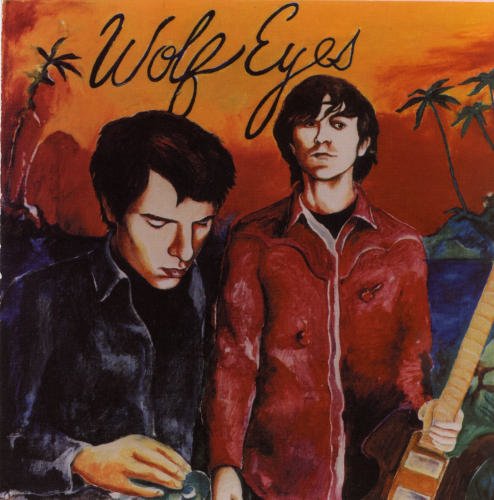
2001: Wolf Eyes - Wolf Eyes
If you’ve never heard Wolf Eyes eponymous release for Bulb Records you might be in for a bit of a shock. There were releases before Wolf Eyes, cassettes and CD-Rs, but this was their first CD and a fitting debut for the band. Bear in mind this is a very different Wolf Eyes than many people are used to. Only Nate Young and Aaron Dilloway contributed to the album and much of the iconic sound from albums like Dread and Burned Mind is absent. Instead, Wolf Eyes is filled with skittering and fractured techno beats, guitar riffs, and an almost clinical sparseness.
Wolf Eyes have always been masters of taking elements of different genres, bringing it into their warped and bizarre world, and deconstructing it ─ this album accomplishes that tremendously. “When I Get Back,” which begins sounding like the techno godfathers, the Detroit Three (a major influence here, surprisingly) and gradually collapses into a massacre of electronic beats, is unexpected for Wolf Eyes but still bears their mark of chaos. Even when they’re working with a different palette of sounds, however, the overall impression is very consistent in their work.
The forward looking centerpiece of Wolf Eyes, the lurching seven-minute “Black is Back,” gives a good impression of where they take their sound. The song resembles a lot of the work that would be found on their follow-up Dread, and is one of the first times when Nate Young began to let himself get completely unhinged in his vocal delivery. That shows the direction they would move in, but this album is filled with strange and wonderful stylistic detours that are absent in the later work. Take a look at the next track after “Black is Back,” and you’ll find one of the strangest songs the band ever recorded. “These Girls of Mine” ends up sounding like something off Tom Waits’ Bone Machine, and is so strange for this band because it simply works as a kick ass rock song. The drums are punchy, there’s a big crunchy guitar riff, Young sounds more like David Yow than the complete fucking monster he would soon begin to sound like on the later albums.
The cover of Wolf Eyes is the only one I know that actually shows the people behind the project. It features an illustration of Young and Dilloway; right from the moment you hold the album there’s a sense of personality on it. That is what I get from this album most of all, that these two guys were still feeling their way. They try out different things without necessarily being successful, they rape and pillage a Ric Ocasek song, they provide an intermission halfway through the album ─ they seem like they’re having fun. This is a glimpse at the less confident, younger Wolf Eyes before they attained the level of brutality and intensity fitting to their name.

1970: Guru Guru - UFO
In every genre there are hidden gems; bands or albums as strong as the paragons of their style that, for whatever reason, never rose as high as they deserved. It’s slightly harder to see this with Krautrock, because more than 90 percent of the bands could be considered hidden, but the same pattern is still there. One of the great lost bands of the 60s Krautrock explosion is the psych-rock trio Guru Guru. Classifying Guru Guru as a lost band is slightly easier than some Krautrock acts, as their contemporaries like Can have received enormous critical acclaim and reissues out the wazoo, even though their reach never extended beyond a modest audience. But with a string of solid albums, beginning with 1970’s UFO, it’s hard to see why Guru Guru remains unknown.
The trio of drummer Mani Neumeier, bassist Uli Trepte, and guitarist Ax Genrich (fitting name) were responsible for Guru Guru’s best releases and are known as the band’s “classic” lineup. They played extraordinarily well together, and every song sounds like a improv jam, which it probably was. Neumeier and Trepte have particularly great chemistry, locking into repetitive and groovy riffs which give Genrich ample room to experiment. Genrich’s guitar playing is refreshingly different from most jam bands because he has the rare ability to crank out a million notes when he wants but also blast listeners with feedback and superb note choice when the time is right.
“Stone In” leads off the album with Genrich’s wailing, wah-wah drenched riffs while Neumeier and Trepte battle for control of the rhythm section. After a few lines of chanted vocals, Genrich launches into an extended solo that last for the remainder of the track. It’s a great sludgy jam to start the album and immediately proves you are dealing with skilled musicians. “Girl Call” opens with 40 seconds of silence before rhythmic blasts of feedback lead into another acid-fried jam. Trepte is especially good here, providing driving bass lines that propel the song and allow Neumeier and Genrich room to solo wildly.
Just as “Girl Call” reaches the height of its insanity, it gives way to the extremely catchy “Next Time See You at the Dalai Lhama.” The song isn’t catchy in a pop sense, but Genrich and Trepte’s riffs take on the swagger of classic rock with an experimental twist. Genrich and Neumeier play with reckless abandon as Trepte modifies, loses, and then eventually rediscovers the opening riff. The title track, “UFO,” is an extended noise collage, made from seven minutes of static blasts and three closing minutes of sonic mayhem. “Der Lsd-marsch” strikes something of a middle ground with another dirge like opening that gives way to an awesome outro jam centered on an impressive solo from Neumeier.
With around 40 releases to their name, Guru Guru certainly hasn’t stayed unknown by choice. UFO was their first, but it isn’t the only great release in their catalog that should be sought out by any Krautrock – or even noise rock for that matter – fans. Guru Guru were largely responsible for the shift in Krautrock from a spacey, flute-dominated music to one of the most aggressive and noisy sounds around, and for that fact alone they deserve to be remembered.
1997: Primal Scream - Vanishing Point
There’s been a lot of celebration for the 20th anniversary of Primal Scream’s breakthrough album Screamadelica and, sure, I can understand why. Released on the zenith of the rave revolution, the album came to define both poles of the smiley-faced culture – the dancey and smooth sounds of electronic outfits like 808 State and the more rock oriented strain of bands like the Stone Roses. Bobby Gillespie and company crafted an album that condensed an era in its groovy, sample-happy guitar vamps. Personally, I don’t think it’s that good. Side A is stellar, no doubt about it, but around the time “Come Together” appears, the album starts to drift towards long pieces revolving around clichés of the era (diva vocals, chill beats). And that’s not mentioning Mudhoney’s superior use of the sample from the movie The Wild Angels.
On the other hand, 1997’s Vanishing Point takes the sound and approach of Screamadelica and goes deeper into its druggy corridors , letting them resolve into their natural conclusions, no matter if they lead to dark and heavy territory. The album is as eclectic as its guests (The Memphis Horns, original Sex Pistols bassist Glen Matlock, and Jamaican dub legend Augustus Pablo), but it has an atmosphere that ties everything together. It contains a cover of the song “Motörhead” that sounds closer to Hawkwind than Lemmy’s subsequent band, while “Medication” is an irresistible Stonesy boogie and opener “Burning Wheel” is a dubby layered song of narcoleptic grandeur.
It also represents a musical step forward, although it’s one that happened without the larger public noticing it. Vanishing Point married the tradition of psychedelia – from the space rock of early Pink Floyd to the experiments in terror of Psychic TV – with well defined songs, but it most importantly revolutionized sound with its approach. Primal Scream usually wrote songs and then played with the results, and many of them would rise from warping and reusing old material. They were one of the first rock bands who didn’t think their guitars and recordings were holy, and they committed sacrilege in the name of creativity to produce something superior, even if it meant mangling their most celebrated artwork.
Here’s the video for “Kowalski”, based on the movie that gives this album its name, which I also recommend.
1998: V/A - Lock, Stock And Two Smoking Barrels: Music From The Motion Picture
Lock, Stock, and Two Smoking Barrels is British director Guy Ritchie’s take on the Tarantino-style quick-witted over-the-top gangster movie. Every element of criminal life is present: guns, drugs, sex, and violence. Characters have humorous/dangerous names like Hatchet Harry, Barry the Baptist, and Nick the Greek. It is both distinctly British – cultural quirks, accents, and slang included – yet relatable to pan-Western character sketches of criminal ruthlessness. And, in the tradition of Reservoir Dogs and Pulp Fiction, Lock, Stock draws from a varied palette of rock and soul establishing mood and a general sense of cool.
The soundtrack starts identically to the movie, with “Hundred Mile High City” by Ocean Colour Scene. Its frantic pace and distinctly Brit-rock flavor instantly draws the listener in. But, much as the plot unfurls, audio clips and instrumental selections mirror the patchwork narrative, creating a dynamic listening experience. The slinky “Spooky” by Dusty Springfield follows “Police and Thieves” by reggae artist Junior Murvin, reflecting adjoining scenes taking place in a marijuana growing den and strip club respectively.
For veteran viewers of Lock, Stock, the soundtrack’s accuracy to the plot and choice quotes make it a close second to re-watching the movie. And, as the soundtrack ends with Big Chris’s quote, “It’s been emotional,” followed by “18 With a Bullet” by Pete Wingfield, you can’t help but agree.
1987-1990: Bitch Magnet
If one was coming up in the 1990s and listened to underground music (and was, most likely, a “dude”), the landscape of indie rock was pretty well shaped by a few preceding soldiers. One of the least talked-about was Bitch Magnet, a trio (sometime quartet) from Chapel Hill, North Carolina via Oberlin, Ohio who would give rise to a good chunk of the post-hardcore landscape of the time. Active from 1986-1987 through the turn of the 1990s, Bitch Magnet waxed three proper LPs (one for their own Roman Candle imprint and two for Communion), a live EP, and a couple of singles before disbanding. Vocalist/bassist and principal songwriter Sooyoung Park went on to form the delicately-paced but profoundly compelling Seam; guitarist Jon Fine later joined Vineland and eventually formed Coptic Light; and drummer Orestes Morfin went on to helm the trap set in Walt Mink. Their records – Star Booty, Umber, and Ben Hur – have been out of print for nearly two decades and are seeing a renaissance as part of a new three-disc set on Temporary Residence, remastered with a smattering of alternate takes and a few studio extras.
The late 1980s were a fertile time in underground rock, post-punk, college rock or whatever one wants to call it, and for a band that now seem ahead of their time, it’s pretty easy to put the pieces together – Hüsker Dü, Moss Icon, and Big Black were, to varying degrees, part of their early approach and those poles never really left. Half-sung and half-spoken/shouted vocals, often somewhat buried in the mix, were mated to a big, uncoiled swirl of guitar and motorik, stop-on-a-dime percussion (sometimes aided by a bit of Roland-style drum machine a la Big Black/early Bastro). All that being said, what Bitch Magnet had – and, with the exception of Codeine, in greater stead than their peers – was a real knack for writing wistful pop melodies that make a clean scramble out of the mud and thrash. A friend of this writer said of the group, in comparison with Seam, that the former was always too “tough” which, in retrospect, is curious. Sure, Fine’s massive chords and Morfin’s incredible technique could front a hard shell, but Park conveys an equally great degree of honest, even reigned-in lyricism. It’s not entirely saccharine, but there is sweetness in his delivery of “Americruiser” that keeps the murmurs and strums from edging into Slinty territory. As a set, the Temporary Residence reissues move in reverse chronology, which is somewhat surprising since Ben Hur, while touted as the beginning of math rock’s stark precision, seems more like a cap on the preceding sessions’ wry Jekyll-Hyde approach to emotive brightness and raging post-punk.
2000: Jay-Z - "Big Pimpin'"
The other day, a Philadelphia-based emcee/producer and I were discussing the extensive malleability of hip hop. Unlike most pop genres, hip hop has an uncanny tolerance that allows its producers to imbibe other styles and genres with ease, while still retaining an authentic footprint. Generally, extensive genre-hopping is often criticized as unfocused or pretentious – in hip hop it is not only encouraged, but also wildly successful both commercially and artistically.
“Big Pimpin’” beautifully demonstrates this phenomenon. Jay-Z’s lyrics dance and skirt around a melody originally composed by Egyptian composer Baligh Hamdi, while Timbaland’s production adds little additional instrumentation. A slithering synth-line and a few extra rhythmic flourishes, maybe, but the strings and flutes leading the track remain unaltered.
Somehow it remains hip hop. And it’s not an isolated incident. Producers frequently snap up elements of soul, latin, jazz, classical, rock, reggae, and myriad other genres, yet the end result is always indisputably within the genre. Very few boundaries separate the clash of styles – there are no borders to define the rules of influence. Somehow, the hip hop community has bred some of the most innovative and eclectic production of the late 20th century while barely setting a template beyond the ubiquitous backbeat. It’s wild. It’s free. It’s… well, what is it?
