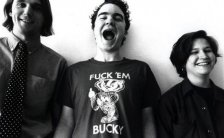
1980: Dead Kennedys - “Pull My Strings”

As far as flipping a massive middle finger to the music industry goes, The Dead Kennedys might have locked up best “fuck you” of all time during the 1980 Bay Area Music Awards. After being asked to play their underground single “California Über Alles” at the show, singer Jello Biafra and drummer Ted (flashy name right?) took it upon themselves to pen a tune railing against the shitty state of popular music at the turn of the decade. The result was the one-off “Pull My Strings” which drew plenty of laughs from the audience and instantly bared the Dead Kennedys from ever attending the show again, not such a high price considering how brilliant the song was. Each member of the band came onstage with a giant S painted on their shirts and, right after the aborted bassline of “California Über Alles,” whipped out a concealed tie creating huge $ signs plastered across their chests. Then they tore into a bitingly critical rant on the music industry’s prefab, boring artists with big cocks and no brains. There’s even a reference to “My Sharona” in the guitar line with the phrase “My Payola” (a payment by a record label to get radio stations to play their songs) substituted. This is classic Dead Kennedys, as much wit as menace and equal parts smarts and pure punk fury.

2003: Open City - The Birth of Cruel

I heard of Open City through guitarist Peter Kolovos’ fantastic solo record from 2009, New Bodies. Kolovos’ uniquely fragmented approach to the guitar was honed in the Los Angeles-based improvisational trio Open City, so I tracked down a pair of their albums: L.A. We Revise Your Neglect (2002) and The Birth of Cruel (2003). I tend to prefer listening to the latter, which better documents the louder side of the trio, opting for a more abstractly textural sparseness than of the former.

The trio performs dynamic improvisations, able to sustain explorative loud sections about as well as more ponderous, haunting, and slightly silly parts. Hints of Kolovos’ guitar-toggling abuse further explored on New Bodies appear here; often, it’s thrilling how well Kolovos’ hiccup-y guitar echoes mesh with co-guitarist Doug Russell, even when the guitars tend to unexpectedly clip and morph. Drummer Andrew Maxwell is also dynamic in the same unpredictable sense, briefly rhythmic before going silent or scraping at his kit’s hardware.

The Birth of Cruel is constantly abstract, but not without a sense of group understanding – it’s even fun at points, with the guitars urged to perform nuanced glitches or richly textured drones at any moment. Best yet, the LP ends on a locked groove of humming low-frequency guitar drone – The Birth of Cruel has no end! Less cloyingly: it rewards active listening, so as to not miss one of the many scattered creative ideas being played between the trio.

Writing about Open City today, however, yields me with an uncommon problem: there’s really not much on the internet about this trio. No Youtube videos (at least none of Open City themselves, though a few videos of Kolovos playing solo are out there), less than a hundred listeners on last.fm, and their name is broad enough that an unspecific search merely yields several city development pages. Aside from pages on Thin Wrist’s website for their now out-of-print records, the trio’s online presence is nil. That leaves me with the basic facts –according to The Birth of Cruel’s liner notes: no edits, no overdubs. Better excuse to let the music speak for itself.

2002: Yo La Tengo: The Sounds of the Sounds of Science

Yo La Tengo are like the radio for many people: a constant companionable stream of distortion and static that throws up gems as frequently as they provide interludes of background music. The process of sound for them has always seemed to lead to songs as naturally as it leads away from them – not forcing a choice between one or the other. I’ve always thought that songs for Yo La Tengo were like motels or picnic sites. They were places where Ira and Co. would uncork flasks and thermos’ and settle with some plain conversation. At the time The Sounds of the Sounds of Science was released Yo La Tengo were in the middle of a particularly long diversion in favor of more muted, instrumental pieces, beginning with And Then Nothing Turning Itself Inside Out. Fans were worried, but they shouldn’t have been. YLT later returned with some cacophonous punishment on I am Not Afraid of You and I will Beat Your Ass. Since then, they have done quite a few soundtracks, which they collected on They Shoot We Score (2008), but The Sounds of the Sounds of Science was the first soundtrack they fully scored.

The films that Yo La Tengo scored on Sounds of Science were made by the controversial documentary maker Jean Painlevé. Painlevé’s films from the 20s onwards were mostly about undersea flora and fauna. However these films, normally the property of science’s exposition, were not dissections of behavior in Jean Painlevé’s hands, but abstract, surreal cinematography about undersea society, presented in a way that some criticized as anthropomorphizing or focusing on the aesthetic rather than the functional patterns of the habits of undersea creatures.

With a YLT soundtrack sea-life does not look alien, but as restless and comic as human life in a coffee shop setting. “Shrimp Stories” in particular is pure YLT comedy. Besides being a particularly good example of a typical YLT screwball jazz track, it also seems to anthropomorphize shrimp-life, as if it were a loose ‘n’ baggy Sesame Street kind of world. It reminded me that the reason we anthropomorphize the lives of other creatures is not necessarily to impose our perspective, but sometimes to remind ourselves that we’re creatures too.
The only unfortunate thing is that Yo La Tengo without the conversation can be a bit plodding. But there’s something about this trek through the lives of sea creatures that, when accompanied by the visuals, is very “sympathique” – the French word for ‘friendly’ – which, for this English speaker, connotes a kind of laid-back sympathy between creatures that Yo La Tengo can aptly describe.

1979: Robert Ashley - Automatic Writing

I recently revisited composer Robert Ashley’s Automatic Writing after listening to several hours of Lil B The Based God. We live in an iPod-shuffled world of divergent tastes so this kind of thing can happen all the time. It always pleasantly surprises me though when this mode of listening offers new insight into connections that can be made across genres and disciplines.

Automatic Writing was composed over a period of five years in the mid 70s. Ashley states he was depressed by the public’s disinterest in his type of music (avant-garde operas). He was intrigued by “involuntary speech” because his own mild case of Tourette’s syndrome led him to juxtapose his own uncontrollable vocal outbursts with the unconscious actions inherent in composing music. He saw his involuntary speech like a primitive means of making music.

Apparently his initial attempts at recording these Tourette’s outbursts failed. He confesses that the performances ended up being imitations of involuntary speech while there were only a few moments where he truly lost control his speech. The story goes that he waited until the summer when Mills College (where he taught) was deserted. Then and only then did he collect 48 minutes of truly unconscious speech.

This would be interesting enough for me to listen to it all the time – Steven Stapleton of Nurse With Wound did listen to it all the time… on acid. But, no, Ashley didn’t stop there. Since he composed mainly in episodic experimental operas, he added three more characters to layer on top of his vocal part. The second character is a female French voice translation of the Tourette’s speech. Third, there’s a Moog. Fourth, there’s an organ. I find these other voices to be an important piece to the puzzle. The best avant-garde artists always feel a need to transgress form and content, delivery and substance.

I don’t think Lil B’s “based” freestyle is far off from Robert Ashley’s involuntary speech opera. Both artists tap into the subliminal, the unconscious, the involuntary. The performers channel words and thoughts instead of willfully creating them. Sure there are many differences between avant-garde operatic music and avant-garde post-millenial rap. But there is justice in the fact that people will recognize and appreciate the beauty of the artistic process in both cases.

1997, 2000: The Promise Ring vs. Wheatus

It’s no secret that music labelled as “emo” is about nostalgia – not only for the past but also for the present. Few bands embodied that as well as The Promise Ring, with Davey Von Bohlen’s voice and an edgy yet poppy sound that was made to make you embarrassingly nostalgic. In fact, The Promise Ring were especially geeky, with some fans being ashamed to talk about them, mumbling about how they liked their first singles and stopped caring afterwards, yet secretly buying everything and learning their lyrics by heart.

In a way, it reminds me of dork rock bands of the 90s like Wheatus, except Wheatus were bad and their best song (which isn’t saying much) is about a loser who can’t get the girl because he loves Iron Maiden but then the girl turns out to be just like him (except hot). It’s a song custom made for teen movies, even if it hadn’t been included in an Amy Heckerling feature and been accompanied by a video with Jason Biggs and Mena Suvari as fresh faced “teenagers.” Come to think of it, it makes perfect sense that Biggs and Suvari remain trapped in that dated image, for everyone young enough who remembers hearing the song and watching American Pie or the aforementioned Loser, or even hating those movies blindly. Just like “Teenage Dirtbag,” The Promise Ring are not about being nostalgic for specific things in your past, but about the time when those things happened and, yes, sometimes those things can be awkward.

I have very vivid memories associated with “Why Did We Ever Meet,” about times that made me feel happy but now make me yearn for them. I’m willing to guess everyone who likes this song has memories like mine, which tempted me to type the phrase “so it’s not important,” but I actually think that it makes it more important than I thought because it’s what the Promise Ring capture with their music, awkwardness and all.

1998: Coil - Time Machines

It’s been over ten years since I first discovered Coil’s Time Machines, but I still find myself consistently coming back to it year after year. Of all places, I found the record in a chain book retailer that was trying to branch into other media. Trying to stock their shelves with import collector’s items to seem, you know, “hip,” Time Machines was filed alongside Nine Inch Nails. I mean, it kind of makes sense, but not really. Being the angst-ridden devilocked 14 year old I thought I was, I picked it up sight unseen.

I don’t remember if I enjoyed the album upon listening to it for the first time. I was probably disappointed it lacked lyrics relating to my perceived 14 year old male failures with the opposite sex. Still, the packaging was enticing and the track titles were obviously some sort of drug reference (and if there is one thing a middle class suburban youth likes to fantasize about…) I forced myself to listen to it repeatedly and was drawn into an experience I still try to recreate with every listen. Initially unnerving, after repeat listens Time Machine became a strange comfort, much in the way a cycling refrigerator or a heating unit might. Its density fills space but not in an oppressive manner.

I still have never found a drone album that makes me feel quite like Time Machines does. The members of Coil conceived this project as an exercise in hallucinogenic time travel. The concept, on the surface level, may seem a little overwrought, especially considering the aforementioned song titles. The results are spectacular though. Oscillating sub-bass tones make up the majority of the album, and even with this limited pallet, Balance and Christopherson craft a full work capable of intense movement. Time Machines never instills a feeling of stasis, it is always traveling somewhere. In that way, the concept succeeds brilliantly. The journey may not be into the void or the farthest reaches of your soul, but it can induce a tangible sensation that most drone and ambient artists can only dream of pulling off.

It is unfortunate that Time Machines is one of Coil’s hardest to find albums. Initially planned as a larger body of work and then a reissue, the album’s current status is unknown with the passing of Christopherson in 2010. One must hope those in charge of Coil’s recorded work will give Time Machines the treatment it deserves. I know I personally have it to thank as a gateway into a whole treasure trove of outsider art. Trust me when I say youtube clips and low quality speakers won’t ever do this trip justice.

1969: Randy Holden - Population II

In 1969, proto-metal guitarist Randy Holden owned no less than 16 amps, each encased with 200 watts of power, which might explain why this record, Population II, has guitars that sound not like heavy metal falling from the sky, but like black holes disintegrating chunks of the earth’s core. It’s an admirable sound achieved by just Holden and drummer Chris Lockheed (who also played keyboards simultaneously), coming together to make the tracks even more unbelievable. The album is a showcase for a great guitarist who was well versed in a variety of styles, who focused on distilling everything he knows into something monolithically heavy and, for most of it, slow, like an octogenarian driving in the left lane. The end result is music that weights down on you, but ultimately feels satisfying, like the best doom metal from any decade.

Sadly, Population II was a fluke, an occurrence that happened once and then quickly fell into oblivion. Soon after its release on Hobbit Records, a large portion of Randy’s gear was stolen, and the album was left in limbo until a couple of years ago. I wonder what metal would’ve been like had Population II directly influenced it with such dragging beats and thicker-than most-of-its-contemporaries riffs. I guess it’s something we’ll never know. But what’s undeniable is that history would’ve surely regarded Randy Holden as one of metal’s greatest blueprinters.

1998-2001: Black Dice’s early years

After recently hearing Black Dice’s forthcoming Mr. Impossible, I found myself thinking about their oft forgotten early days. Before Williamsburg and DFA, back in the depths of the Providence noise rock scene, this formative version of Black Dice could have been confused for a different band. Eric and Bjorn Copeland, earlier member Hisham Bharoocha, and very early member Sebastian Blanck generated an incredibly unique permutation of noise rock. Moments like on the dense-pulsing “The Raven” off Cold Hands (2001) have a nihilistic bluntness to them, something that was eventually stretched and deconstructed on their masterpiece Beaches and Canyons (#9 on TMT’s favorite of the decade).

Meanwhile, Black Dice #3 (2000) begins with nearly a dozen brief 30-second tracks that melt into one another in a blur of Boredoms-inspired aggression. Eventually, it evolves towards more structured pieces in its last few tracks, the 14th of which reveals itself to especially brutal peak as they show early on their knack for distorting guitars like no one else. Keep in mind, most of this material existed in the late 1990s, before the DFA, Kid A, or the massive Brooklyn music scene had come to fruition.

A decade later, Black Dice are still around, and this rediscovery of their early work has given me an opportunity to look at their career and especially the new record with a fresh perspective. For example, in the last minute of single “Pigs,” after multiple bursts of violent glee, Black Dice break a final time into that propulsive stomp, and you can hear that same energy howling away from nearly 14 years in the past. Recently, in an interview with Stereogum, Bjorn Copeland discussed the sound of his band’s new work: “In a lot of ways this album is stripped down, you can get really hung up on gear and equipment and sometimes you forget that some of the music you love best that satisfies your needs is just made with a guitar and vocal.” This quote certainly rings true in the present, but it also shows how their approach to music-making today has clear continuities with their aesthetic of the past.

1977: David Bowie - “Heroes”

Once upon a time, David Bowie moved to Berlin, snorted epic amounts of cocaine, and recorded some killer tunes. So killer, in fact, that what has come to be know as the “Berlin trilogy” – Low, Heroes, and Lodger – have been universally recognized as some of the most groundbreaking and influential pop music ever recorded by a strung out ninety-pound drug addict (though John Frusciante certainly gave him a run for his money). But in all seriousness, these albums kick ass like few have before or after and have managed to sound fresh to this day, a feat not much electronic based pop from the 70s has been able to pull off – I’m looking at you Styx. Though Low is easily the best album of the three, the high-point of the trilogy is the track “Heroes” from the album of the same name.

The thing that sets “Heroes” apart from three albums worth of brilliant electro-pop is the stellar live performances from Robert Fripp and David Bowie. Fripp conjures some downright strange but shimmeringly pretty sounds from his guitar, tapping into the style of violin-like sustain long before it was popular and doing it better than almost every imitator that followed. Bowie’s vocal is a masterclass in angsty longing, using three mics staggered 9 inches, 20 feet, and 50 feet away to capture the pure anguish in his voice. When he finally opens up on the third verse, he radiates pain in a way few singers have ever managed. Thank God for cocaine and the Thin White Duke.

1998: Ted Hawkins - The Ted Hawkins Story: Suffer No More

“Good morning my darling, I’m telling you this/ to let you know that I’m sorry you’re sick/ no, tears of sorrow won’t do you no good/ I’d be your doctor if only I could/ What do you want from the liquor store?/ Something sour or something sweet/ I’d buy you all that your belly can hold/ You can be sure you won’t suffer no more.”

So goes the opening of Ted Hawkins’ “Sorry You’re Sick” and the inspiration for a 1998 greatest hits CD, one of many Ted Hawkins retrospectives. He’s an immensely talented bluesy soul singer who simply slipped through the cracks of widespread mainstream success. Somewhere between Otis Redding and Sam Cooke, the booming voice snugly fits into a long tradition of singers who seem capable of stopping time.

What little we know about Ted Hawkins’ history: he was born into a difficult life in Mississippi and was sent to reform school at 12. After that, the personal mythology starts – with tales of Hawkins drifting in and out of prison/various American cities and eventually (in the late 60s) hitchhiking to California to make a career as a musician. He accrued fans playing on a milk crate at the boardwalk in Venice Beach, gaining the attention of record producer Bruce Bromberg in the early 70s. But drug problems and another jail stint prevented him from recording his debut album, Watch Your Step, until 1982. The album gained impressive critical acclaim but little commercial success. Three years passed (with no knowledge of Hawkins’ whereabouts) until he recorded his next album, Happy Hour, with Bromberg, which managed to gain the attention of European fans. The famed British broadcaster Andy Kershaw invited him to Europe where Hawkins’ brought his milk crate songs to packed venues. However, when he moved back to the U.S. in the 1990s, he returned to street performing – until Geffen producer Tony Berg convinced him to record his songs with professional musicians. The subsequent album would gain him the U.S. fame that he had never been able to accumulate in the 20 years prior, but Hawkins would pass away months after the album was released.

It’s a remarkable story. As for the music itself, it’s a crudely wonderful mix of gospel, country, blues, and soul music. Hawkins plays in an open tuning, reportedly distinguishing between happy and sad chords. The 1998 collection boasts many great songs (“Watch Your Step,” “The Good and the Bad,” “The Lost Ones,” “Happy Hour”) but the real fun is tracking down the bootlegs and cover renditions that Hawkins’ recorded into relative obscurity throughout the years. There’s a beautiful image I have of him sitting on a milk crate at the Venice Beach boardwalk belting out songs for those passing by – the Temptations “Just My Imagination,” John Denver’s “Country Road,” Sam Cooke’s “Bring it On Home to Me,” and (my personal favorite) Charley Pride’s “All I Have to Offer You is Me.” If you’ve read the 2007 Pulitzer-winning article about renowned violinist Joshua Bell conducting a street performance experiment, it does make you wonder what it takes for people to truly recognize musical brilliance – even if it’s just sitting right in front of them on a milk crate.

There's a lot of good music out there, and it's not all being released this year. With DeLorean, we aim to rediscover overlooked artists and genres, to listen to music historically and contextually, to underscore the fluidity of music. While we will cover reissues here, our focus will be on music that's not being pushed by a PR firm.