Cable #11: One-Night Experimental Fest
Blockhaus 10; Nantes, France;

[Blockhaus 10; Nantes, France]

Cable #11 was a noisy, nasty, wonderful night of music held in a cramped bunker built during WWII by the Nazis. Homemade benches and tables. Homemade instruments too. The soirée was organized in part by Will Guthrie, an Aussie and Nantes resident whom I saw perform at Pannonica a few months ago.

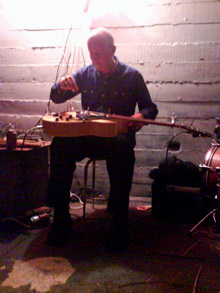
Keith Rowe and Ben Patterson showed early on that this was going to be a special night. Their set was, at once, medical, visceral, and abstract. They sat at a card table and scraped rocks across rocks, sometimes knocking them together, occasionally employing the amputated neck of an electric guitar with a motorized toothbrush sitting atop the strings. Everything was closely mic’d and reverbed. The smallest movement of the stones on the table created sounds that made the bones in my chest vibrate. I imagined steps down a corridor to a giant morgue or boulders falling in a deep crevasse. The duo performed two pieces in one stunning half-hour burst. I love how experimental music can bring your focus back to essentials; in this case, I rediscovered my appreciation for the simplicity and power of rotation, vibration, and friction as musical agents.

Next, Fabrice Favriou unleashed a distortion fetishist’s dream: a 30-minute screed where the dude recorded the carnivorous feedback from his guitar with pedals and then looped the shit over top of new noise he made by jamming a wire brush from a drumkit across the pickups. His show had a nice crest and release that finished with some pecking at a cymbal with the headstock of his guitar. I must emphasize the violence of the sound and technique here: halfway through the set, I could no longer hear and he was no longer holding his ax like it was an instrument. It was swinging in front of him, parallel to the ground. It looked like he was holding his guts in.

The best act of the night was Anthony Pateras / Sean Baxter / David Brown, a trio of Aussies that improvised on prepared piano and guitar and drums. The music was somehow raucous and sophisticated all at once, and the dynamic tension among the three was fascinating to watch.

The oldest member of the group sat in the middle and tweaked the prepared strings of his polished guitar with the precision of an acupuncturist. He remained stoic throughout the set. The men to his right and left, however, let fly. For a while I thought the pianist had even taken the strings completely out of his instrument. In fact, he had loaded that baby with handfuls of common bolts and screws which somehow yielded tones remarkably similar to those from an African mbira. I loved his playing style: he often looked more like a furious stenographer than a pianist, his fingers typing madly over each other at the high end of the keyboard. He used the butt of his palm to mash rows of keys at once. The playing, however, was passionate without being wayward. It was the perfect counterpoint to the broad poise of the guitar and the childlike violence taking place on the drumkit a few feet away.

The drummer used a large set of wind chimes as “drumsticks” and simply pulverized his kit with them. He shoved the chimes into the drums, as if they were long metal pills to be swallowed by the drums’ flat mouths. His foot was always on the kick pedal, sending agitated rolls of bass tone through the cacophony spilling out above them. At one point his drumsticks were actual sticks (like from trees), which he broke and dropped onto the drums from two feet above.

In the last piece, he used tin flatware to attack his drums. After several minutes of battering breadpans and platter covers, the piece reached its dramatic peak as he cracked a plastic plate with agonizing slowness.1 He and the pianist often looked at each other as they played: the pianist’s head bobbed; the drummer’s eyes widened with what looked like the fierce hope that he could keep assaulting his kit all night.

The final set came courtesy of Brit Tim Goldie, who poured beer on himself, struck kung-fu poses, put a snare drum over his face and screamed through the surface of it, and generally did his best to torture us with acute metal-on-metal screeches. It was a fittingly discordant end to a night that was altogether beautiful thanks to the originality of its attendant terrors.

1This, to me, was amazing. P, B, & B had developed the tension in this piece so thoroughly that a room full of people was fucking {mesmerized by a guy bending a plate. This is the only thing that was happening. No guitar, no mad piano. Just a man and his bare hands and a Frisbee. And it was musical.}

Pierre Gordeeff / Pierre Bastien
Pannonica; Nantes, France

[10.12.2006]

When I walked in there was a metal frame about the size of a walk-in closet set up on the left wing of the stage. An incredibly elaborate assembly of homemade instruments and machines was affixed to the joints and struts of the frame. It looked like the coolest science fair project ever, or maybe a prototype for the game Mouse Trap that got rejected for being too dangerous. Toilet brushes, CDs, computer hardware, springs, strings, forks and spoons, miscellaneous Erector set components, probably even the obligatory chewing gum and shoelaces: this thing, whatever it was, caught the attention of anyone who came in the room. I was intrigued but also a bit worried. It seemed like this show could become obnoxiously gimmicky real quick.

Luckily, that was not at all the case.

Like almost every concert I’ve gone to at Pannonica, this show did not disappoint. I am now a fan of Pierre Gordeeff because his built-from-scratch apparatus and the ambient music he makes with it have changed my understanding of electronic music, the relationship between humans and machines, and light and space. The man made a drum out of a fork wrapped in a sock striking a compact disc.

When his set began, all the lights in the place were turned off, save a pair of little bulbs attached to two of the stations of his Great Glass Elevator, Supercalifragilistic, whatchamacallit: the big instrument thing. As his songs progressed, different stations went to work - simple machines in motion. The lights were connected to the machines; they moved when the machines did. The ingenious part of the performance was its visual component. Gordeeff had arranged the lights in such a way that they created a stunning shadow theatre on the walls, making the room shrink and expand as they became large or imperceptible according to the position of the light. One bulb shone through a fly swatter, freckling the wall with circles of light and dark.

The accompanying music was mostly a minor key drone with occasional percussion. Although the songs were simply constructed, I think he made a compelling statement about electronic music by showing the intermediary nature of any instrument. He situates himself between those who play traditional musical instruments and those who work primarily with computers and synthesizers, but he does this without relying on traditional electro-acoustic techniques (i.e. modifying the sound of traditional instruments with computers). Anything beyond a cappella involves a machine of one kind or another, and Gordeeff’s performance was a captivating case for the legitimacy of any kind of machine as medium, so long as it is used with skill.

Pierre Bastien had what seemed like a miniature version of Gordeeff’s equipment. His frame was closer to the size of a shoebox. A small camcorder fed the footage of his ensemble onto a projector screen. Among other instruments, he had constructed a kind of music box sans box: a collection of rods with studs in them turned and pressed the keys on a small electronic organ. For percussion, he used slowly turning, asymmetrical wheels whose spokes would push down small metal prongs. He had carefully mic’d the prongs so that the sound approximated that of an actual drum kit; he used a small mixing board to shape the tone of the “drums.” Once he had his organ and erector-set drum loops rolling to his liking, he played standard jazz hooks with a very small trumpet, employing a variety of peculiar mutes to elicit unexpected sounds from the instrument. At one point he took a long straw and inserted it in the hole of the mute and the bell of the trumpet. He put the other end of the straw in a glass of water and blew a Framptonesque solo into the Dixie cup.

The toymanship of the two Pierres made for a provocative, dramatic show. Cheers once again to Pannonica for continually softening the boundaries of its identity as a jazz club by giving these artists a chance to show their stuff.

H Burns
Le live; Nantes, France

[12.07.2006]

It’s fascinating how much changing languages changes a personality. I tutor a French girl on Thursdays who develops a lisp and severe shyness as soon as she starts speaking English. It still surprises me every time how the shift from French to English immediately changes her from sassy to meek and a bit clumsy. “I have... boughten?” “You have bought.”

On this particular Thursday, I took the 12 euro I made during our hour of preterits and simple pasts and invested it in a pint of Beamish Red and a ticket to H Burns’ show. I found him all alone at the bar about a half hour before his set was scheduled to start. He was writing his setlist on a napkin. We chatted briefly, congenially. He’s opened in France for Okkervil River, Smog, and Magnolia Electric Co. He’s waiting on word back from SXSW about a possible slot in Austin this spring. His real name is Renaud.

When H Burns sings in English, he loses all the soft amiability that whispers through his lovely, aspirated French. He sounds like a miner’s son. Who’s had his nose broken. By more than one family member. He knows how to use his throat and sinuses to torque pathos from ordinary notes, but there’s a humility in his intonation that keeps his stories, no matter how emotionally bare, from seeming pressed upon the listener. He convinces without pushing. He gives the listener the space -- to get inside the narrative, inhabit his scenarios, and empathize with the characters he sketches -- all while giving his guitar a smart, harmonic beating.

Typically, the 15th-Century castle that marks the center of Nantes is visible from the back windows of this little bar. I couldn’t see it on this Thursday because the tiny plywood stage was set up in front of the back entrance to the bar, which was covered (incompletely) with black sheets. It creaked beneath his sneakers when he leaned into the microphone. Sitting in the second row of folding chairs, I could see single eyeballs peeking through the window behind him. He didn’t know they were there. His guitar was the same shade of red as the walls. This unassuming staging helped bring about the delicious feeling that these songs were being sung, these stories told, for me. It seemed almost as if H Burns was telling me my own history, but cleverly and passionately enough that I could still be captivated by it.*

He played for an hour straight, taking a quick break halfway through. We heard his entire solid debut album (Songs from the Electric Sky -- being re-released this spring on Boxson records) alongside some covers of Okkervil River, Magnolia Electric Co. and Dylan. He stepped back onstage for one encore and bashfully refused a second. He had run out of songs.

We shook hands. “À bientôt.” I hope so.

* I wonder if this is really the kernel of folk music: simple instruments played skillfully alongside simple stories that seem to belong to everyone. But that belonging to everyone: doesn’t that make it pop? And with the wide availability of music software, aren’t computers just as much of a folk instrument now as an acoustic guitar was 50, 70, 100 years ago? Which witch is which? (I love how an hour of songs played in a hole in the wall can confuse all the categories.)

Dinosaur Jr. / Thalia Zadek
Rebel; New York City, NY

[12-02-06]

The surly doorman stamps my hand at the Rebel, a brand new club in Midtown Manhattan. I look down and realize the stamp features a unicorn penetrating a porpoise, which I later learn is the club’s logo. Oookay. Obscene hand decorations aside, I am pumped. Born way too late to catch the essence of true post-punk, I am getting a second chance tonight, because the newly reunited Dinosaur Jr. is playing a sold-out show.

I catch Thalia Zadek’s opening set, which I can best describe as “morning after music.” I’m talking the mornings when you fall out of bed, claw for some ibuprofen and water, and have a 10-minute debate with yourself about whether or not a shower is worth sacrificing 15 minutes of sleep. This is soft on the ears, yet powerful; androgynous, plaintive moaning with guitar reminiscent of The Walkmen and a smattering of violin and soft drums brings me to the following conclusion: yes, indeed, you can be low-key without being a snore. As my college radio station would say, RIYL (recommended if you like) Godspeed You! Black Emperor.

In between sets, I realize I am quite possibly the youngest person here. A few audience members have clearly come straight to the show from work. One of the few exceptions lies in the teenage boy who approaches me and asks me to buy a beer for him. The cruelty of being surrounded by cold beverages at an all-ages show is fresh in my mind, and I briefly ask myself what Lou Barlow would do, but I decline the kid’s request. This place is freaking me out already. It’s awkward and L-shaped, and there are cages on the walls with staircases leading up to them, plainly marked “Do Not Enter the Cages.” The between-set music ranges from amazing to nonsensical, from Tears for Fears to Beat Happening to uh, Fountains Of Wayne.

The club is crisp and tense with expectancy, and the applause is akin to shattering glass when Dinosaur Jr. take the stage around 10pm. J Mascis grunts, “Awrightthanksforcomin’ ” and we’re off. He’s still got that hair, all right, but it’s silvery. Forget it. I’m dancing, and I can almost see memories of 1989 forming above the audience’s heads. The band draws out the final words of “Freakscene” like they almost can’t believe it, lingering on “… when I need a friend it’s... still... you... ”

Murph, sans hair and looking a little bit like a misplaced accountant, is whaling on the drums, but the hollow, crashing beats are exactly as I remember them -- on record, of course. I wonder how they sound to the audience members who recall the real thing. Dinosaur Jr. obsessively tune between every single song, and while they’re not big talkers, Lou smirks during one break and comments, “Me and Murph are really sweatin’ up here... but J never seems to sweat.” J’s looking pretty smiley, in fact, with sort of a sideways grin that doesn’t leave his face for long throughout the set. His solo during “Raisans” lasts nearly five minutes.

Ripping through most of You’re Living All Over Me and Dinosaur, plus a couple solo tracks from Lou and J, it seems they’ve done good by the audience, who are screaming every single lyric along with the Dinos. The vocals are mixed a little low in the PA, but no one seems to mind. I’m still in a mild state of disbelief that I’m in a club seeing THE Dinosaur Jr., but the encore finally makes it real. Their now-famous “Just Like Heaven” cover ends with a punched “YOU!” and somewhere, Robert Smith is suddenly ashamed of himself. The show closes with “Chunk,” but I’m in a fog after they play “In A Jar,” due to the mild existential crisis that is my 21-year-old self getting to see my favorite Dinosaur Jr. song played live.

We’re eating pizza next door after the show, our ears ringing. A couple of fellow audience members around our age wander in, looking dazed.

Yeah, we’re some lucky kids.

Joanna Newsom / P.G. Six
Somerville Theatre; Somerville, MA

[11-14-06]

I'd never before seen a concert at the Somerville Theatre, so I was surprised to learn that it's the same Somerville Theatre I've caught a couple movies at, its big yellow marquee glowing in the dusk of the tree-lined, brick-and-leaf-paved Davis Square. It didn't occur to me until I entered that the choice of this venue was such an intentional one. Few of the burgundy seats had yet been occupied in the fully-lit theater when I was directed inside; I passed under the balcony and bent my neck to the high ceiling and the box seats that hung on either side of the tall, heavy, drawn open curtains. And between those curtains, surrounded at its feet by wires, microphones, guitars, and drums, stood Joanna's harp, large and inert. I thought of the beer-soaked places I'd seen Les Georges Leningrad, Art Brut, Portastatic, Ladytron in recent months, and saw that this venue was offering far more than max. occupancy.

As the rows filled up, members of the crowd staked out the most prized vantage points, their eyes often examining a digital camera's LCD. Before long, the lights dimmed and Pat Gubler of P.G. Six emerged from backstage. With black hair, black glasses, a black t-shirt, black jeans, and a young face, he picked up his acoustic guitar, stood with eyes half-closed and sang politely about a jealous murder and his subsequent trial, stepping back between lyrics to study his fingers as they ably picked at rapid arpeggios. Upon finishing, he introduced his small band of drummer, bassist, and guitarist, and the four of them comfortably strolled through a forgettable set of sometimes melancholic, sometimes explosive blues-folk-rock. Nobody was inconsolably displeased.

The lights came back up and the stage was re-set. The anticipation became even more palpable when the lights dimmed again and a spotlight shone down, illuminating the harp, as several wings of dust were borne slowly up the lone column of light. A recording of some pastoral woodwind teased us for what felt like half an hour until finally Joanna stepped briskly from the dark toward her instrument, to the release of our suspended applause. With a red smile and a "Thank you," she thoughtfully situated herself against the body of the harp and swung her hair from her cheek before plucking the familiar gallop of "Bridges and Balloons."

To watch her play is just mesmerizing. It's difficult to believe that such an unassuming presence really can be responsible for those piercing squeals and syrupy coos, the resonance of her lungs and her tongue and her sinuses more vivid than even the sight of her. Her head is cocked, her brow is knit, and her eyes are fixed on her fingers, with only an occasional and deliberate and precious glance into the crowd. Her wrists are buoyed by the tempo and her arms spring from the notes in wide arcs in the shape of a figure 8, or an ellipse. In more spirited passages, the alternating strokes of her arms rock her torso mechanically, like a marionette's. Few instruments afford this degree of expressiveness, and Joanna knows this instrument very, very well.

Next came "The Book of Right-On," after which she announced that, following a Scottish traditional, she would be joined by her band to perform the entirety of Ys, front to back, to the delight of the crowd, and coinciding with the day of its release. Four men and one woman completed the semi-circle of which Joanna was the center, supporting her with banjo, guitar, glockenspiel, drums, accordion, jaw harp, singing saw, and a Bulgarian stringed instrument resembling a mandolin. The bulk of Ys' string section was approximated by the accordion, to convincing effect, with the finer details tended to by the rest of the band, and almost every person singing at one point or another.

Given the length of each song, every break was met with extended applause while Joanna sipped water, flashed grins with a rehearsed sheepishness that we forgave, or explained "Sweaty hands" as she wiped her face and palms on her dress. Predictably the band rested during "Sawdust & Diamonds," the solo piece of the album, and though the rest of the time I found myself wishing on more than one occasion for them to keep it down (particularly the late appearance of the frequently off-key and unusually abrasive singing saw), the sound was well balanced and we couldn't have asked for a better translation of this record to a live setting.

The standing ovation persisted well after they had shuffled offstage, as we demanded Joanna unencumber herself and take the spotlight again. When she finally did, walking without pause back to her seat, the newly relaxed, almost celebratory mood of the room was marked by exaggerated yelps and whistles. Her belting out of the word "Sadie!" was met with wild cheers, the first time all night anyone dared interrupt her. She sang a song about her dog, then she sang another song about a peach and a plum and a pear, and we sat, spellbound.

Sean Lennon / 8mm
Richards On Richards; Vancouver, BC

[11-21-06]

The lineup outside of the walls of the place the locals so affectionately call "Dicks On Dicks" consists of about ten people. It's a few minutes past eight o'clock, the official 'doors open' time for this, Sean Lennon's first solo show in Vancouver since 1999. There is truly an odd mix of people in the lineup for the show; the middle-aged Beatles obsessives are the ones that really stick out like a duck's ass. After a few minutes of waiting and a generous frisking outside the club's inner sanctuary, we are ushered into the scummy little bar.

As the minuscule crowd gathers around the sticky bar tables and wobbly barstools, opening act 8mm takes the stage. The group (consisting of former NIN/Marilyn Manson engineer Sean, his wife Juliette, and drummer Jon Nicholson) plays trip-hop-oriented 'alternative' music reminiscent of early Portishead or Goldfrapp. Their sound is built largely from pre-recorded sequences via Sean's stack of sequencers and filters and the cooing vocals of R. Unfortunately, the group isn't getting much of a break here in their first Canadian appearance. There is a grand total of two people on the dance floor, and the rest of the half-assed crowd is distributed amongst the barstools lining that area, like a bunch of perverted girl-watching drinkers. Sounds harsh, but there is some truth here; there are quite a few whistles coming from male patrons in response to lead singer R's choice of attire.

Sadly, the beautiful girl with the tight red dress carries less presence than the enthusiastic backing by the drummer and guitarist, who seem to thoroughly enjoy playing the music that they do. Juliette is, quite simply, a rather uninteresting performer on this occasion. This is why the most memorable song of their set is "Forever and Ever Amen," a track where Sean takes over the lead vocal position. After nine songs of distilled, rigid performance, the band finally allows themselves to get a little unhinged for their final song, the aptly titled "Give It Up." The apathetic audience gives them some obligatory farewell applause, and the band exits the stage, leaving me to believe that this band would be much more interesting on record.

After at least half an hour’s worth of equipment shuffling and audience member repositioning, Sean Lennon and his band approach the stage. I feel a tinge of excitement to see Yuka Honda position herself behind the keyboards, as the group launches into the opening chords of the title track of Friendly Fire. Sean is an entertaining performer who peppers in comical little anecdotes between some otherwise straightforward performances of his songs. He is a charming man with a deadpan wit, which he uses to share his thoughts on such deep subjects as Pamela Anderson ("Pamela Anderson is Canadian? It's just that she's so American. But you know the one good thing about Pamela Anderson? She'll never drown. Okay, that was inappropriate.") and clouds ("They look like they're taking a nap on the mountaintops.").

This is a show of limited surprises when looking at the choice of songs (one B-side and only one track chosen from Into The Sun). But all things considered, Lennon and his band turned in an incredibly tight, thoroughly enjoyable performance. The sound was almost flawless, the bass tone was nice and phat (note the exceptional use of a fancy hip-hop adjective there), except for some slight buzz from Sean's acoustic guitar. One of the most enjoyable performances of the evening was the inclusion of Friendly Fire outtake "Piano Epic," which sounded far more interesting in the live format, versus the rather uninteresting MP3 available on his MySpace account.

The one misstep in the set was a recalculation of the boppy "Headlights," which Lennon and his band opted to take from a mid-tempo clap-along to a higher-tempo rock number. Unfortunately, the new pacing of the song leaves it feeling slightly empty and drives the chorus' hook beneath a surface of distraction. That said, if the group had continued to play each song in such a similar manner to the album, it could have left the gig feeling contrived. So "Headlights" became the suicide bomber in the set, designed to lift up the remainder of the songs.

What is most apparent during this evening is the fact that Lennon has mellowed, and his music has become slightly more melancholic than that of his Into The Sun days. After a ridiculously obvious encore cue after a vastly extended cover of Marc Bolan's "Would I Be The One," Lennon re-emerges to perform an intimate solo acoustic version of "Tomorrow." The song thrives without the hindrance of the additional musicianship in the background, leaving him with more room to extend notes, prolong rests between chorus and verse, and play with his captive audience. He is an engaging performer who doesn't seem to mind if anyone else is enjoying what he's doing.

"I have to play a song from my first record," quips Lennon, as the rest of his backup entourage joins him on the stage once more. There is more truth to this statement than I think he is aware; had he opted not to rewind his life for that moment, this gig wouldn't have had the same kind of impact. Sure, it's understandable if he doesn't want to have to play ten-year old songs that don't have a lot of relevance to him now, but this is not the case with the audience, who is waiting for such a moment with much anticipation. The crowd gives an enthusiastic cheer as the band begins to play "Mystery Juice," the first track on Into The Sun. One couldn't help but wonder if there would be a distortion-filled chorus a la 1998, and when the moment finally arrived, it didn't seem cheesy, but incredibly satisfying.

As the band meandered along the song's addendum, Sean concluded the evening with a warm thank you and a "see you next time," which is an incredibly encouraging thing to hear from a person who waits eight years between album releases. And while this set of 12 songs did seem relatively short, there is something to say for leaving one’s audience wanting more. Which is precisely what Lennon did: leave these Dicks on Dicks patrons yearning for more. Perhaps if Friendly Fire manages to create enough forward momentum, we, as music listeners, won't have to wait so long for the next solo release by Mr. Sean Lennon.