Glenn Branca: Lesson No. 3 (A Tribute to Steve Reich)
Issue Project Room; Brooklyn NY

[05-07-2009]

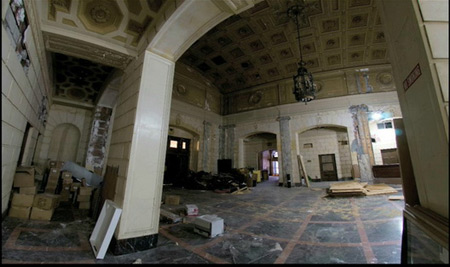
So, Glenn Branca is debuting a piece in what used to be a Brooklyn can factory -- an old brick building complete with cool metal clad doors that are like two-feet thick. The temptation is to see this as an opportunity to catch a latter-day glimpse of New York's past life as the home of dirty art rock. But as it turns out, the Issue Project Room is as equally clean as it is cavernous, and the appearance of the audience, seated in metal folding chairs, conjured fears that established society has finally reached its creepy tentacles into the sacred halls of punk rock.

Luckily, Branca, perhaps sensing this fear himself, imposed his will on whatever stuffiness lingered in the air by prefacing his piece with a personal "fuck you" to the Village Voice, on account of them having the balls to accuse his Lesson No. 3 as nothing more than a suck-up move in the direction of Steve Reich (to whom the piece is dedicated).

And a "fuck you" well aimed it was, as Lesson No. 3 is anything but empty Reich worship. The first few minutes of the performance were, above all, funky. Not almost funky: there was an actual groove in there. And just in case anyone was resisting a groove, Branca, while conducting the four guitarists and drummer making up the ensemble, added visual verification, suggestively wagging his knees the way you do only when you're conducting music that's actually funky.

Once established, though, the groove was systematically abandoned over the course of the rest of the piece. Change came on relatively slowly, as the guitarist's interlocking figures opened up, moving from distinct rhythmic elements, through the gradual addition of harmonics, and into a collective roar that managed to be equal parts rhythm and drone. When the figures dissolved into tremolo, it was hardly noticeable. While it's primarily an entertaining listen, the piece would also function pretty well as a sonic diagram of entropic decay.

At least if you discount the drum work. Paranoid Critical Revolution's Libby Fab somehow had enough left in the tank after her band's set -- which, at its best, brought to mind lightning bolts and Lightning Bolt -- to maintain a tight, heavy backbeat, leading the slight acceleration and dynamic build that occurs throughout the piece.

Let's not turn this into a formal analysis though. Lesson No. 3 is a pretty weighty title for a piece from which pleasure largely involves the feelings of being gradually enveloped in sound and losing yourself in the overtones and rhythm. There's enough meaty intellectual content in Lesson No. 3 to encourage study, but the real lesson here has more to do with the body than the mind.

WFUV's "The Alternative Side" Launch Party with Pela and The Postelles
The Mercury Lounge; New York, NY

[05-11-2009]

What could have been an otherwise tame Monday was suddenly transformed into a Monday That Rocked by my pal Jeff, a DJ at the legendary indie New York City radio station WFUV. An invitation to a party celebrating the launch of WFUV's new internet radio station The Alternate Side, featuring the Postelles and Pela? Don't mind if I do! Bonus points for said party being held at The Mercury Lounge, one of Manhattans' best music venues ever.

Since I am starting to border on being what NYU students would refer to as an Old, I was rather pleased to attend an early show featuring only two bands. New York's The Postelles opened the show with their wholly earnest take on indie boy doo-wop, imploring the crowd to nod along contentedly. How could anyone take issue with a group whose lead singer looks like Shia LaBeouf? I'm a glutton for punishment, so the ear-friendly, sweet stylings of The Postelles do not win my heart, but I wouldn't argue if they were to be nominated some sort of Adorableness Award. The Postelles just finished working on a single with Strokes guitarist Albert Hammond, Jr., entitled “123 Stop.”

Pela are everything I like about pop-punk. That is not to say, however, that they fall into this category, because they are a bit more complex. It's a simple fact that certain bands don't represent themselves as well on record, and until tonight, I'd only been moderately interested in Pela's music. After a 45-minute set, I was converted to official Pela fandom. Pop-punk enters my mind, because while Pela possess many live tics of the genre, such as incessant, infectious grinning by lead singer Billy McCarthy and picture-perfect synchronized group jumping, they also possess such raw substance that they could never be mistaken as such. While The Wrens certainly show no shortage of energy on stage, Pela remind me of a slightly younger version of that band, complete with soaring harmonies and deceptively simple guitar licks that creep up on you with their brilliance. McCarthy smiled at us and says, “I'm feeling crazy rock ‘n’ roll tonight... that feeling came to me as I was sleeping in the van on the Lower East Side. Shine on, you crazy diamonds,” gesturing to the band.

Pela mainly stuck to material from their 2007 full-length, Anytown Graffiti, leading off with its first three tracks, “Waiting on the Stairs,” “Lost to the Lonesome,” and “Drop Me Off,” but we were suddenly treated to the title track of their elusive upcoming album, Rise Ye Sunken Ships, along with another new track, “The Chapel Song.” My personal favorite was the mourning, sparkling “Strange Days,” also from the new album. The set felt cut short, as Pela had to finish in time for The Mercury Lounge to have its late show, but a rollicking cover of The Clash's “Guns of Brixton” dulled the shock with a satisfying snarl. My companion, Pela show veteran Juliet, informed me that “Guns of Brixton” is often interchanged with The Pixies' “Nimrod's Son” or “Holiday Song” as a closer. Sounds like a win/win to me.

Pela recently split from their record label, Great Society, and are currently shopping around for someone to release Rise Ye Sunken Ships, naming July as a possible release date. Until then, those of you in Europe can probably catch them on tour with The Gaslight Anthem. Grump. Someone find these dudes a label already!

Deradoorian
Cake Shop; New York, NY

[05-05-2009]

This time next month, Angel Deradoorian will be a rock star. Dirty Projectors, for which she plays bass and sings, is set to release an album June 9 that will surely be their breakthrough. And I know you've heard about their collaborations with the likes of David Byrne and Björk. Well, okay -- maybe Bitte Orca (Domino) won't make Dirty Projectors the next Radiohead. But the band is certainly bound for Animal Collective- and Arcade Fire-like levels of popularity.

All of which is to say that in a few months we may not still be able to see Deradoorian play to a hundred or so friends and admirers packed into a basement venue like Cake Shop. The event was a record release party for her new EP, Mind Raft (Lovepump United), which had just hit stores that morning. Her Dirty Projectors comrades clustered supportively at the front of the stage; the band's singer/songwriter Dave Longstreth grinned through the entire set like a proud papa. And, as it turned out, Deradoorian's backing band was a real family affair: Her brother Aram played the drums, and two dear friends covered bass and keyboards.

Deradoorian's music isn't terribly similar to Dirty Projectors. In place of the bright, symphonic sounds that band makes, we get moody, layered, sometimes claustrophobic tracks that fall somewhere between PJ Harvey's Nick Cave period and Antony and The Johnsons. Although Deradoorian seemed nervous as all get-out between songs, she never let it interfere with her performance. Her powerful singing, on tracks such as "You Carry the Deed" and "High Road," was especially impressive in an underground cave with notoriously poor acoustics. The set topped out at about 25 minutes, as Deradoorian made it through the entire EP and (I think) one additional song before running out of material. But that was sufficient time to impress this reviewer, to say nothing of the rest of her wrapt audience.

The Skaters Solo / P.A.R.A.
Modern Tower; Newcastle Upon Tyne, UK

[05-09-2009]

Mordern Tower is a cosmic, low-key music and poetry venue set into a super old Roman-era stone wall, now out the back of Newcastle's Chinatown. Naturally, these three expert noise adventurers -- P.A.R.A. (a.k.a. Labanna Bly) joined James Ferraro and Spencer Clark, who were playing solo sets rather than as their usual duo Skaters -- made the place even more magical.

Once the sun had gone down, P.A.R.A. changed from double denim to ephemeral gowns (and wig) and filled a table with a buttload of weird New Age jewels, bowls, incense, a MacBook covered in fur, keyboards, and one amazing Gridiron or motorcross helmet pimped out in feathers and fur -- all with pickups attached. Tapping the bowls, for instance, caused a strange resonance, exemplifying pristinely the paradox between the organic and the digital that seems at the heart of her dreamed-out noise wanderings.

Tonight, Spencer Clark, one half of Skaters, played as Monopoly Child Star Searchers. He sat at the desk, now sans those mystic adornments and replaced with a couple of small keyboards (one only had like five keys left!) and some pedals. There seemed to be a slight malfunction with the PA during his set, causing an intermittent and weirdly percussive clicking sound that only built on the skattered rhythms that eventually wiggled out of his blunted tropical noise. It was real head-nodding material, and paired with massively psychedelic imagery via layers of squiggle, it was absorbing and salubrious.

Skaters' James Ferraro ended the show as Genie Embryo Garden, sitting around his keyboards and pedals. It's always struck me as amazing that his myriad CD-Rs and tapes of liquidy textures are all created from scratch, aside from the odd Beavis and Butthead sample. For noise so obsessed with pop culture, it's incredible how otherworldly and just plain bizarre these ’scapes are, channeling tack culture and and cereal boxes as much as intergalactic feelings and astral vibrations. His set focused on a twinkly and busy ambience that had a constant scruffy grandeur, shimmering in a similar way to those dozens of recordings. His particular sort of mystery was still all over his improvised set; even seeing him embark on those insular processes right in front of us, it was, fittingly enough, still unclear how exactly it was happening.

Mogwai / The Twilight Sad
Phoenix Concert Theatre; Toronto, ON

[05-04-2009]

I enjoy attending shows filled with guys that don’t get out much. Collapsing under the weight of late modern ennui, student loans, vitamin D deficiency and unfulfilled dreams, they are teeming with repressed emotions waiting to be unlocked by one killer riff.

Unfortunately for The Twilight Sad, too few of these concert-goers ventured out early enough to catch the opening set of Monday night’s Scottish double bill at the Phoenix. The Twilight Sad’s pop-masking cloak of noise -- built on 16th notes of overdriven and reverb-drenched guitar and bass -- seemed light and thin as the night’s festivities began. The fullness of the sound was lost in the ether of the vapid spaces of a slowly filling theater. In a smaller venue, I could see their sound engulfing you then deviously sliding a cool shiv deep between your shoulder blades when you least expect it -- but not at the Phoenix.

Their set was good; just not mind-blowing. Vocalist James Graham was evocative,and presented his lyrics with earnest sincerity that from a weaker front man would have appeared melodramatic and contrived. His Scottish brood with forever-rolling Rs acted as a perfect accent to lyrical imagery of the loss, yearning, and confusion of adolescence.

For all the guitar bursts, rumbling bass lines, and vernacular vocals, the one element of The Twilight Sad’s set that stood out was the drumming of Mark Devine. His tom-heavy stoicism and subtle flourishes added progression and movement to songs that otherwise may be lost in repetition.

The band played 45 minutes of material from their two EPs and debut LP Fourteen Autumns and Fifteen Winters. Standouts included “Cold Days From the Birdhouse,” which opened with two minutes of shimmering chime samples under Graham crooning “..and so you make it your own/ But this is where your arm can’t go”, “That Summer at Home I Became the Invisible Boy,” and closing track “I am Taking the Train Home,” which ended with a wave of noise passing by a statuesque Graham staring blankly into the crowd: transfixed, silent, and motionless.

The Twilight Sad’s set may not have been consciousness-shaking, but it showcased the draw of earnest and simple pop songs floating in a cloud of dissonance.

Having canceled the Toronto stop of their fall 2008 tour due to complications with drummer Martin Bulloch’s pacemaker, Mogwai reentered the city to an eagerly anticipatory crowd whose enthusiasm was as large as its numbers. Opening to the creeping piano melody of “I’m Jim Morrison, I’m Dead,” Mogwai laid the terrain for which the rest of the night’s set would be built. In traditional Mogwai fashion, the crowd was consistently lulled into dreamy dazes through tension-building light melodies, only to be trashingly awoken into a universe of chaotic and consecrated crescendos.

Mogwai played a diverse set of new and old songs spanning their decade-long career. Reaching into the back catalog for “Mogwai Fears Satan” and “Cody,” breaking the instrumental mold with vocoder-sung “Killing All the Flies” and “Auto Rock” and stopping out rocker “Glasgow Mega Snake,” the now full venue went ecstatic. Cathartic outbursts flooded the club as the unleashed emotions of no-longer-youthful crowd poured into the air in tandem with the fluttering tense melody and orgasms of sonic discharge streaming from the stage.

The transparency of Mogwai’s song structures became apparent as the show progressed. You could anticipate with near pin-point accuracy when the guitars would kick in and inevitably fade away. However, their slowly building explosions weren’t meant to be experienced as surprise, but rather as a jubilant release of the tension that their melodic sections create.

With guitar techs rushing to the stage as the band finished their set, an encore seemed inevitable; yet, the capacity crowd didn’t rest on their laurels. They demanded more, and as requested the Glaswegians post-rockers returned to the stage to a triumphant roar, bursting into the epic “My Father My King” to end the night.

As the venue cleared and the newly rejuvenated crowd returned to their mid-rise apartments in anticipation of tomorrow’s commute, I was reminded of the non-ironic love people hold for a good guitar rock song.

Mogwai setlist:

I’m Jim Morrison, I’m Dead

Killing All the Flies

Travel is Dangerous

Scotland's Shame

Small Children in the Background

Cody

You Don't Know Jesus

Auto Rock

Thank You Space Expert

Hunted by a Freak

Mogwai Fears Satan

Glasgow Mega Snake
--Encore--

My Father My King

Photo: [3rd Party!]

Richard Buckner
Tractor Tavern; Seattle, WA

[04-25-2009]

With the digital reissues of Bloomed, The Hill, and Impasse to promote, Richard Buckner has taken his one-man act back onto the dusty roads he has continually sung about since his 1994 debut. Fans would be quick to tongue lash those who neglect the chance opportunity to catch Buckner in a live setting, as each of his songs take on a sinister shadow -- more mangled and heartbroken than the recorded origins from which they were birthed.

This particular Saturday evening, before the sun had even set on the sleepy Seattle hamlet of Ballard, Buckner quietly took the stage amidst dim lights, a hushed crowd, and a smattering of guitars — at least five that I could count from my vantage point. Without a word, Buckner launched into his non-stop set, mimicking the momentous roll captured in his one-track catch-all The Hill. Not once did Buckner take a breather as he weaved throughout his lengthy canon. The crowd was too frozen and fixed to dare make a sound, as Buckner ran through such favorites as “Tom Merritt,” “A Chance Carousel,” and “Lucky Buzz,” each sprinkled in between re-imagined instrumentals from The Hill. The only real peep heard from the crowd was the smattering of applause before Buckner launched into “Slept” and the amazement at his effortless shifting of guitars with the aid of pedal loops, slides, and an EBow.

What's particularly astonishing is how evidently alt-country Buckner’s crowd continues to be, despite his live performances bordering more on experimentation than any of his recorded output would allude. While the melodies and birthmarks that pox Buckner’s signature songs remain intact, he doesn’t shy away from drawing out something new from those old chestnuts. Often, Buckner was caught bending and stretching notes until their near breaking point, transforming complacent guitar plucking into Thurston Moore bastards. Whether he was in a sour mood that he poured into his setlist or just a man looking to liven up the old, it didn’t matter. Richard Buckner proved once more that despite being pigeonholed as an alt-country/alt-folk leftover, he’s more on par with the current crop of psych-folkies with his twisted interpretations of an old but fruitful style.