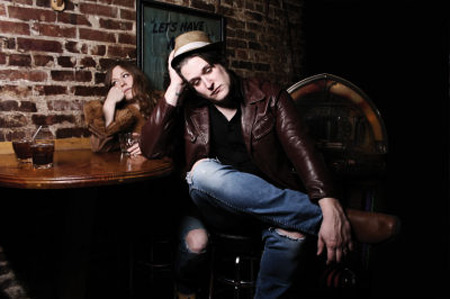
James Jackson Toth / The Dutchess and the Duke
Gravity Lounge; Charlottesville, VA

“Everybody squint your eyes a little bit, so it looks like it’s darker in here,” said The Duke, also known as Jesse Lortz. He and The Dutchess (nee Kimberly Morrison), joined by a percussion player, were perched on the edge of the stage, forgoing the PA and strumming and singing straight at the seated audience. The duo’s debut album, She’s The Dutchess, He’s The Duke, takes up a folkish minimalism, and their live show follows that same path. Their proximity to the crowd was one example, as was their simple, unplugged orchestration and precise delivery.
Such a basic approach might come off as sterile or lacking talent, if not for the energy at the root of The Dutchess and The Duke’s sound. On the album, the source of this essence is hard to pin down, but in a live setting, it’s literally right in front of you. They behave like good friends: slightly drunk, slightly unruly, but completely endearing and disarming.
In between songs, The Duke disclosed his newfound fascination with port wine while sipping on a glass, then polled the front row about their astrological signs. The Dutchess, meanwhile, apologized for singing with her eyes closed, joking that it made it easier to imagine that no one was watching. But even with eyes squinted or closed, you can’t miss the spark between them. Performing much of the material from their debut, they showed that the raw, straight-ahead path of their album is their natural musical cadence. And the jovial nature of their stage banter is the same spirit that brings their rhythms and melodies to life.
Standing up to put their guitars away at the end of their set, the duo displayed their friendliness one more time. A fan in the front row asked if they could play “I Am Just A Ghost.” The duo shrugged and smiled, returned to their seats, and delivered the tune, forgoing the typical leave-and-return encore formalities and making their last number a personal, special farewell.
Since The Dutchess and The Duke went PA-free, James Jackson Toth and his band, The Born Bads, took the stage after only a short break, and while The Dutchess and The Duke made their impact with stripped down directness, Toth’s five-piece ensemble pulled out the stops and rocked with a full and focused force.
Jexie, James’ wife, contributed backing vocals, and the rest of the band proved that a stellar recording lineup (including guitar-god Nels Cline and Deerhoof’s John Dietrich) isn’t the only thing that Toth’s latest incarnation has going for it. Abandoning the more shaggy, meandering aspects of a lot of Wooden Wand material, Toth’s latest material is well-groomed and drives forward with a determined momentum.
While the band impressively channeled the album’s energy on Waiting in Vain-tunes like “Look in on Me” and “Poison Oak,” “Mother Midnight,” from Wooden Wand and the Sky High Band’s 2006 album Second Attention, burst out towards the end of the set as the night’s highlight. The Born Bads’ rendition showed that the amped-up, reigned-in sound not only works for the new songs, but can also inject new blood into Toth’s back catalogue.
Standing on stage and rocking out, Toth looked confident and comfortable. His latest musical steps may be venturing away from some of the more experimental back roads that he has embraced in the past, but it looks like he’s got his compass aligned just as he wants, and the open highway lies ahead.

Bon Iver
Aladdin Theater; Portland, OR

Justin Vernon, née, Bon Iver, recorded his album For Emma, Forever Ago while living alone in a cabin in Northwestern Wisconsin. It is almost impossible to read anything about Bon Iver without this nifty fact being called to your attention. While it is almost certain that Vernon retreated to the cabin and recorded these songs without lucre or fame in mind, you can see the dollar signs in the eyes of record execs and publicists with such a juicy story to exploit. So, in case you didn’t know, Justin Vernon recorded his music while living alone for months. Let’s get that out of the way first.
But marketing tools aside, there are a great set of songs that populate Emma. They are hushed, pained elegies that sprung from Vernon’s isolation. The melodies unfold slowly as the ghostly vocals drift over the strum of a spare acoustic guitar. Though some additional overdubs and recording were done elsewhere, this album is Vernon and Vernon alone. It made me curious how such a personal collection of songs would translate in a live setting.
This event marked the first show I would attend since relocating to Portland, Oregon. There is a special thrill when visiting a venue for the first time, but after a few years and scores of shows elsewhere, that initial trip can be disorienting. There is something comforting when a club or ballroom becomes familiar. After seeing scores of shows at the Black Cat and the 9:30 Club over the years, I had the corner on when to arrive, where to park, where to stand. Even the venue staff had become recognizable. This, however, was a whole new world.
The Aladdin Theater is an intimate setting with a 600-person capacity. It reminded me of a high school auditorium with general admission seating. I took a seat near the soundboard, halfway back from the stage where a nice pitch in the floor would give me good visibility. But as more and more people filtered into the sold-out show, the pit and aisles became free game for standing room. Without the proper neck angle to see through the crowds, it was either stand or not see much.
Vernon took the stage, with three other musicians, and launched into “Flume,” the opening track from Emma. As Vernon strummed, his striking tenor almost identical to the tracks on the record, guitarist Mike Noyce pierced the fragile song with laces of electric feedback. Silence filled the theater (beyond that obligatory dick who claps at first and then is stared down by displeased neighbors). The song had transformed from a personal ballad to a powerful anthem. Vernon is no longer alone in the woods.
With only nine songs to his credit, I had assumed the concert would be fairly short. Even Vernon, himself, joked, “Guess what, everybody? We only have so many songs. We’re probably going to play them all.” But the metamorphosis from the introspective tunes on the album to the southern rock crescendos of the live show brought more vitality and drama to the music. Highlights included the soaring “For Emma” and the slow-building “The Wolves (Act I and II).” For the latter, Vernon told the audience that he has a nightly audience sing-along where the crowd must sing “What might have been lost/ Don’t bother me” over the rattling percussion on-stage. Before we had our chance, Vernon said San Francisco and Amsterdam were tied for first place. The members of the Portland audience seemed to give it their all. Vernon never said who won.
The concert only dragged when the band played two covers. While covering Talk Talk’s “I Believe in You” and Graham Nash’s “Simple Man,” Vernon allowed other members of the band to take over the vocals. Though the singing wasn't bad, the voices could not equal the haunting quality of Vernon’s pipes. Consequently, the aisle cleared during this segment of the show and the visibility became perfect as folks fled to the restrooms or out to have a smoke.
Bon Iver closed the first set with “Creature Fear.” As the theater filled with a barrage of drumming and feedback, the transformation of Justin Vernon became complete. Reclusive music had become a full-scale rock show. Although no one danced, the audience remained frozen in rapt stillness. The band came out and finished the show with the plaintive “Blindsided” and “Skinny Love.” While Vernon played the dobro, the three other musicians drummed. This is a far cry from the woods of Wisconsin. Justin Vernon is alone no more.
The Walkmen
Bowery Ballroom; New York, NY

The Walkmen are the best rock ‘n’ roll band on the planet, plain and simple. Sorry to have to break it to you so bluntly, but how this group of Bob Dylan disciples has avoided consistent mainstream attention is a mystery to me. Riding high on a strong four-album run, the quintet possess all the tools required of a slick r-n-r machine: A guitarist with a splendid ear for melody, a bassist with near-perfect instincts, a keyboardist in the shadows, a vocalist with no shame, and a flexible, creative drummer.
The Walkmen are one of those bands, like Dylan, that don’t reach everyone. For me, that usually means I’ll try to Get It for years unsuccessfully, then suddenly BLAM-PLOP-FIZZ-SMASH, it crashes in my head like an errant crow planting beak-first into a windowpane.
Ouch.
This immediate immersion has, in the past, caused me to do unreasonable things. I still remember scrapping together cash to buy Mötley Crüe tapes from a neighborhood pawn shop, and I wasn’t gunning for just, say, Shout at the Devil or a “Home Sweet Home” single; I wanted everything they had to offer up to that point, and I made it happen (though I never did find the Toast of the Town/Stick to Your Guns EP, rare as it is).
Next came Metallica, and I moved with even more stealth, even more wrath until I had the coveted Kill ’Em/Lightning/Master/Garage Days/And Justice… quintet in my possession. And, let me tell you, I rocked out so hard and so often on my headset my family forgot I was around on family gatherings.
Perhaps not coincidentally, I was listening to a Walkman.
I won’t go into the depths of my Van Morrison jones too deeply; just know that, within a few months, I purchased/inherited the following records like downloading never existed: St. Dominic’s Preview, His Band and the Street Choir, It’s Too Late to Stop Now, Hard Nose the Highway, Moondance, Beautiful Vision, Inarticulate Speech of the Heart, Veedon Fleece, Into the Music, Wavelength, Common One, and A Period of Transition.
So yes-yes-yes, I have an addictive personality when it comes to collecting certain artists. Strangely, this phenomenon normally only occurs with bands that I can’t stand upon first listen. I thought Mötley Crüe were evil when I first heard them, and back then, that wasn’t a compliment; ditto for Metallica. I figured Van Morrison was a one-hit-wonder for years upon years until I stumbled upon a $1 copy of the Tupelo Honey LP in an antique store.
I had a similar moment with The Walkmen. I found Hamilton Leithausen to be arrogant in the way he swung his voice around and wrung so much piss out of it, to the point where I often squirmed in my seat when “Little House of Savages” took its melody an octave higher halfway through.
I still wriggle when “Savages” goes next-level, but I’ve slowly realized that The Walkmen are much more than a stylish, stubbornly singular NY rock band with a singer that’s too confident for his own good. For one, drummer Matt Barrick has quietly carved the most distinctive percussive entity in indie-rock with his sense of subtlety, driving the songs with woodblocks, shakers, tambourines, hi-hat chicka-chicka, cymbal taps, and triangles. He never lets his drumset become an expensive trap, never lets the obvious thud of a bass drum suffice when a simpler pleasure could add something more personal, and never, ever, ever cuts corners, often holding several instruments at the same time and never looking too comfortable behind his set. And don’t worry: when it comes time to throw the-fuck down, he can do that too, as punk ragers like “Tenley-Town” attest.
Taken as I am with Barrick and his relentless push to revolutionize the way indie-rock songs are metered, he is but a part – albeit perhaps the most important part – of a machine that is eternally more than the sum of its cogs. Any Walkmen song sounds the way it does because of guitarist Paul Maroon; without him, Barrick would be slapping shiny decorations on a dying tree, and his ability to pluck out euphoric little stabs of electricity in between verses and choruses precludes the need for a true rhythm guitarist (though Leithauser straps a six string on occasionally). Peter Bauer is steady as they come on the bass, and though Walter Martin fills a less-defined, auxiliary roll, I can’t imagine The Walkmen’s splendid atmospheres burning so bright without his thoughtful, crafty, tinker-toy approach to his duties.
And, of course, any discussion of The Walkmen has to hinge on Leithauser, he being the out-front presence he is. Much has been made of his penchant for Dylanese, but however prone Leithauser is to imitating Dylan’s gurgles, it’s important to think about the last time you heard a Dylan impersonator that didn’t COMPLETELY miss the mark. When was it, “Sultans of Swing,” maybe? Yeah, that’s right – it’s literally been decades since anyone aped Dylan with any authority (Micah Hinson gets the silver medal, and the guy from Mendoza Line gets Honorable Mention), and no one wraps their lips around a song like Leithauser, who, like Dylan, has a way of crooning overtop the rhythm so haphazardly it’s as if he doesn’t even hear what the rest of the musicians are doing.
Another piece that makes the Walkmen puzzle so cohesive is their songwriting ability and the way it lends itself to different forms of expression. To cite the most recent example, You & Me, every song carries its own set of moods. Not a single song ‘rocks out’ in the traditional sense, yet every song is heavy in its own way. It’s a devastating album; what’s more, it’s The Walkmen’s fourth devastatingly good album of original material.
Thing is, you might not quite Get It until you see The Walkmen live; it’s what pushed me over the edge of fandom to rapture five years ago when, against my instincts, I skipped a Public Enemy show to see The Walkmen at Bumbershoot 2004 in Seattle. They played “What’s in It For Me” and “The Rat” in succession, as they are laid out on the album, and it was impossible to abstain from the feeling they wrung out of their devices. A subsequent trip to Seattle that same year cemented the relationship.
This time around, with two more albums to their name, the new cuts were hanging on the hook: “On the Water” starts with a ripple of urgency before exploding in red-alarm whistles and a frenzied tempo; the swingin’ “Donde Esta La Playa” (the first encore offering) slides casually along a downtown apartment’s hardwood floors in its socks, while “In the New Year” packs more power into its sudden bursts than a nuclear-powered jackhammer.
The true treat, however, is “I Lost You,” which is buried near the end of You & Me and contains a few of The Walkmens’ most memorable flourishes and an opening guitar sequence so lovely it sounds like it should have been crafted by an ace session musician in the ’70s.
Bring-down-the-lights numbers “Long Time Ahead of Us” and “New Country,” like “138th Street” and “No Christmas While I’m Talking” (which they played at the 2004 shows but not this time) before them, present us with the troubling possibility that The Walkmen would be just as effective as a stripped-down act, their awkward moments of solitude easily as important as the ‘whoosh’ moments that stand out upon first listen.
I could have gone without the horn section bleating in on the action so often, and “Little House of Savages,” an encore selection, didn’t shirk my irk once again.
Neither concern was an issue when the big picture is considered. As expected. The Walkmen roared out of the Bowery Ballroom’s imaginary gates with the same intent they seem to harness wherever they play, Leithauser taking his place front and center, forcing the crowd to not only hear him but to deal with him, one way or another. Sort of reminds me of a Walkmen album, actually; his squeals push you away before they draw you back in, and during performances, Leithauser takes an even more prominent role in projecting the group’s live energy, yelling and flapping his vocal cords for all they’re worth and hitting every note while not hitting every note, if you dig.
If you’re been snubbing The Walkmen, I don’t blame you, but it won’t be so easy to ignore them in the near future. It took U2 a half-dozen albums to truly break the surface; I’d be truly surprised if The Walkmen didn’t hit the number if they surge on for a few years. We can only hope we’re so lucky.
MusicfestNW 2008
Various Venues; Portland, OR

I remember a conversation from a few years ago where one of my friends bemoaned the lack of summer festivals in the United States. It seemed like all the best acts were gathering in places like Roskilde and Reading, playing these crazy weekend-long bonanzas. Meanwhile, we got the annual Steve Miller and Jimmy Buffett borefests on this side of the Atlantic.
But things have changed, and each weekend there is some sort of festival out there promising to rock your world. Bonnaroo, Sasquatch, Coachella, Lollapalooza, Bumbershoot -- and those are only the big ones. Hell, I even attended Captain Morgan’s Jam on the River just so I could see the Flaming Lips. But like all things American, these festivals have begun to homogenize. The lineups are becoming interchangeable. Seriously, how many did Jack Johnson headline this summer?
MusicfestNW 2008 would be the third festival I attended this summer. But rather than use the blasé format of take-a-big-field-throw-up-some-stages-and-wedge-people-into-a-campground that the bigger fests have employed, MusicfestNW turned the entire city of Portland into a musical playground. Instead of worrying about who is playing on what stage (pun intended), one can see Les Savy Fav at the Wonder Ballroom or travel across the river and catch The Cool Kids open for Del the Funky Homosapien.
I decided to take it relatively easy. Even though it’s ambitious to see every band, standing around for hours can take its toll if meshed with drinking and other merriment. But the shows I did catch were great. No Age helped whip up the crowd with its two-man lo-fi rock, and Battles finished them off with a tight, weird, wordless set. Headliners Vampire Weekend played a set of serviceable songs to a sold-out crowd. The Fleet Foxes sounded great during a truncated set. Local favorites Menomena, claiming this would be the last show for awhile, translated their songs perfectly on-stage. It was also a night of firsts: TV on the Radio and Blitzen Trapper played music from new albums for the first time. Mogwai and the Fuck Buttons kicked off the first night of a joint tour together.
As the city recovers from so much music, I’m sure the blogs will light up with all kinds of reviews and stories, each different from the other based on who the author decided to see. We decided to do things a little differently here at TMT. So, check below for a handful of Shrimp Scampi videos with some of the artists who played MusicfestNW. (Click here for an in-depth talk with Stuart Braithwaite of Mogwai and here for an interview with TV on the Radio's David Sitek.)
----
----
----
----
----
Rufus Wainwright / Lucy Wainwright Roche
The Egg; Albany, NY

It was a family affair -- the happy kind. The kind where everyone's a little buzzed, discussions on music and movies are rampant, and you discover your favorite uncle smokes pot, too. Rufus Wainwright performed an intimate solo show, and his half-sister Lucy Wainwright Roche opened in similar fashion, armed only with an acoustic guitar and witty banter.
Lucy warned us that she'd been basically living in her car due to all her travels and that she was subsequently eager to chat. Musicians always have great crazy stories from time spent on tour, and Lucy was no exception. We got the details on how U.S. security threatened to sic the drug dogs on her car at the Canadian border. Homeland Security: protecting America from harmless folk singers. We got another story on how friendly people are in Australia. Apparently, opening the bathroom stall to converse with those at the sink flies when you're Down Under.
The songs were the usual folk singer fare -- some nice melodies and a personal story or two. Her voice was strong and capable but lacked a certain identifying personal style like that of her brother. Still, the family talent was clear in her performance. After the set, she offered to share dirt and sell secrets along with some EPs. Lucy tempted the audience with the following nugget: when they were kids, Rufus made her pretend to be dead so he could sing arias to her. To those who have heard Rufus' music or seen him perform, the revelation proved less than shocking.
Rufus himself maintained a similar rapport with the audience, joking that he likes Albany because, unlike Manhattan, it still has poor people. He kept the talk brief, however, as he had a large repertoire of songs to play, from his self-titled debut to last year's Release the Stars. “Danny Boy,” “This Love Affair,” and “Beauty Mark” quickly confirmed that Rufus' rich, languorous voice is just as impressive live as it is on disc. His stature might be small and slight, but his lungs are those of a giant. Throughout the show, he walked back and forth, switching from piano to acoustic guitar. His first stint on six-string featured “Sanssouci” and “Greek Song.” The crowd clapped and even sang along, with a little prodding, to the first of the two.
The high points came later in the show. During “Nobody's Off the Hook,” Rufus had the entire theater afraid to breathe. The sweeping operatic piece showed off his range as he cooed softly and barely touched the ivory to begin, but later danced his hands along all 88 as his voice built to the song's crescendo -- "'Cause life will take that little heart, and bring you to your knees/ Threatening to break it for the final time/ And you'll believe it, yes, you will believe it." The song took over the room. No one spoke. No one coughed. The pin drop cliché was startlingly appropriate. Stomach gurgles and hard swallows could be heard from those sitting in entirely different sections.
Following that emotional highlight, Rufus lightened things up again, stumbling and joking his way through the danceable “California.” The lyrics may have been botched, but any disappointment vanished when he absolutely crushed the high note on the line "Ain't it a shame." At the song's conclusion, Rufus issued a charming little burp, uncouthly plopping the cherry on top of a bizarre, but memorable version of his “Poses” standout. The yet-to-be-released “Zebulon” followed, with a quick transition into the popular “Cigarettes and Chocolate Milk,” to the crowd's delight.
Lucy joined her brother, singing backup for the encore, as she did sporadically throughout the show. The two tackled Rufus' interpretation of “Hallelujah,” which is quickly becoming the most covered song of all time. Still, Cohen's words are moving no matter who sings them. Rufus even yielded a few lines to Lucy alone, and their harmonizing on the chorus was wonderfully ghostly.
The last song of the show was dedicated to newly crowned Olympic hero Michael Phelps. The crowd erupted in laughter once Rufus revealed it to be "Gay Messiah." "You never know...," he teased. He then altered the lyrics a bit in honor of the aquatic hardbody, changing "Better pray for your sins, 'cause the gay messiah's comin'" to "Better pray 'fore you swim, 'cause the gay messiah's swimming." He may have left the audience questioning why Michael Phelps doesn't have a girlfriend, but no one was questioning that Rufus himself was, naturally, fabulous.
Xiu Xiu / Evangelista / Prurient / Common Eider, King Eider
Bowery Ballroom; New York, NY

Upon hearing that Xiu Xiu would be playing a show at the Bowery Ballroom in my humble hometown New York City with the city’s noise son Prurient, my brain involuntarily winced, an appropriate reaction to a seemingly impossible paradox. Why would the tinnitus-inducing, power-electronics testosterone fest that is Prurient be matched up with the often effete, fractured tales of hurt and emotionally honest outpourings of Xiu Xiu? Was this some promoter’s idea of a joke? Even others I told all seemed to cock their head in disbelief.
But it all began to make sense. Xiu Xiu and Prurient, if you think about it, are actually an excellent pairing. Though Xiu Xiu find themselves consistently exploring a tender side that Dominick Fernow (Prurient) seemingly doesn’t possess, both use torrents of sound to explore the same recesses of psychic territory and emotional longings. They also both use their art as a cleansing ritual, and though they’ve developed their own divergent modes of purging the pain, neither is less harrowing. The twisted tales of Xiu Xiu frontman Jamie Stewart teem with a wretched beauty both as nauseating and as moving as the layered drones, tortured screams, and microphone feedback of Dominic Fernow. I braced myself for what could be one hell of a cathartic evening.
The heartache wouldn’t end there, though. Carla Bozulich’s Evangelista were later be added to the bill, and since my exposure to the group was minimal, I decided to ask my editor, Mr P, what he knew. Well, my fears of breaking down in emotional throes were only compounded as he informed me that Evangelista’s Hello Voyager was not only one of his favorite albums of the year, but another one of those dangerous acts whose purpose lies in the pouring out of emotion and transference to their unsuspecting audiences. After taking a listen to Hello Voyager, I became really excited for this show -- or terrified, depending on how you look at it.
Entering a sparsely populated Bowery Ballroom, I came upon openers Common Eider, King Eider -- the nom de plume of Rob Fisk (7 Year Rabbit Cycle, Deerhoof) -- mid-set. Immediately, the viola drones and guitar work reminded me of Lou Reed and John Cale working out a midnight Theater of the Eternal Music jam in Soho in the late ’60s. Their dronescapes had a less is more approach, creating trance-inducing moments along with greater moments of breakout glory and grandeur, kind of like a more minimal and sparse Silver Mt. Zion or Godspeed You! Black Emperor. Though their set had its moments of tense foreboding, ultimately their music would be guilty of lulling everyone into a false sense of security, for Prurient was to take the stage next.
As the room started to fill out a bit, Fernow tested a few deafening squeals before the start of his set. My girlfriend turned to me to bemoan two things; first, that she didn’t bring ear plugs; and second, that Prurient was wearing a shirt. Shirt or not, his set was astonishing, and though it wasn’t as ear-splitting as I’ve witnessed in the past, it was one of the least abrasive (though it was still abrasive) and dare I say beautiful sets I’ve ever experienced from Prurient. The layered drones and distorted screams of agony were a perfect compliment to the theme of the night, i.e., the purging of pain. Prurient’s cries were marked with the black infinity of a Burzum album. Like a sputtering roman candle, Fernow created howling feedback with a microphone and a mini-amp. I’m not sure if what he performed was new material, but if so, it was promising, with less harsh noise and p.e. leanings and more of the black metal-tinted drone loops that made his Pleasure Ground album so memorable. It was all injected with an almost kosmische-influenced salute to the cosmos.
Evangelista was on next. Compiling a group comprised of the plodding bass of Tara Barnes, prepared sounds of electronics man Dominic Chas, the fractured drumming of Lisa Gamble, and orchestral swells provided by guests strings C. Spencer Yeh (Burning Star Core) and Okkyung Lee, Carla Bozulich’s Evangelista were absolutely stunning. Bozulich has admittedly used Evangelista as an outlet to overcome her innate shyness, and indeed engaging the audience is something she makes a conscious attempt to do every night she’s out there. In one of her signature stage moves, she put her arm around an unsuspecting audience member and began to powerfully coo in his ear. Choking out restrained bits of screeching guitar and walking around the stage spilling her guts in the confessional style she’s honed so well, Evangelista waded through the black mist of their signature chamber pop. Quiet moments would unsuspectingly gather gusts of wind and steam, creating the perfect spell-casting environ for Bozulich to spit her vitriolic venom through the tempest. At times throughout the set, Yeh would play his violin so furiously, the chalk residue that came off his violin made it look like the violin itself were smoking. For the epic closer “Hello Voyager,” Bozulich, in another patented act of engaging the audience, entered the crowd to deliver her message in a more intimate matter: “When there’s only one word left, one word that hasn’t dried on your parched lips, that word is love.” Amen, sister.
Finally there was Xiu Xiu. This would be my second time seeing the group this year, the first time being a bare-bones semi-acoustic set in the basement of a Lutheran church in Brooklyn, with only the accompaniment of drummer Ches Smith. So this would be my first time seeing Xiu Xiu in full-band form, and wow what a difference it made. The stage was setup in an impressive array of exotic percussion and Croatian bells. Drummer Smith sat behind an oversized kit, and his crash cymbal had the hulking circumference of a flying saucer -- though he looked diminutive in comparison to the set, Smith would nonetheless bang the shit out of it during the group’s more aggressive moments. Multi-instrumentalist and Stewart cousin Caralee McElroy played an array of different toys, from percussion to melodica to synth to harmonium to autoharp. Though the stage was almost completely covered in strange instruments, the strangest had to be Stewart’s voice itself. Shifting seamlessly from the little-boy-needing-his-mommy falsetto weirdness to Ian Curtis bravado on a dime, Stewart led the group through a set of songs culled primarily from their new album, Women as Lovers, alongside some old favorites (“Hello from Eau Claire,” “Fabulous Muscles,” “Boy Soprano”). They closed the night out with live standard “Bog People,” which featured Stewart on zither, a thankfully upbeat and buoyant way to end what wound up being one otherwise movingly disturbing night.

