Jukebox the Ghost / J. Roddy Walston and The Business
DC9; Washington, DC

[02-28-2009]

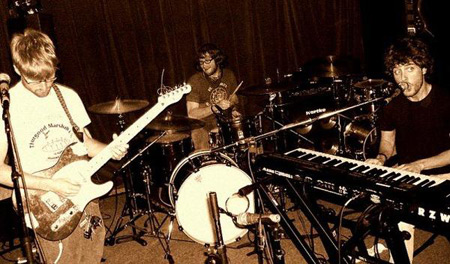
Have you ever been to a show where you hoped during every song that it wasn’t the last, because you didn’t want the show to end? Jukebox the Ghost’s set at DC9’s five-year anniversary party was one of those shows. There was yelling and dancing and clapping and the kind of frenetic energy normally only seen at house shows.

I arrived halfway through J. Roddy Walston and the Business’ set and was immediately drawn to the twangy country-rock filling every corner of the room. Their bassist had metal-as-fuck hair, and the band members were obviously enjoying themselves. Their set ended when one of DC9’s owners came on stage to introduce Jukebox the Ghost, who he thanked for playing “even though they’re too big now to play at DC9.”

Jukebox the Ghost seemed overjoyed to be back on home turf (they recently relocated from DC to Philadelphia) and immediately dove headfirst into their set. They’re a band whose live show clarifies their recorded material, and the energy blindsided me; I came in not feeling particularly invested in their debut album, Let Live & Let Ghosts, but walked out excited to listen to it as soon as I got home. Keyboardist/vocalist Ben Thornewill’s intricate piano trills provided a surprisingly effective anchor to the songs, as he hammered away at the keys with precision, successfully carrying melodies from simple to bombastic and back again within the span of a single song. Guitarist/vocalist Tommy Siegel provided both unobtrusive chords and expertly shredded solos, while drummer Jesse Kristin kept the beat both thumping and danceable. They tore through every song, pausing briefly for the occasional midtempo quiet moment, but the energy never subsided.

As their set came to a close and I thought things couldn’t get any better, they came back with an encore consisting of two excellent covers, “Beautiful Life” by Ace of Base and -- this is where they won me over completely -- Rage Against the Machine’s “Guerilla Radio.” Hearing most everyone in the venue screaming “All! Hell! Can’t stop us now!” and watching the band stumble around the stage screaming along was the perfect end to a nearly perfect night. They couldn’t have picked a better way to finish, because I don’t think anything in hell can stop Jukebox the Ghost.

Dirty Projectors
Walker Art Center; Minneapolis, MN

[03-06-2009]

The indifference of Western formality was made poignantly clear when Dirty Projectors took the stage at The Walker Art Center. There we were, sitting in our particularly comfortable seats (The Walker's McGuire Theater isn't even four years old), while one of the most rhythmically complex guitar-based bands traveled at the speed of light in comparison to our rigid immobility. Dave Longstreth, Dirty Projectors' "musical director," jerked about the stage, hardly concerned with the technicalities of his labyrinth guitar lines. It was eye-opening just witnessing Longstreth scaling all over the neck of his left-handed guitar, stroking the strings just above the pickups with nary a pick (besides for a few rock-out moments).

A bulk of the set was comprised of new songs, mostly from Bitte Orca, their forthcoming album on Domino. Much is made of the group's stylistic appropriations, and these new songs projected this two-fold. Like the songs on Rise Above, they were melodically acrobatic, intricately composed, sharply accented, and structurally daring -- and if this performance was an indication of things to come, Dirty Projectors' increasing complexity is being matched by their increasing accessibility. They claimed to have little experience performing these songs, but it was certainly hard to tell.

Aside from Longstreth's expressive warbling and explorative guitar technique, the night was made successful by a wonderful rotating cast of bandmates. The foundation was held down by Brian McComber on drums and Nat Baldwin on bass, while Amber Coffman (vocals/guitar), Angel Deradoorian (vocals, guitars, keyboard, samples), and Haley Dekle (vocals) decorated the songs with additional rhythmic and harmonic ornamentation. I found their vocals at their best when creating textures ("Gimmie Gimmie Gimmie") rather than repeating lyrics or assuming lead vocals (Amber took a couple songs, and Angel did another), but it was nonetheless a welcome variation to DP's otherwise hierarchy of voices.

The rest of the set drew mainly from Rise Above, including fantastic versions of "Six Pack" and "Thirsty and Miserable," plus a stunning encore of "Spray Paint (The Walls)" performed without mics and in the crowd. Although I can't stand the ego and theater involved with encores, the naked performance of "Spray Paint" was refreshing, especially since the sound for the full-band portion was terribly mixed. It's as if the sound dude was trying to spotlight Longstreth like he was Neil Young, turning up his vocals and guitar and completely de-emphasizing the other members' contributions; the lopsided mixing essentially obliterated the dynamics of the rhythmic juxtapositions on songs like "Knotty Pine." Nonetheless, Dirty Projectors put on a thoroughly engaging, impressive performance -- and anything that gets me closer to Walker's Fluxus collection is a plus in my book.

Earth / Sir Richard Bishop / James Blackshaw
The Tractor Tavern; Seattle, WA

[02-26-2009]

The night’s triple bill was as jangled as one can imagine. While Earth, Sir Richard Bishop, and James Blackshaw focused on sounds coaxed from guitar, the hands doing the work were from three completely different worlds. James Blackshaw’s work is intricate and deliberate, transforming 12 strings into a symphonic work based around simplistic raga melodies. Richard Bishop is much more cunning, choosing to transform his own six strings into Mediterranean pastels and cheeky reinterpretations. Meanwhile, Dylan Carlson’s approach to guitar is uniquely his own, as he manipulates modest drones from crafted blues slides and subdued riffage. Despite the perceived differences, however, each act had something more in common that we were all to discover as the night wore on.

James Blackshaw quietly opened the show. As soon as he began strumming, the once scattered crowd lumped together group-by-group to gaze at the wonderment that is Blackshaw and his fingers. Much like his recorded material, one gets lost in the easy flow that Blackshaw creates. Minds begin to wander, thinking about the day’s events. Once disposed, the mind continues to quickly drift back to younger memories — all the while Blackshaw produces his dreamy melodies. Your childhood begins to adopt 12-string lullabies-as-soundtrack, as the steely plucks reverberate from stage to wall. There is little to differentiate Blackshaw’s live iteration from his recorded output, though there’s a richness to be gained by standing in a crowded club as each note bounces from one person to the next before reaching your ear. Blackshaw tore through material from his upcoming The Glass Bead Game and politely exited the stage

If Blackshaw left like a lamb, Richard Bishop came storming in like a lion. Bishop wasted no time delving into his erratic and cutting guitar ruminations. Whereas Blackshaw forms melodious, well-rounded ragas that sing with high notes and twinkle like stars, Bishop picks and plucks at each string with the fury of a lumberjack, as if he’s determined to split each in two to prove a point. His set began with much of the Eastern ideas that have graced his recent output, Polytheistic Fragments. Slowly, the mood changed, as Bishop drifted into a more classic rock sound. The songs began to rise and fall to match his breathing. Bishop would hack out a stanza with an unseen — but easily heard — anger while apologetically caressing those same strings to create a piece of beauty and sorrow. Bishop finished his set by inviting James Blackshaw and new Seattle resident Ben Chasny (who was in the crowd for much of the evening) onstage. The ensuing chaos not only found the crowd clutching to cameras, but found the trio slowly building their own unique styles into a ball of frenzied guitar. When the collaboration reached its overpowering climax, it was difficult to tell which guitar was loudest, but every audience member was standing on their tiptoes waiting for it all to fall apart into a glorious mess.

Earth claimed the stage shortly after Bishop, Blackshaw, and Chasny finished their jobs. Dylan stood alone with the band’s new cellist waiting for the rest of the band to get their asses onstage. The band kicked off the set with “Omens and Portents I: The Driver” and proceeded to trudge through the tar that is their sound. It’s hard to explain Earth’s music — for as simple and derivative as it may seem, it’s a calculated morass of thick blues and deconstructed rhythms. Earth is a niche all its own, despite being tagged with the ‘stoner rock’ moniker for quite some time. There is plenty of musical evidence to back up such an assertion, and I don’t doubt for a second that if Earth were sharing a bill with a methodical jamband, they’d be all over etree.org for long-jam aficionados to devour. ‘Earth’ would probably be the best describer of Earth, for as the set flowered, it was as if each clumsy cymbal shot, each impromptu organ stroke, and each slack-jawed bassline was coming up from The Tractor’s foundation. Dylan and company were meticulously destroying the old crust and building a new one at 33 1/3 speed, and no one cared if they were swallowed whole.

Photo: [Earth MySpace]

William Elliot Whitmore / ft (The Shadow Government) / T Wehrle
The Picador; Iowa City, IA

[02-21-2009]

Stepping into the Picador in Iowa City Saturday night for William Elliot Whitmore's sold out CD release show was not unlike stepping into one big Iowa family reunion. The house lights of the small club were on, even as opening folk crooner T Wehrle played his Iron & Wine-meets-Sea Change tunes. T Wehrle was more like a house band for hipsters and farm town folk to mingle and drink to while awaiting the main event. See, Whitmore's new record Animals in the Dark just came out on ANTI-, which is a big accomplishment for the gravel-voiced neo-bluesman from a small town nestled down in Mississippi river country. Saturday night felt like a celebration of Eastern Iowa itself, in the form of praising one of Iowa's favorite musical sons.

It is hard to capture the essence of what Will Whitmore means to the state of Iowa. This perhaps owes in part to the fact that I'm not an Iowa boy. Live, Whitmore is a tremendous presence. He generally performs seated, occasionally with accompaniment but largely solo, relying heavily on his banjo but also picking up the acoustic guitar for select numbers. His weary baritone aids him in his rare ability to command a room that escapes so many performers, and yet I don't get the sense that he's particularly well-known or revered outside of Iowa. At the risk of speaking for an entire state, part of the Iowa identity is to be overlooked and underappreciated. Will Whitmore? Despite his new, high-profile record label, he's still an under-the-radar national talent.

It was certainly not the case for this show, the first of a two-night stand at his adopted hometown venue (the second being an early all ages show to counter the late-night drinking crowd). Saturday was a family affair in the loosest sense -- if you knew Will, and everyone knows him somehow -- you were family.

As they were checking my ID, one well-known hipster was checking in. Whitmore happened to poke his head around the corner and say in his unmistakable drawl, "He's my banjo tech. Let him in." Banjo tech? Really? It seemed like a stretch. One club "security" officer estimated "more than 50 but less than 100" people didn't pay for the show. Capacity is 300. You do the math -- I mean, how many banjo techs were there? Part of the allure was mysterious noise-pop quartet ft (The Shadow Government) playing as direct support. It was an obvious choice, though not aesthetically. Whitmore's cousin Luke Tweedy, who records Will and just about everyone else in Iowa City, plays in the band. They hadn't played in ages and might never play again, but their combo of punk, camp, and noise was fitting, and their short set provided just the buffer people needed to get both drunk and ready for Whitmore's set. It was a total reversal from the openers.

When Whitmore took the stage, the place exploded, and rightfully so. The crowd response was equal parts drunken fervor and swollen pride. You could tell Whitmore was just happy to be at home. The more, the merrier, but you get the sense he could have been playing for 50 people and would've been just as content. He ran through some solo songs before inviting some folks on stage to join him. Local blues performer David Zollo jumped up to play organ on a few songs. This typifies Whitmore's taste and points to his appeal -- Zollo is more of a classic blues player and definitely not a staple of the indie rock scene. He routinely does well with the 40+ sect, and yet here he was, jamming out in front of drunken hipsters. It testifies to how Whitmore has broken down a barrier that few here have. He manages to be hip to the younger punk and indie rock circuit while still attracting the old guard, folks who revere the classic playing of Bo Ramsey and Greg Brown.

Members of the Shadow Government joined to run through some new material, starting with the first track, "Mutiny," from the new disc. It must be noted here that Animals in the Dark is starkly different from Whitmore's older work, and probably weaker as well. Live, though, he sounds justifiably confident in his own work. It's obvious on "Mutiny," where he sings a cappella with a small drum corps backing him, that he is not only having fun with his boys, but also showing a bit of swagger. In turn, "Mutiny" comes off as a powerful live number, despite the cheeky nature of the outdatedly politicized closing refrain: "He don't need no water, we'll let the motherfucker burn/ Burn, motherfucker, burn." "Johnny Law" is the same way -- a song about being hassled by the law, it sounds almost silly on record. But live, these faux-politcal diatribes become calls-to-arms, or at the very least calls-to-drink, as there was plenty of whiskey and PBR going around to fuel the love fest.

But for as much as these rowdy songs punctuated the night, it's Whitmore's more sensitive moments that really stick with you. Quasi-gospel number "There's Hope For You" was dedicated to his brother's children. Haunting banjo number "One Man's Shame" is still one of his most rousing and powerful numbers. The line "Ain't no hell below, ain't no heaven above/ And I came for the drinks, but I stayed for the love" seemed to embody the spirit of the evening. But nothing speaks to the essence of Whitmore as must as his song "Black Iowa Dirt." He sings the song as though it's the last song he's ever going to sing, and the crowd responds in kind. His devotion to his home is repaid to him by his fans and followers, all of whom on this evening, at least, are family.

[Photo: Curtis Lehmkuhl]

The Music Tapes / Nana Grizol / Brian Dewan
7th St. Entry; Minneapolis, MN

[02-24-2009]

"Put your money where your mouth is/ Put your money in your mouth," sang opening artist Brian Dewan, perhaps half sarcastically, half philosophically. With odd tales ranging from fruitless labor to Jimmy Carter, backed with accordion, autoharp, and his self-invented Melody Gin, Dewan opened the night on a suitably peculiar note. It's a shame how few got to see it. Thankfully, the floor started filling up by the time Athens, GA band Nana Grizol took the stage with their energetic, infectious pop. Although they were a bit too saccharine for my tastes, the crowd ate it up. And who could blame them? The horns sounded fantastic -- especially on "Motion in the Ocean" -- and Matte Cathcart's drumming continually threatened to blow a hole through the whole shebang.

After a hilarious slideshow made by Dewan (which you can find here), The Music Tapes' Julian Koster crammed onto The Entry's itty bitty stage with members of Nana Grizol (including Laura Carter and Robbie Cucchiaro of Neutral Milk Hotel) and some handmade gadgets (Static, The 7 Foot Tall Metronome). While the set was dominated by tracks from 1st Imaginary Symphony and last year's Music Tapes for Clouds and Tornadoes, it was also heavily laced with unintentional feedback and awkward mishaps. Obviously their performance was far from refined, but not only did these smudges accentuate the theme of the night (music as embodied, music as magical, music as organized sound that would otherwise "gnaw" at your face), they were also befitting of an artist whose scope just couldn't be contained within a venue that was originally designated as the coat room.

After hearing Badger (a singing saw) nervously sing "The First Noel," we played a secret game for roughly 20 minutes. The Music Tapes then returned to the stage to finish off the set, capping it with Major Organ's "Life Form (Transmission Received)." I left The Entry with an image of Koster bouncing a rubber ball on stage, already eager to relive the performance through the recorded version of "Songs for Oceans Falling."

Witch / Earthless / Quest for Fire
Horseshoe Tavern; Toronto, ON

[02-20-2009]

Lingering near the back of a capacity Horseshoe Tavern with Fucked Up’s Damian “Pink Eyes” Abraham, J Mascis peered out onto a crowd eagerly anticipating Witch’s Toronto debut. Three hours later, the view must have looked much different to him.

Locals Quest for Fire opened the night with their own brand of sludgy stoner rock. It was very well-received. They manipulated standard tropes of the genre with ease and exhibited a strong sense for creating contrasting soundscapes of drone and screeching high-end. Added late to the lineup, there was probably no Toronto band more suited for the slot.

Next up, Witch’s Tee Pee labelmates Earthless erupted in front of two gigantic Marshall and Fender stacks. It was clear from the front and center drum kit that Mario Rubalcaba was the pounding heart and crushing soul of the San Diego threesome, but he didn’t dwarf his bandmates. Isaiah Mitchell and Mike Eginton’s slodging cascades of overdriven guitar and bass created a pulsating backdrop to Rubalcaba’s precise yet chaotic drumming. They fully exploited the Horseshoe’s notoriously loud soundsystem; their little-pause set contained a sonic presence that seemed to rival the now-legendary MBV 26-minute closing holocaust. It didn't of course, but in the cramped Horseshoe, it really seemed to.

Of course, most of the crowd was there to see J Mascis, a man whose reputation seemed -- on this night -- to supersede the presence he brought to the stage. The Dinosaur Jr. frontman and Witch drummer began the night with one arm figuratively tied behind his back. There were wild expectations of how crushing his newish band’s sound would be at the Tavern, but like most high expectations, the reality fell short.

Witch had the pot-addled crowd handed to them on a platter, but they just failed to deliver. As they began their skraunchy but lackluster set, the venue slowly cleared, leaving a two-thirds full bar behind. It's not that Mascis wasn't great on the drums, he was just overshadowed, and the rest of the band seemed thin in comparison to their opening counterparts. I’d give you a setlist, but I could honestly no longer distinguish the reverberating tinnitus in my ears from the music coming from the stage after experiencing the auditory face-stomp that was Earthless.

News

  • Recent
  • Popular