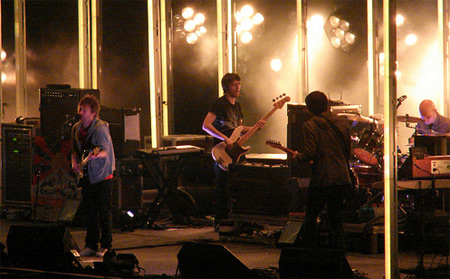
Radiohead / Liars
Nissan Pavilion; Bristow, VA

[05-11-2008]

If you’ve lived long enough in the DC-area, you will hear that the Nissan Pavilion sucks. When Radiohead first announced they would be playing this “shed” to the southwest of DC, a collective groan must've shot out of fansites and hipster message boards across the region. I have never been to the venue, but I have frequented my share of shitty places. So I bought tickets, wondering what could be that much worse here than any other corporate-owned amphitheater.

Radiohead and DC, historically, have never jibed. A show at Bull Run had to be canceled due to flooding, and lightning struck during a performance at RFK Stadium. I didn’t live in the area during those weather-related disasters, but little did I know I would be involved in yet another Radiohead vs. the weather fiasco this time around. As I left the house, a deluge of rain bucketed down and water cascaded in rivers down streets. Thankfully, I didn't possess a lawn seat. Besides, I probably wouldn’t have sat in the lawn anyhow. I’m one of those “Oh yeah, I saw Radiohead in a club 11 years ago for $15” kind of guys. Nothing but good seats for me to see this band.

I live 78 miles from the venue, so it took over three hours to get there. The rain continued to hurtle down. When we finally arrived at the venue (via a two-lane road!), it suddenly dawned on me that my seat was a mile away. Long story short, I was drenched by the time I sat down -- and so was everyone else around me. It was less than 50-degrees out, and Liars hadn’t even gone on yet. This would be a long time to wait in wet, cold clothes. Of course, I could continue with stories about the two-hour wait to get out of the parking lot, the flooded road closures, the drunk girl peeing in a cup next me in the car, but this is a concert review. Let’s focus on the music.

Liars came on promptly at 7:30. The amphitheater was still more or less empty, but that didn’t stop the band from turning in a cracker performance. As Angus Andrews prowled about the stage, his massive hands waving about in a blur, the freezing crowd danced along, desperate to find a beat to warm up to. Highlights of the 45-minute set included “Plaster Casts of Everything” and “Houseclouds.” The guys on my left had never heard Liars nor did it seem many of the others who responded with polite applause. It is easy to forget just how mainstream Radiohead is, even though they manage to defy expectations with each and every release.

Someone mentioned that the rain would only add atmosphere to Radiohead’s music. And it's true: their songs are rife with dread, and some of their crystalline piano ballads are perfect for a rainy day. I was intent on ignoring the cold in order to focus on the music. Amid a sea of beams that hung from the roof of the stage like metal stalactites (or the world’s biggest example of vertical blinds), Radiohead finally took the stage to thunderous applause. Behind us, a sea of umbrellas swallowed up the lawn, but the crowd under shelter was relatively sparse. Thom Yorke, dressed in a red T-shirt with grey hoodie welcomed “the wet people.” Then the band launched into the dirge “All I Need,” from its outstanding new album In Rainbows. Filled with looming synths and a menacing bassline, the song’s lingering intensity set the tone for the evening.

It takes something quite powerful to lift a shivering, soaked writer out of his saturated jeans, and as Yorke’s warm, fragile voice filled the amphitheater, I was taken away to someplace else. The band then transitioned into “Jigsaw Falling Into Place,” and as the tempo picked up, the crowd began to dance.

What amazed me the most about the 25-song set was just how clear everything sounded. Yorke’s vocals swooped and soared on ballads such as “Lucky” and “Nude.” But it wasn’t only a grim affair. On faster songs such as “15 Step” and “Myxomatosis,” Yorke danced about the stage, his scruffy head twisting in all directions. Jonny Greenwood met Yorke’s intensity as he freaked out with guitar, synth and who knows what else.

Midway through the set, Yorke said, “We know how tough today has been for you guys and, uh, sorry.” The band then launched into OK Computer’s “Paranoid Android.” Whether or not he aimed the “Rain down, rain down/ Come on rain down on me” refrain to the freezing groundlings below, the moment was chilling. As bright blue and red lights reflected off the metal beams and Ed O’Brien’s unnerving backing vocals poured from the stage, the moment turned magical. Even a hardened concert-goer like me felt the magic.

There were just so many high points: the spastic paranoia of “Idioteque,” the sweeping beauty of “Reckoner.” By the time the band finished its first set with the rollicking “Bodysnatchers,” I didn’t think that it could get any better. But it did.

They returned for the first of two encores, with the haunting “Like Spinning Plates,” soon to be followed by “Optimistic” and “Karma Police.” Next came “Go Slowly,” a track off the bonus LP of In Rainbows. This fragile ballad felt perfect against the rain, its melody a menacing, twisted music box, Yorke’s vocals both ethereal and enveloping. After closing the first encore with “Planet Telex,” Yorke returned to inform us that many concert-goers never made it to the show. Some of the local roads had been washed away by the rain. The band offered up “Fake Plastic Trees” in dedication to the unfortunates who never arrived.

The concert ended with a raucous “The National Anthem” and the gentle “House of Cards.” Yorke and company eased us out of the show cooing “I don’t want to be your friend/ I just want to be your lover” before singing about collapsing infrastructure and lascivious key parties. Then the band retreated to drier quarters, leaving us in silence to face the rhythm and fury of the rain.

Photo: [kubacheck]

Colin Meloy
9:30 Club; Washington, DC

[04-13-2008]

IN DEFENSE OF COLIN MELOY

Why do so many people think Colin Meloy is such an asshole? If one were to scour the web for opinions on the front man of the seminal Portland collective The Decemberists, any praise found would be tempered with an equal amount of vitriol. This sentiment is never leveled at the musicality of Meloy and his cohorts, though, but squarely targets the man himself. After a period when nary an article would reach print without dubbing the band “literate” and “erudite,” the inevitable backlash appeared, attacking the very virtues that made The Decemberists famous in the first place.

Then what’s the problem? Has Meloy’s brand of nerd-rock for those who do the Sunday Times crossword and revel at online IQ tests grown tiresome? When my friend describes Meloy as “the smarmy villain from every ’80s teen flick,” did he mean the sweater-wearing Ivy League-bound James Spader from Pretty in Pink or the dickhead thug William Zabka from The Karate Kid fame? Has Meloy just grown too priggish, pretentious, and preposterous for the indie kids?

Let me be the first to admit that I am a Decemberists fan. While I waited outside the 9:30 Club for my friend to arrive, I saw a bunch of people trying to unload spare tickets. Bad sign. Usually the corner of V and 9th is jumping before a show, but beyond the unlucky scalpers, only I stood out in the cold that night. Something felt wrong. That didn’t matter too much. I was excited.

Inside, a modest crowd waited for Meloy to take the stage. I have been attending shows here for a few years, and rarely has it been so empty. What’s the story, Colin? Do you need Chris Funk to bring the noise? Is it really Nate Query the groundlings are clamoring to see?

Meloy finally appeared and informed us that DC is his “home away from home.” As he led the crowd through a series of vocal warm-ups, I asked myself if this was the self-possessed man I have heard so much about. He was positively disarming, embracing the crowd before launching into “Shiny” from the 5 Songs EP.

One thing can be said about Decemberists fans: they are wordy folk. As Meloy moved between stripped-down renditions of “The Perfect Crime” and “O Valencia!,” the crowd sang along, not missing a single word. When Meloy strapped on a 12-string guitar to play the Picaresque trio of “The Engine Driver,” “We Both Go Down Together,” and “The Bagman’s Gambit,” his wistful melodies presented themselves, unburdened by The Decemberists’ lush arrangements. It is undeniable that Colin Meloy has stage presence, and these three songs were the highlight of the evening. He has a strong, distinctive voice, and he employed it well during the show. The guitar sounded crisp and clear, and it is easy to lose oneself in his tales of chimbly-sweeps and scalawags.

The Decemberists announced but then promptly canceled a tour late last year, where they planned to play long songs one night and short ones the next. Meloy apologized to the crowd for the cancellation and said, “I’m doing my best to make up for it on my own. Self-flagellation in the form of a rock tour.” Though he didn’t draw the numbers that the truncated sold-out tour had garnered, the appreciative crowd applauded his self-effacement and apology.

This is not Meloy’s first solo tour, and it has become a tradition for him to hawk a tour-only EP of covers. Past collections saw Meloy covering the songs of Morrisey and Shirley Collins. Before launching into a version of “Cupid,” Meloy took a moment to pimp out his newest Sam Cooke collection. Joined onstage by opener Laura Gibson (dressed in something last seen in some Polygamist sect), Meloy turned in a serviceable version of one of Cooke’s classic songs.

Meloy closed out the first set with a humorous new track about Valerie Plame that dissolved into a sing-along of “Hey Jude” and “A Cautionary Song” from his band’s first LP, Castaways and Cutouts. As Meloy sang the lead guitar part over his own strumming, it struck me just how dependent his tunes are on the full orchestration of the band. While a lot of them are just good folk songs without the rest of the band, others are sketchy and slight. Could it be the accordion and violin that really make The Decemberists standout?

The encore did little to exorcise my doubts, but it did confuse me more. After refusing to deviate from the setlist (he blamed something in his past life that prevents him from doing so), Meloy performed a heartbreaking version of “Red Right Ankle.” Somewhere in the quiet plucking, I realized that beneath the armor of big words and tongue-in-cheek witticisms, Meloy is a sentimentalist. Most of his songs are about lost love or longing. Could all the ostentatious instrumentation and high-minded tales be the self-defense mechanism of a romantic? I think so.

But Colin Meloy the Showman soon reappeared for the evening’s finale of “The Mariner’s Revenge Song,” perhaps one of the best known tracks by Decemberists fans. The crowd thrilled to this shanty of madness and revenge. Meloy paused to let the audience sing the female parts and even to lecture us on the differences between “screaming” and “quailing.” Though rollicking and fun, this final song seemed safe, a big way to end the evening.

Why does everyone hate on Meloy so much? Plenty of rock stars have been pricks and have rarely gotten such a bad rap. Let’s admit it, most of us music nerds were never the most popular kids at school. We weren’t in the lowest stratum, but we weren’t the All-American football stars either. Just maybe Meloy was one of those guys below us, a shy kid with glasses who liked to read. Could it be envy? Does his success cause us to look at our lives with more scrutiny?

Xiu Xiu
Music Hall of Williamsburg; Brooklyn, NY

[03-23-2008]

Xiu Xiu aren’t for everyone, and that’s nothing new. But their latest album, Women As Lovers (Kill Rock Stars), is probably their strangest and most off-putting yet. It’s packed with dark, perverse childhood sexual imagery and even alludes to incest. A few months ago, it racked up a sheaf of ambiguous reviews that basically amounted to, “Well, it’s Xiu Xiu, so it must be good, but for my part, I’m weirded out.” People knew it was good, but some measure of disgust was preventing them from truly engaging with it on its own terms. But that utter awkwardness makes it one of this year’s most challenging albums to date, and every listen has revealed something new, fascinating, and, yes, frightening, too. It isn’t easy, and it isn’t always fun, either, but this is music as art, kids. We ain’t just talkin’ about the shit you can dance to.

The seriousness is just as palpable live. Xiu Xiu always form a little box of bizarre instruments, pushed into the center of the stage, that sort of isolates them throughout the show. There’s a skeletal-looking electric, upright bass in one corner, an enormous cymbal, and some gongs attached to the drum kit, a xylophone, and a flute that make brief appearances. Keyboards of all kinds are everywhere.

The entire show revolves around Jamie Stewart, who says almost nothing to the audience between songs. Someone yells, “Good job, guys!” and gets not even the slightest hint of a response. But when he sings, it’s like he has the only vocal role in the kind of opera in which everyone dies at the end. He’s a consummate performer and a loose cannon at the same time. Stewart can be violent, childlike, or completely spastic.

Equally changeable and unpredictable is Xiu Xiu’s sound. At one moment, they’re all discord, feedback, and the scream of castrated brass instruments; the next, they lay down the hottest rock riff you’ve ever heard. You only feel the transition if they want you to. They’re the horror movie and its soundtrack.

And just because the band members didn’t speak to the crowd, it doesn’t mean they failed to connect. Looking down from the balcony, I saw people jumping up and down, hugging each other, even crying. I don’t think Vampire Weekend is ever going to move anyone to tears, but I seem to remember the vast majority of their reviews being overwhelmingly positive. Coincidence?

[Photo: Sean Ruch]

Handsome Furs
Satellite Ballroom; Charlottesville, VA

[04-03-2008]

With anticipation for the upcoming Wolf Parade disc reaching fever pitch, Dan Boeckner’s other outfit, Handsome Furs, is still touring in the wake of last year’s debut, Plague Park. Alongside wife Alexei Perry, Boeckner uses the Furs as a conduit for the more electronic-oriented side of his musical self. Teaming his live guitar parts with Perry’s frenetic fingers while grappling with various knobs and keys, the couple creates music that's equal parts trippy electronica and conventional indie rock.

With this as a backdrop, the band greeted a small but devoted crowd with a fantastic set, especially for an act armed with such a limited pool of material. Boeckner’s throaty vocals were perhaps the most impressive part of the show, as they were more dynamic and forceful than on the Furs’ recorded output. In listening to Plague Park after the show, I’m still frustrated over its lack of the crisp and soaring quality that Boeckner and Perry are able to convey in their live performance. Throughout the set, the pair was loaded with a contagious brand of energy, and it all came spilling out through Boeckner’s voice and Perry’s impassioned electronic work. Stationed at the front of the stage, a gold necklace encircling her neck like the end of a lasso, Perry bounced about brandishing a smile that was impossible to ignore, as the duo bubbled with exuberance and communicated every bit of nuanced emotional expression.

Refreshingly, the band was very gracious and pleased with the occasion, churning out tune after tune and fitting each with both a compelling tension between live music and recorded sources and a visible harmony between husband and wife (made possible in part because of the egalitarian arrangement of the couple). All the expected standouts from Plague Park made appearances, with the euphoric momentum of “Dead + Rural” emerging as the centerpiece of an altogether engaging performance. Boeckner’s mumbling of “la, la, la, la” near the close of “Sing! Captain” was a second highlight, as the set slowed for a contemplative moment, allowing the lazy vocals to wash against an enraptured crowd.

In the dead space between songs, Boeckner’s banter was a source of additional entertainment. He laughed over his recent April Fool’s revelation that the new Wolf Parade record is titled Kissing the Beehive. He confessed that he’d been falsely telling audiences that one song (I’ve forgotten which) was about his time at Columbia, and then admitted that he’d never attended the Manhattan Ivy and didn’t vacation at Cape Cod, taking obvious swipes at the drab though upcoming Vampire Weekend. In another instance, Boeckner acknowledged some fans that had come from Indiana to catch the show, jokingly regarding the move as “retarded.”

The night didn’t settle the endless Spencer-Dan debate that captivates so many music nerds and bleeds across the internet. It did, however, provide a forum for Dan to showcase talents that seem so often overshadowed by the wondrously prolific Spencer Krug. It created excitement for what’s to come from a guy with such varied and gifted musical abilities, someone who’s been able to retain that youthful enthusiasm usually lost to the business of music-making.

Hot Chip / Mathew Dear And His Big Hands
Barrowland; Glasgow, Scotland

[02-26-2008]

It is impossible to miss the Glasgow Barrowland Ballroom if you find the right street. The venue is marked by a giant sign with the word Barrowland spelled out in hot orange neon letters surrounded by bright white neon stars. Inside, the scuffed wood floors and faded orange and yellow stars scattered across the domed ceiling of the ballroom further enforce the sentiment that you have been transported to an oversized rollerskating rink from the 1970s. Matthew Dear And His Big Hands were already playing for the half-full venue when I arrived. There weren’t enough people in the ballroom to balance out the acoustics, or maybe they didn’t get a sound check. In any case, everything sounded swampy and indefinite, and in the old ballroom, it was surreally beautiful.

After Matthew Dear And His Big Hands left the stage, the sound crew quickly installed an impressive array of music making devices including guitars, a bass, four futuristic-looking synth stations, bongos, and part of a drum set. It was evident that the night’s show wasn’t going to be a pre-recorded karaoke fest. My prediction proved accurate as soon as the lights dimmed and the London quintet ripped into the first song of the set. Alexis Taylor furiously pounded away on the toms and snare, while Owen Clarke manned the bongos and Al Doyle provided that ever-appreciated cowbell groove. Soon, the whirlwind of live percussion was replaced by Felix Martin’s drum machining, as Taylor’s cry of “I’m ready to try this!” established that the gritty techno onslaught that had emerged was “Shake a Fist.”

Throughout the set, Hot Chip molded their material into a fluid club set that was often a drastic departure from the songs’ recorded versions. Gone were the candy-coated nuances that make Hot Chip a rewarding headphone listen. They rejected their dorky pop-wizard persona and attempted to reinvent themselves as red-blooded, club-shaking rock stars. And I kinda liked it. The wall of heavily distorted guitars and hungry synths became harsh and overbearing at times, but these guys know how to craft a sweet riff and channel the immediate rapture that comes with it. Despite all the distortion and stadium-ready riffs, Hot Chip couldn’t deny their roots as nerdy nice guys, which created an endearing tension with the rock star posturing. Bearded frontman Joe Goddard, looking like a jolly camp counselor, danced awkwardly behind his synth-station, while co-frontman Alexis Taylor, wearing his big glasses and singing earnestly, stood stationary behind his synth.

Although they forsook the often-gorgeous details and buoyant warmth of their recordings, Hot Chip’s live set displayed a knack for subtlety and engagement with the audience. About halfway through the show, the audience’s energy levels dwindled as the simplified renditions of their songs started to become monotonous (especially the drums, which didn’t change much). But then, quietly at first, and without any other shift from the last song, came the opening riff of “Over and Over.” And that was all it took for the audience to rush forward and dance wildly. By the time the rest of the band caught up and settled into the verse, everyone was jumping up and down jubilantly. “Ready For the Floor” was the show’s highlight, as they briefly dipped into the intro and then extended the bridge for a full two minutes of tension-building before ecstatically launching into the chorus at just the right moment. Clearly, their experience as DJs has paid off.

As they closed the set with the lyrics of New Order’s “Temptation” sung over “No Fit State,” I reflected on what seemed to be Hot Chip’s mission: to break down barriers in the pursuit of pop. Were they DJs, rock stars, nerdy bedroom divas? Throwbacks to the synth-pop of the 1980s or to 1990s techno? I don’t know. Maybe all of those things to some extent. I can’t call the gig a revelation, but it certainly was fun.

The Pogues
Rams Head Live!; Baltimore, MD

[03-12-2008]

Okay, full disclosure time. My history with The Pogues has been a rocky one at best. I came onboard as a fan to their unique blend of Irish folk with punk sensibilities in 1994, a few years after the band fired singer and main songwriter Shane MacGowan. By this time, MacGowan had become a legend, not only for his legacy of timeless songs, but also for the amounts of alcohol and drugs he had consumed.

As a newcomer whom the music instantly captivated, I wanted to see this stuff live. The closest thing at the time was Shane MacGowan’s solo band, The Popes. But fortune had a way to keep me and Shane MacGowan separate. The first time he came to Philadelphia, I was too young to get into the show. Then I finally did see him in 1999, but MacGowan did not appear onstage until close to 1 AM, and I was too drunk to remember anything. The next chance was in 2000, but MacGowan never showed, inciting a near riot in the audience. I can still hear the shouts of “Fuck you, Shane MacGowan,” coming from some drunkard as the cops dragged him out. My last chance was the most pathetic. I was too sick to go, and my friend had to drive me to Times Square so I could sell my tickets to a scalper at a pathetic return.

I knew The Pogues had reunited in December 2001 to play some shows in England, but I had chalked them up there with Nirvana and Nick Drake as musicians I would never see in concert. In 2006, I was working in Vermont when I heard the Pogues would be coming to Boston, with MacGowan in tow! I searched for tickets, but it was too late. Sold out. I posted my sob story (very similar to the one above) on The Pogues message board. I had almost given up when a member of the band read my post and sent me two free tickets. Holy shit! The Pogues care about their fans.

Flash forward two years, and The Pogues are yet again playing a brief St. Paddy’s month tour of the eastern United States. Going into the show, the excitement of seeing The Pogues still vibrated within me, but something felt different. What had seemed like a once-in-a-lifetime opportunity in 2006 had become less unique. What’s March without a Pogues concert?

Whenever a band long defunct regroups for a ‘reunion’ tour, it is only natural to be dubious. Whether it be for filthy lucre or... filthy lucre, many old bands reform, dust off some old tunes, thrill a bunch of old farts, and make a mint in the process. But is there anything wrong with that?

MacGowan took the stage wearing a bowler hat, black suit jacket, and dark sunglasses. Never a good-looking man, you could hear the sold-out crowd go all atwitter at just how bad he looked now. Bloated, stooped, and barely coherent, MacGowan seemed like he had washed up on the Inner Harbor after a night out on the piss. The band burst immediately into “Streams of Whiskey,” and as soon as Spider Stacy’s tin whistle filled the club with its familiar melody, any hesitations about a half-assed set vanished. Next came “If I Should Fall From Grace With God,” and each song thereafter sounded like a greatest hit. MacGowan’s voice, always garbled and slurred, remained strong for most of the night. Although he now shook from too much drink, he didn’t make sense when he tried to speak in between songs and did little more than shuffle about the stage -- it was as if the music itself transported MacGowan’s voice back in time to an era when he was young enough to come through a rough night somewhat intact.

There is something about human nature that enjoys a good disaster. Rather than feel pity for MacGowan’s condition, the crowd egged him on. They handed him shot after shot (in addition to the always filled glass he kept on stage), and as he got more soused, they cheered. Why contribute to his condition? Why watch this sad human who can write such heartfelt music degenerate with such bemusement? It seemed unfair and sad. Yet I watched as well.

Other highlights from the set included a sing-along version of “Dirty Old Town” and “The Broad Majestic Shannon.” The most heartfelt moment of the evening was when guitarist Philip Chevron took the mic to sing “Thousands Are Sailing.” Recently besting throat cancer, Chevron appeared frail. He had just rejoined the band the week before. He had beat cancer, and the emotion he put into this tale of Irish immigrants sailing to the New York resonated throughout the club.

The band closed out the first set with a rocking version of “The Sick Bed of Cüchulaínn.” While MacGowan seemed worse for wear, Stacy and accordionist Jamie Fearnley jumped around the stage in manic displays of showmanship.

The Pogues closed the show with two encores that included favorites “Sally Maclennane” and “Rainy Night in Soho.” As the show wound down to the finale, “Fiesta,” I wondered if this would be my last time seeing The Pogues. I searched the faces of the eight men as they put behind years of discord to play these great songs live again. They were all smiling. As the song ended, the band waved to the crowd and headed for the wings, leaving MacGowan alone. He fumbled around, all lights on him as he tried to replace the mic on its stand. A roadie approached to help out, but at the last moment, MacGowan did it himself. He then picked up his glass and bottle and shuffled off as well.

Photo: [Dan Schultz]

News

  • Recent
  • Popular