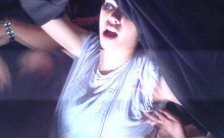

Deradoorian
Cake Shop; New York, NY

[05-05-2009]

This time next month, Angel Deradoorian will be a rock star. Dirty Projectors, for which she plays bass and sings, is set to release an album June 9 that will surely be their breakthrough. And I know you've heard about their collaborations with the likes of David Byrne and Björk. Well, okay -- maybe Bitte Orca (Domino) won't make Dirty Projectors the next Radiohead. But the band is certainly bound for Animal Collective- and Arcade Fire-like levels of popularity.

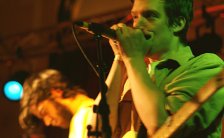
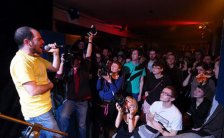
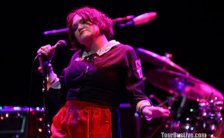
All of which is to say that in a few months we may not still be able to see Deradoorian play to a hundred or so friends and admirers packed into a basement venue like Cake Shop. The event was a record release party for her new EP, Mind Raft (Lovepump United), which had just hit stores that morning. Her Dirty Projectors comrades clustered supportively at the front of the stage; the band's singer/songwriter Dave Longstreth grinned through the entire set like a proud papa. And, as it turned out, Deradoorian's backing band was a real family affair: Her brother Aram played the drums, and two dear friends covered bass and keyboards.

Deradoorian's music isn't terribly similar to Dirty Projectors. In place of the bright, symphonic sounds that band makes, we get moody, layered, sometimes claustrophobic tracks that fall somewhere between PJ Harvey's Nick Cave period and Antony and The Johnsons. Although Deradoorian seemed nervous as all get-out between songs, she never let it interfere with her performance. Her powerful singing, on tracks such as "You Carry the Deed" and "High Road," was especially impressive in an underground cave with notoriously poor acoustics. The set topped out at about 25 minutes, as Deradoorian made it through the entire EP and (I think) one additional song before running out of material. But that was sufficient time to impress this reviewer, to say nothing of the rest of her wrapt audience.

The Skaters Solo / P.A.R.A.
Modern Tower; Newcastle Upon Tyne, UK

[05-09-2009]

Mordern Tower is a cosmic, low-key music and poetry venue set into a super old Roman-era stone wall, now out the back of Newcastle's Chinatown. Naturally, these three expert noise adventurers -- P.A.R.A. (a.k.a. Labanna Bly) joined James Ferraro and Spencer Clark, who were playing solo sets rather than as their usual duo Skaters -- made the place even more magical.

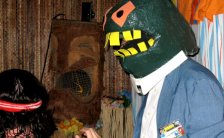
Once the sun had gone down, P.A.R.A. changed from double denim to ephemeral gowns (and wig) and filled a table with a buttload of weird New Age jewels, bowls, incense, a MacBook covered in fur, keyboards, and one amazing Gridiron or motorcross helmet pimped out in feathers and fur -- all with pickups attached. Tapping the bowls, for instance, caused a strange resonance, exemplifying pristinely the paradox between the organic and the digital that seems at the heart of her dreamed-out noise wanderings.

Tonight, Spencer Clark, one half of Skaters, played as Monopoly Child Star Searchers. He sat at the desk, now sans those mystic adornments and replaced with a couple of small keyboards (one only had like five keys left!) and some pedals. There seemed to be a slight malfunction with the PA during his set, causing an intermittent and weirdly percussive clicking sound that only built on the skattered rhythms that eventually wiggled out of his blunted tropical noise. It was real head-nodding material, and paired with massively psychedelic imagery via layers of squiggle, it was absorbing and salubrious.

Skaters' James Ferraro ended the show as Genie Embryo Garden, sitting around his keyboards and pedals. It's always struck me as amazing that his myriad CD-Rs and tapes of liquidy textures are all created from scratch, aside from the odd Beavis and Butthead sample. For noise so obsessed with pop culture, it's incredible how otherworldly and just plain bizarre these ’scapes are, channeling tack culture and and cereal boxes as much as intergalactic feelings and astral vibrations. His set focused on a twinkly and busy ambience that had a constant scruffy grandeur, shimmering in a similar way to those dozens of recordings. His particular sort of mystery was still all over his improvised set; even seeing him embark on those insular processes right in front of us, it was, fittingly enough, still unclear how exactly it was happening.

Mogwai / The Twilight Sad
Phoenix Concert Theatre; Toronto, ON

[05-04-2009]

I enjoy attending shows filled with guys that don’t get out much. Collapsing under the weight of late modern ennui, student loans, vitamin D deficiency and unfulfilled dreams, they are teeming with repressed emotions waiting to be unlocked by one killer riff.

Unfortunately for The Twilight Sad, too few of these concert-goers ventured out early enough to catch the opening set of Monday night’s Scottish double bill at the Phoenix. The Twilight Sad’s pop-masking cloak of noise -- built on 16th notes of overdriven and reverb-drenched guitar and bass -- seemed light and thin as the night’s festivities began. The fullness of the sound was lost in the ether of the vapid spaces of a slowly filling theater. In a smaller venue, I could see their sound engulfing you then deviously sliding a cool shiv deep between your shoulder blades when you least expect it -- but not at the Phoenix.

Their set was good; just not mind-blowing. Vocalist James Graham was evocative,and presented his lyrics with earnest sincerity that from a weaker front man would have appeared melodramatic and contrived. His Scottish brood with forever-rolling Rs acted as a perfect accent to lyrical imagery of the loss, yearning, and confusion of adolescence.

For all the guitar bursts, rumbling bass lines, and vernacular vocals, the one element of The Twilight Sad’s set that stood out was the drumming of Mark Devine. His tom-heavy stoicism and subtle flourishes added progression and movement to songs that otherwise may be lost in repetition.

The band played 45 minutes of material from their two EPs and debut LP Fourteen Autumns and Fifteen Winters. Standouts included “Cold Days From the Birdhouse,” which opened with two minutes of shimmering chime samples under Graham crooning “..and so you make it your own/ But this is where your arm can’t go”, “That Summer at Home I Became the Invisible Boy,” and closing track “I am Taking the Train Home,” which ended with a wave of noise passing by a statuesque Graham staring blankly into the crowd: transfixed, silent, and motionless.

The Twilight Sad’s set may not have been consciousness-shaking, but it showcased the draw of earnest and simple pop songs floating in a cloud of dissonance.

Having canceled the Toronto stop of their fall 2008 tour due to complications with drummer Martin Bulloch’s pacemaker, Mogwai reentered the city to an eagerly anticipatory crowd whose enthusiasm was as large as its numbers. Opening to the creeping piano melody of “I’m Jim Morrison, I’m Dead,” Mogwai laid the terrain for which the rest of the night’s set would be built. In traditional Mogwai fashion, the crowd was consistently lulled into dreamy dazes through tension-building light melodies, only to be trashingly awoken into a universe of chaotic and consecrated crescendos.

Mogwai played a diverse set of new and old songs spanning their decade-long career. Reaching into the back catalog for “Mogwai Fears Satan” and “Cody,” breaking the instrumental mold with vocoder-sung “Killing All the Flies” and “Auto Rock” and stopping out rocker “Glasgow Mega Snake,” the now full venue went ecstatic. Cathartic outbursts flooded the club as the unleashed emotions of no-longer-youthful crowd poured into the air in tandem with the fluttering tense melody and orgasms of sonic discharge streaming from the stage.

The transparency of Mogwai’s song structures became apparent as the show progressed. You could anticipate with near pin-point accuracy when the guitars would kick in and inevitably fade away. However, their slowly building explosions weren’t meant to be experienced as surprise, but rather as a jubilant release of the tension that their melodic sections create.

With guitar techs rushing to the stage as the band finished their set, an encore seemed inevitable; yet, the capacity crowd didn’t rest on their laurels. They demanded more, and as requested the Glaswegians post-rockers returned to the stage to a triumphant roar, bursting into the epic “My Father My King” to end the night.

As the venue cleared and the newly rejuvenated crowd returned to their mid-rise apartments in anticipation of tomorrow’s commute, I was reminded of the non-ironic love people hold for a good guitar rock song.

Mogwai setlist:

I’m Jim Morrison, I’m Dead

Killing All the Flies

Travel is Dangerous

Scotland's Shame

Small Children in the Background

Cody

You Don't Know Jesus

Auto Rock

Thank You Space Expert

Hunted by a Freak

Mogwai Fears Satan

Glasgow Mega Snake
--Encore--

My Father My King

Photo: [3rd Party!]

Richard Buckner
Tractor Tavern; Seattle, WA

[04-25-2009]

With the digital reissues of Bloomed, The Hill, and Impasse to promote, Richard Buckner has taken his one-man act back onto the dusty roads he has continually sung about since his 1994 debut. Fans would be quick to tongue lash those who neglect the chance opportunity to catch Buckner in a live setting, as each of his songs take on a sinister shadow -- more mangled and heartbroken than the recorded origins from which they were birthed.

This particular Saturday evening, before the sun had even set on the sleepy Seattle hamlet of Ballard, Buckner quietly took the stage amidst dim lights, a hushed crowd, and a smattering of guitars — at least five that I could count from my vantage point. Without a word, Buckner launched into his non-stop set, mimicking the momentous roll captured in his one-track catch-all The Hill. Not once did Buckner take a breather as he weaved throughout his lengthy canon. The crowd was too frozen and fixed to dare make a sound, as Buckner ran through such favorites as “Tom Merritt,” “A Chance Carousel,” and “Lucky Buzz,” each sprinkled in between re-imagined instrumentals from The Hill. The only real peep heard from the crowd was the smattering of applause before Buckner launched into “Slept” and the amazement at his effortless shifting of guitars with the aid of pedal loops, slides, and an EBow.

What's particularly astonishing is how evidently alt-country Buckner’s crowd continues to be, despite his live performances bordering more on experimentation than any of his recorded output would allude. While the melodies and birthmarks that pox Buckner’s signature songs remain intact, he doesn’t shy away from drawing out something new from those old chestnuts. Often, Buckner was caught bending and stretching notes until their near breaking point, transforming complacent guitar plucking into Thurston Moore bastards. Whether he was in a sour mood that he poured into his setlist or just a man looking to liven up the old, it didn’t matter. Richard Buckner proved once more that despite being pigeonholed as an alt-country/alt-folk leftover, he’s more on par with the current crop of psych-folkies with his twisted interpretations of an old but fruitful style.

Yann Tiersen / Asobi Seksu
Logan Square Auditorium; Chicago, IL

[04-21-2009]

You almost have to feel bad for someone like Yann Tiersen. Much like samba hero Seu Jorge, Tiersen is a brilliant musician and composer of the avant-garde grain, with international popularity. Like Jorge, Americans will remember him best for doing a soundtrack to a quirky but popular movie, in this case the pretentiously titled Le Fabuleux Destin d’Amélie Poulain, also known as Amélie. Of course, having such a legacy leaves a double-edged sword when it comes to touring in such a country as this one: A lot of fans will come to your shows, but many of them will be expecting you to play songs from that soundtrack. You can choose to fully placate them (and make yourself a sideshow), partially placate them, or just ignore their demands and play new material. Tiersen went with the last option (to the best of my knowledge), and yet pulled off an amazing show nonetheless.

Openers Asobi Seksu don't carry the weight that Tiersen does: the most they can claim is having their music on single episodes The L Word and Skins. Yet they still had a lot to push. Continuing their tour in support of February’s release and shift in direction Hush, the dream-poppers were playing a larger venue from what they were used to, having only been at the Empty Bottle nearby a month before. Coming out, they started with safe shoegazing fare, such as “Thursday” and “Strawberries” off the acclaimed Citrus, before venturing on to the new album with single “Me & Mary” and opening track “Layers.” If they were known for being shoegazers, they certain weren’t acting like them tonight: throughout their set, guitarist James Hanna and bassist Billy Pavone deployed some amusing antics with their amps. Frontwoman Yuki Chikudate, whose willowy voice should make J-Pop idols like Utada bow their heads in dishonor, attempted to headbang towards the end of “Transparence” and was otherwise rocking out the entire time. They were enjoying themselves, and it translated well in their performance. Switching between albums never seemed strained, with layers intact from Citrus tracks and stronger synths apparent in tracks from Hush -- and all the while, Yuki’s vocals were stronger and clearer. They may have dropped interest in future shoegazing, but they still got something to show for it.

What brought many people in was Yann Tiersen, but what shocked many people was Yann Tiersen as well. Many people expected him to jump on with a piano, accordion, maybe a violin, and play some Amélie tracks. They got the violin, but they also managed to receive an avant-garde combination of shoegaze-layering and post-rock insanity. Some were obviously stunned, but overall the crowd reacted well and enthusiastically. The set mostly contained songs from more recent albums that have taken this rock direction, in particular Le Ratrouvailles. As per the band itself, they may as well had been playing to a sold-out crowd at Paris Olympia, as most players were enthusiastically bouncing around during the performance, switching roles from time to time. In particular, the lead female, with a striking resemblance to previous collaborator Elizabeth Fraser of the Cocteau Twins, split her time between vocals, reciting French poetry, playing the flute, sitting on the stage, or messing with the Moog. But then there was Tiersen himself, who at mid-point played one song as a violin solo, in a manner so intense hairs started snapping off the bow (this particular piece brought the crowd to a frenzy). He continued using it, with horsehairs flailing about, through the rest of the set, without batting a lash. If nothing else, Yann Tiersen’s performance was a reminder to people that he is not just that guy who wrote the Amélie soundtrack.

The Dead Weather
Bowery Ballroom; New York, NY

[04-14-2009]

As much as Jack White would like to be just another band member, he will always remain the center point, even when he plants himself behind a drum kit. The Dead Weather, his latest side project, played its first public show (the group performed a private show in March for White’s new Third Man Records building) to a sold-out audience at New York’s Bowery Ballroom and, of course, the draw was most certainly to see what Mr. White would be pulling out of his hat this time. What the fans saw was the sleaziest guitar-driven rock to come out of White’s arsenal yet.

Comprised of White on drums, singer Alison Mosshart (The Kills), guitarist/organist Dean Fertita (Queens Of The Stone Age), and bassist “Little” Jack Lawrence (The Raconteurs), The Dead Weather performed a 12-song set of songs from its forthcoming record, Horehound, due in June.

Leather-clad, the band tore through a set of finely-tuned bluesy garage rock. Singer Mosshart fiercely stalked the stage, chain-smoking and with her face obscured by a bird’s nest of hair; she commandeered the audiences’ attention away from White as de-facto group leader -- that is, if you were brave enough to stare directly at her. Opening with “60 Feet Tall,” The Dead Weather instantly made believers of those in attendance. Perhaps they heard an opening heckle from an audience member of “Impress us, bitches,” but it's more likely that the band’s performance was a testament to its skill and musicianship. Oh, and guess what? Jack can totally drum!

The band’s songs were all similar in style, with room-shaking bass and White’s signature guitar sound (only not played by White) that sounded like it came from rock’s yesteryear. White did, however, emerge from behind the drum-kit to play guitar and duet with Mossart on “Will There Be Enough Water?” The two shared a mic and sang face to face in close enough proximity that each breath mussed the other’s hair; the mic pairing made for a provocative moment that left many wondering, myself included, if you can fake that sort of tension. The lyrics “Just because you caught me/ Don’t mean it’s a sin,” didn’t help matters much either.

By the time the group played its final song, a pulverizing cover of Bob Dylan’s “New Pony” from Street Legal, The Dead Weather had proved they are a unit entirely of themselves. Even if Jack whatshisname is in the group, too.

Cloud Cult / Margot and the Nuclear So & So's / Ice Palace
Black Cat; Washington, DC

[04-11-2009]

If I could go back to this show and change one thing, I'd simply cut out the second band. Ice Palace, the first group, were clearly friends of Cloud Cult: they play melodic pop with plenty of instruments from the orchestra pit. Gleeful and engaging, Ice Palace managed their elements in such a way that highlighted their songs’ complexities without losing sight of needed structure. Perhaps all that needs to be said is that I bought their album after their set. The youngest portion of the room shrieked as soon as band #2 Margot and the Nuclear So & So’s took the stage. After a couple songs, I couldn’t understand why. The only energy they exerted was a result of the sheer number of instruments onstage, which left songs sounding messy and confusing. This band plays self-serious pop, and it didn’t work. My friend, in his infinite wisdom, decided the only thing worthwhile about MNS&S was their “really hot keyboard player.”

Cloud Cult’s set started off rocky, with some sound malfunctions stemming from a cable that didn’t connect to anything, but as frontman Craig Minowa said, “I can feel this is going to be a great show. They’re always great when the beginning doesn’t work.” The band soon proved him right. After a couple songs, they were swooped into a fantastic energy flow, reinforiced by the audience’s rapturous attention and enthusiastic singing. They played songs exclusively from their last three albums and focused particularly on their latest, 2008’s Feel Good Ghosts. They've clearly tightened up their live chops since the last time I saw them (TMT Interview) -- strings took an appropriately prominent role and each member was attuned to every other, the perfect formula for doing justice to their profoundly humanizing music.

As we walked outside, my friend said he was pretty sure he saw God during the final minutes. I wouldn’t go that far, but I would agree that Cloud Cult’s set was nothing short of breathtaking. I rode the Metro home feeling proud to be alive, which is probably the best thing a show can leave you with.

The Drones
Pianos; New York, NY

[04-02-2009]

Even if you write off their more somber numbers as too subtle, The Drones have great songs to draw on when planning a set. The high point of this evening, though, is not a spirited rendition of "The Minotaur" or a crowd-pleasing trip through "Shark Fin Blues"; it's "Six Ways To Sunday," a mainstay of The Drones' live oeuvre that dates back to their first independent release in 2001. It's a little more rough around the edges than the stuff they're releasing in 2009, but that's all the better in a live setting. The backbone of the song is guitar noise over a simple bass groove, which the band periodically cuts out, leaving two beats of plain old silent space that will actually make you stop breathing for a second if you're not expecting it.

The silence is so stunning primarily because, by this point in the set, you're so used to the roar of The Drones' guitars. Gareth Liddiard and Dan Luscomb have brought noise guitar to a certain level of perfection. Liddiard, in particular, employs both skilled fingerpicking and skilled footwork -- this is the first time I've ever seen someone successfully manipulate the tiny knobs on their footpedals with their feet while playing. It's a sight to see.

And while the guitars alone are reason enough to justify such statements as "The Drones should be much bigger than they are," my guess is that this feeling is stoked as much by the fact that their records come off as deadly serious in an age that's increasingly attuned to real talk about death, war, poverty, and the like. But if you're gonna remain human while you play a song like "She Had an Abortion She Made Me Pay For," you're gonna have to adopt a "fuck it" attitude. When they introduce "Oh My" as a song about the world's imminent demise, it doesn't come off dreary or pseudo-prophetic -- just a fact.

Towards the end of the night, there is some worry that the band will need to cut the set short in order keep their van from getting towed (thanks NYC parking statutes). They say "fuck it" (of course) and plow ahead into "I Don't Ever Want to Change." Luscomb's amp starts acting up. He could easily panic, slump off stage, or pout, but he instead has fun with it, playfully getting in the way by throwing his guitars onto the drum kit.

Since fiddling while Rome is burning implies a social irresponsibility that I don't think is warranted in this case, call this fiddling about Rome burning.

Photo: [Arny Raedts]

Paul McCartney, Ringo Star @ David Lynch's Benefit Concert
Radio City Music Hall; New York, NY

[04-04-2009]

As strange as David Lynch’s mind is, at least it’s at peace. Holding a benefit concert for his foundation that promotes Transcendental Mediation to at-risk youths, Lynch brought together a lineup of “what the fuck,” a touchstone of his for over 30 years, for his Change Begins Within Benefit Concert. With an audience of people who, from the looks of things, have never uttered an ‘Om’ in their lives, it’s safe to say that the majority was attending to see the all-star lineup of Paul McCartney, Ringo Starr, Eddie Vedder, Donovan, Moby, Jim James, Bettye Lavette, um, Sheryl Crow, and others.

The first set showcased artists who subscribe to the Transcendental Meditation method, while the second half brought out the artists who famously traveled to India four decades ago to practice with the Maharishi Mahesh Yogi and made this meditation a household name.

With a majority of acts joining each other onstage, the night began with Moby and legendary soul singer Bettye Lavette. Taking the place of Vera Hall, who Moby sampled on “Natural Blues” from 1999's Play, Lavette showcased her range, while Moby proved he could still rock a shaved head while, for some reason, wearing a Black Flag shirt. Fashion blunders aside, the two stuck mostly to songs in line with the spiritual theme of the evening, while also playing “We Are All Made of Stars” and “Close As I’ll Get To Heaven.” The two songs were highlights of the evening's first half.

Surprisingly, a solo Eddie Vedder did little to showcase any of his talent, besides using vocal delays to make an annoying chant that should have been, well, meditated on before stepping onstage. Adding to Vedder’s night of mistakes was a duet with Ben Harper on the Queen/David Bowie track “Under Pressure.” The only thing that performance proved was that no one should ever try to cover that song. Ever.

With sporadic speeches from David Lynch and his muse Laura Dern about the wonders of meditation, the night dragged until the originators took the stage for the second half.

Donovan, both a casualty of the ’60s if I’ve ever seen one and the head of the organization’s musical wing, was joined by My Morning Jacket’s Jim James on the songs “Hurdy Gurdy Man” and “Wear Your Love Like Heaven.” A little dated, Donovan’s songs are definitely of the time when he traveled to India, yet they're still a pleasure to ears and a helpful reminder of the wonders of drugs. Donovan was followed by jazz flutist Paul Horn, who introduced a piece of music he’d written for the evening called “Meditation,” which was dedicated to George Harrison and John Lennon. It was a reminder of the two legends waiting in the wings.

Coming out first was Ringo, and for all that’s said about his lack of talent, he really knows how to get the good feelings in the audience going. He played “It Don’t Come Easy,” “Yellow Submarine,” and surprisingly “Boys,” a track that had been part of The Beatles’ repertoire before he was a even a member and was once played by former drummer Pete Best [ouch].

Finally, the night concluded with Sir Paul himself. McCartney’s set was not only the longest of the evening, but also the most energetic of the night, consisting of songs from The Beatles, Wings, and his solo catalogue. Performing classics like “Got To Get You Into My Life” and “Let It Be,” McCartney knows that people want to hear the songs they and their children and their children’s children have grown up on. Surprisingly, he played “Here Today” from his 1983 album Tug of War, a song he described as a one-way conversation with his ex-bandmate John Lennon after his murder in 1980. If anyone denies the emotional impact of anything McCartney has done post-Beatles, tell that to the woman weeping next to me throughout the whole song, face in hands.

There was no guarantee that Ringo and Paul would be performing together but with a triumphant introduction of Ringo as Billy Shears, Starr’s personality on Sgt. Pepper, the two shared a microphone on “With A Little Help From My Friends,” marking the first time the two have shared a stage since 2002 when they performed at “A Concert For George.” The moment was perhaps more legendary for the people in the audience, and from the looks of things between McCartney and Starr, it was just two friends reconnecting in front of 6,000 people.

Ceremoniously, the evening concluded with the night’s lineup onstage performing “Cosmically Conscious,” a song McCartney wrote on the 1968 trip to Rishikesh, India that appeared as a hidden track on his 1993 album Off the Ground. They all then launched into “I Saw Her Standing There,” with Ringo on drum and McCartney still hitting those high notes -- it was the most inspirational moment of the night.

If this is what Transcendental Meditation gets you, I’m pretty confident that more than a few people might check it out.

Brittain Ashford / Letters & Numbers
Northeast Kingdom; Brooklyn, NY

[03-26-2009]

Brooklyn's Northeast Kingdom is a restaurant that manages to look like a proper bistro while surrounded by decaying industrial architecture. On the ground level, people babble loudly through their arugula. Downstairs, in stark contrast, hides a quiet-looking room reminiscent of every musty suburban basement of the day, save for the smell, which is actually quite pleasant. Faux-wood trim creeps halfway up the wall, meeting the wallpaper that is adorned with mirrors and lamps everywhere. It is an intimate venue, its only notable flaw being that the soft light lining the room fails to illuminate the standing performer.

It's raining outside, and everything is far away from Manhattan, but the room is still as full as it can comfortably handle. Normally consisting of a wider lineup, the two that make up the group Numbers & Letters tonight -- Joe Lops and Katie Hasty -- are seated in the performance area, near lamps, holding guitars. They play a sort of folk tune that sounds familiar, but probably isn't. Lops plays his guitar carefully, including some great slide guitar in his last song, while Hasty's curiously small voice yelps in the lower register and bolsters more control and delicacy in the upper. The overall sensation is inviting, reminiscent of Alela Diane. Katie is clearly the dominant focus of the group, and perhaps she should be. They play five songs, give out free CDs, and are friendly throughout the evening.

Brittain Ashford occasionally plays with a band, but she too performs tonight as a duo. Caitlin Steitzer begins the set with a dedicated tone of melodica and later contributes tambourine, xylophone, and sweetly sparse vocal harmonies, as Brittain alternates between auto-harp and a dulcimer lain flat on a high platform. She sings in a beautiful, trembling voice that sounds closely mic'ed, with a passion that is as visible as it is audible. Limning the perimeter of the crowd, she jumps up and tears about, face constricted with emotion, as if overwhelmed by the gravity of her own words. The crowd is silently focused throughout the set, save for warm laughter when Brittain jokes about buying a Subaru between songs.

News

  • Recent
  • Popular