

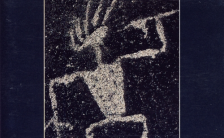
1972: Don Bradshaw-Leather - Distance Between Us
Don Bradshaw-Leather was born 1948 in Essex, the son of middle-class Jewish parents. According to Bradshaw-Leather’s sister, “[Don] grew with and into music more by genetic destiny than environmental consequence.” During the long, dark hangover of the Summer of Love, the classically-trained prodigy approached CBS Records with demo recordings. Though it seems incredible in hindsight, a forward-thinking A&R executive must have seen a potential revenue stream in Bradshaw-Leather’s avant-classical noise. The artist was given a generous advance to record an album. DBL’s sister fills in the blanks: “[Don] used the funds to create a large studio in Sussex with many instruments including an actual church organ. Here, on his own, without the use of any electronic sequencing, he recorded Distance Between Us using simply multitrack tape, layering each part of the composition.”
Upon hearing the product of their financial investment — four side-long tracks of blurry organ drones, frantic piano tinkling, and ritualistic percussion — CBS understandably got cold feet. The album was self-released on Bradshaw-Leather’s own Distance imprint, a vanity label established for the sole purpose of releasing the album. Pressed in a tiny edition, mint condition copies of the album can fetch up to $500 at auction today. The double gatefold sleeve is full of mysteries, from the misspelling of “Bradshaw” (“Bradsham”), to the coal-blackened visage of the bohemian madman on the cover (DBL himself?), to the rear photo collage depicting the same madman accosting a nude woman. The music isn’t any less mysterious; shapeless symphonies of smeared-out Mellotron, tribal drums, and wordless vocals. After swimming in the album for a little while, the absence of structure begins to seem utterly logical, and the album washes over like a peyote-induced Gothic fever dream. Don Bradshaw-Leather passed away in the 90s, making a reissue of this classic oddity seem increasingly less likely, though David Tibet of Current 93 has intermittently announced plans for a reissue on his own Coptic Cat label over the years. It’s an inspired match. Here’s hoping it comes to pass.
1990: Incapacitants - Feedback of N.M.S.
Everybody loves Merzbow. Or what the name of the noise genre would be if it was a sitcom, right?
I, for one, do love the ‘bow – most of what he does anyway – but noise in Japan, and certainly noise in general, doesn’t end with Masami Akita’s oeuvre. For me, nothing beats the soundscapes of pure aural meltdown that Incapacitants conjure.
The project started in Osaka as something Toshiji Mikawa would do during times Jojo Hiroshige didn’t need him for his main outlet, Hijokaidan. Fumio Kosakai, for his part, was a member of scuzz-erotic performance art troupe C.C.C.C. but craved something harsher. The banker and government employee met eventually met and decided to make the best and most disgusting sounds humans could endure with two contact mics. Thus starts the legend of one of the most inspired outlets to concoct pure, uncomfortable sound.
Their earliest recordings were released on tapes by Toshiji’s own label Pariah (later compiled and released as a CD box set on Finnish power electronics haven Freak Animal) and, as a duo, they did some work before Feedback of N.M.S., but this album is significant for important reasons. For starters, it was released on Jojo’s Alchemy Records as part of the Good Alchemy Vol. 1 series, whose first part was Merzbow’s classic Rainbow Electronics, no fucking less. Feedback is no slouch, and should be regarded as fervently as Masami’s masterpiece; it’s a continuous force of low-end rumble with high pitched clashes of frequencies with what sounds like ongoing screaming for much of the three tracks presented. “Curse Of Ceauşescu” takes almost 30 minutes to unroll, yet you barely feel it lasting that long through your aural nervous breakdown. The live track really shines, demonstrating that noise can breath and become a living entity when captured at the spark of the moment in front of a crowd.
Incapacitants themselves call their style hard noise. I call it “relentless, collapsing art” – it should be on permanent display at all museums, schools, and mental hospitals the world over.
Here’s a rare but brief open-air live performance from 1991.
2009: Outdoor Miners - "Twelve Hundred Dollars"
“Everybody, pay your rent.”
Maybe it translates more subjectively in text, but the preceding statement takes on a sort of reassurance as the hook of “Twelve Hundred Dollars.” Vaguely ennui’d in delivery, it’s a small part of a song that should be a year-round anthem for the functioning slacker archetype, as if to say: yeah, stocking shelves is a bore, but it pays the rent – besides, we’ll all get to hang out soon, right?
The production on the first Outdoor Miners single is a bit murky, but not with the intent of obscuring hooks or hiding instrumental woes. Take its chorus, for example: shining bright as silver through clouds of static clatter, Alec Meen’s guitar lines ascend with all the joy of a beaming summer’s high noon glow. Dig further, and more subtle touches become apparent, like the way Peter Sagar’s bass hops between a few notes before the chorus hits. Further still, the underlying themes of the song apply even in the dead of winter — those twelve hundred dollars still have to be collected, and we still need to keep on living. As much as the band may have shrugged it off, “Twelve Hundred Dollars” has “anthem” written all over it.
This Edmonton-based trio’s sound is vaguely referential in the sense that astute listeners of 90s indie rock will likely be able to spot several assorted nuggets of influence. The trio’s songs often come together in such a fully formed, seemingly effortless manner that comparisons like Pavement via Dinosaur Jr. and Galaxie 500 via the noisier moments of Yo La Tengo could be made, but this isn’t to suggest they only made competent pastiche. While a song like “Turn You Into Glue” has a beautiful Ira Kaplan guitar lead at its crest before trailing off into the noise-wrangled pop ether, it’s not like the song was built around one idea — call it homage, call it influence, but don’t call it a mere revival of ideas past: in the right hands, as demonstrated here, all sorts of influences can sound simultaneously vital and comforting.
That this band’s two singles weren’t at the top of college radio station charts across Canada is one fitting bummer of a joke — songs like “Twelve Hundred Dollars” and “Disgust” embody what I want in my indie rock more than any number of Metric and Japandroids singles could ever hope to approach. Still, due to all sorts of common reasons around these parts — e.g., life, needing to get out of Alberta — Outdoor Miners weren’t a long-lived group. Leaving only a pair of fantastic three-song 7”s and a compilation appearance for posterity, I don’t want to talk about this band in tones of hushed reverence or overblown acclaim (though admittedly, in comparison to all of the disposable garage rock Alberta tends to produce, hearing a band that probably listened to Sebadoh more than Thee Oh Sees felt like a blessing) — they were just a band of dudes that played some shows, released a bunch of great songs, and have since moved on to other things. And yet, still: “Everybody, pay your rent.”
1997: Space Needle - Never Lonely Alone
Space Needle got my attention because their album, The Moray Eels Eat the Space Needle, was a tribute to a 1968 Holy Modal Rounders album. “Never Lonely Alone” is really the only song of its type on the album – which veers off into more experimental avant-prog tendencies – staying comfortable with its slow driving U2-ish 90s pop rock vibe. The other song included on the single, “Love Left Us Strangers,” does operate in a more traditional pop mode too, but the songs feel completely different from each other. I’ve always liked how the band released them as the single for an album that is otherwise filled with lots of spacy experimental noise-jazz.
I tend to listen to 1995’s Voyager and The Moray Eels… for their experimental proggy tendencies, but there are always these two pop songs waiting for me. After digging around a bit online, I found an interview with band leader/drummer Jud Ehrbar that changed everything about these two songs. In the interview, Ehrbar explained that “Love Left Us Strangers” had slicker production and was purposely set up for radio airplay while “Never Lonely Alone” was just recorded by him on a four-track. Intriguingly, he also said the latter was written “from the point of view of somebody who is a loner that goes to movies by himself.”
Now I absolutely love this knowledge. Of course I understand that sometimes it’s really awful for a song’s point-of-view to be unveiled. A songwriter’s secret can complicate and devalue the meaning of a song on a personal/subjective level. There are clearly times when the secret can enhance it too though. The closing harmony-soaked lyrics become more than just hypnotic pop that reminds me of a film montage or The Police or U2’s “With or Without You.”
Knowing this point of view gives me an image that I wouldn’t have had otherwise. The closing lyrics are: “You never go out alone/ but I’m never lonely alone/ oh I’m never lonely alone.”Instead of thinking about a failed relationship or how the song is trippy and the lyrics seem less important than the harmonies, that movie-loner fact makes me imagine this person sitting in the movie theater alone. It makes me think of a Paul Baribeau song with the lyrics “I am learning how to be alone without being lonely.” It makes me think of all the friends I have who are afraid to be alone and who equate alone with lonely. This difference between solitude and loneliness is profound. The point of view on its own turns an otherwise enjoyable song into a completely different beast. For that, I am grateful.
1977: Goblin - Suspiria
One day I’d like to attend a screening of Dario Argento’s Suspiria without the music to see if it has nearly as strong an impact on me. Admittedly, it would be a tough job to argue against the brilliance of Argento’s film, which could be described as a complete warping of the giallo-slasher genre into a surreal and psychedelic pseudo-fairy tale. But all of this gets turned to a disorienting 11 by Goblin’s equally influential film score.
The highlight of the entire soundtrack remains the opening theme, “Suspiria,” which manages to pit ghoulish vocals, pounding drums, and spacey synthesizers against fragile and innocent sounding celesta and bells. The entire six minutes, while overwhelmingly creepy, builds into a powerful piece of music in its own right. It manages to transcend the film score trappings that could have left this ignored as the Italian version of The Exorcist’s “Tubular Bells.” Meanwhile the funky and synth-crazy “Markos” sits in the center of the album and is an easy reference point for the recent vintage synth revival.
Fascinatingly, Argento had Goblin compose the score for Suspiria before he began filming. This music existed for the film, even before its creation. Its mark shows throughout every shot and the pairing of the two create a powerful symbiosis that still remains a rarity in film.
1888: Gabriel Fauré - "Agnus Dei"
Fauré wasn’t a composer I’d heard much about before I discovered “Agnus Dei” (lamb of God) from his Requiem. I was impressed by the stately procession of mini-movements within the piece; the unexpected transitions in mood and the way the melody twists through major and minor crescendos, making the choir of singers appear to be on a perilous journey with a major key resolution just out of reach. The more famous movements are the “In Paridisum” and “Pie Jesu,” but the “Agnus Dei” is the one that harnesses the ‘menace’ of choirs to interesting effect. In a religious setting, choirs have a reputation for conveying two things: the piousness of the blessed and the collective terror of the damned; one way or another, the choir can be an overbearing influence. Fauré left out some of the harsher elements of the requiem mass – including the “Dies Irae” (wrath of God) sequence. In fact his requiem was often said to resemble more of a ‘lullaby’ than a funeral mass. His lifelong professional relationship with the church is one of the most interesting contexts of the piece. He was an organist who played only for money and was fired for turning up to work hungover in party clothes. It seems that his faith – if he had any - was uncommitted and secular. He even dedicated a “Salve Regina” to his mistress.
The more I found out about Fauré, the more I realized what a pervasive influence he was on the last musical movements before modernism. His French songs were hits that became legends – so much so that Proust weaves a song inspired by Fauré throughout his character’s whole life.
Even when I didn’t know anything about the piece’s context, the “Agnus Dei” surprised me for being romantic church music that was actually likeable. It seemed that the power of voices was harnessed in a spirit of discovery as much as a religious narrative sense. Fauré’s admission that he wrote the traditionally serious requiem initially for ‘fun’ was considered eccentric, but it’s not so odd if we recall that he had been through this rehearsal many times at work and wanted to try a new approach. Fauré apparently found the organ tedious, and was known for his unusual approach to harmony. Listening to the Requiem is not like listening to a serious farewell; it’s more like a colorful painting of harmonic/melodic possibilities. I’m no classical music scholar, but from the first time I heard “Agnus Dei” I sensed that I was hearing something traditional in a way I’d never heard it before.
1967-1974: Steve Lacy Solo and Ensemble Works
There’s a famous adage in jazz that soprano saxophonist Steve Lacy (1934-2004) thought Thelonious Monk’s music was a “door to the other side,” which meant, for him, a transition from Dixieland into free improvisation by the mid-60s, later introducing a range of his own idiosyncratic compositional devices. In a sense, Lacy developed a sound world that his compatriots and followers have had to work through in much the same way as he did with Monk. And while Lacy was incredibly prolific during his lifetime, the last several years have uncovered a tremendous amount of previously unheard (or at least very rare) recordings. This year has already seen four important discs’ worth of Lacy’s music – in addition to the two on UK label Emanem I’ll discuss here, there’s a pair of great reissues on Portuguese imprint Clean Feed (Esthilaços, 1972) and Unseen Worlds (agitprop chanteuse Maria Monti’s Il Bestario, 1975).
Emanem started in 1972 with an LP of Lacy’s first solo concert at the Théâtre du Chene Noir in Avignon, released as Steve Lacy Solo with (in my opinion) one of the most beautiful-looking album covers in jazz. It was reissued once before as Weal and Woe with quintet material added (The Woe); the all-solo Avignon and After vol. 1 consists of selections from the Avignon concert and five tracks from a 1974 Berlin performance. Not all solo saxophone concerts capture the feel of improvising without a net in the way that these Lacy documents do, presenting the saxophonist in full chirp-and-quack mode, in a struggle to create both compelling tunes and an involving, reflective environment from sonic kernels and referential phrases. What’s immediately surprising from the first moments of “The Breath” is that, unaccompanied, Lacy’s kinetic force is just as remarkable as his tone and improvisational choices. He takes a singsong, folksy melody and tears into it with resources that alternately express the “quaintness” of the theme and go well beyond it (a la Albert Ayler). The chance piece “Stations” finds Lacy improvising along with a radio tuned to some sort of lieder; rather than background, an intense dialogic push-pull is the result. The pretty “Josephine” begins with a spare clamber, moving to almost inaudible puckering noises and then an easy swing. While less cleanly recorded than the Avignon concert, the Berlin pieces are just as rugged (if not moreso by dint of their “rawness”), including particularly choice readings of “The Owl” and “Torments.” There’s a lot of solo Lacy available, but this set is indispensable.
The Sun is a compilation based around Lacy’s anti-Vietnam War music, created with his longtime partner, Swiss-born vocalist Irene Aebi. Some of the material here was issued before – four parts of The Woe and a short set of improvisations on The Way, with electronic artist Richard Teitelbaum – though much of it is rare and archival. “Chinese Food” is the most storied of the pieces here; it was recorded in New York in 1967 and finds Aebi reading (and hurling) anti-war texts from Lao Tzu against Teitelbaum’s unhinged, patchwork live electronics and Lacy’s screams and sideways twirls. Buckminster Fuller’s texts are used as the springboard for the title piece, recorded in 1968 with Aebi, Lacy, trumpeter Enrico Rava, vibraphonist Karl Berger, drummer Aldo Romano, and bassist Kent Carter (all favored collaborators from 1965 onward). Tart horn lines move in a gooey orbit with free percussive chatter and Berger’s ringing, monolithic chords. Aebi is often described as an acquired taste – indeed, her approach to reciting/singing is a cross between lieder and a distinctly European declamation – but in the context of weighty, far-out protest music, she is a perfectly-applied element. The four parts of The Woe are a prime example of Lacy’s working group of the mid-70s with Aebi, Carter, saxophonist Steve Potts, and drummer Oliver Johnson. On “The Wage,” live cassette recordings of artillery fire are thrown into the mix as well as the ensemble’s vocal shouts, driving an already potent hardcore free-jazz unit into a timely stratosphere. While protest art can be hard to unravel from its immediate context, the state of perpetual strife we live in serves as a regular enough background to this music that its political impact isn’t lessened.
1969: Damon - "Song Of A Gypsy"
When they teamed up to record Song Of A Gypsy, Damon Del Conte and collaborator Charlie Carey were already veterans of the 1960s Los Angeles music scene. For a few years, Damon had pursued a career as a Byrds-y folk-rock singer-songwriter, releasing a few 45s as Damon Lane on his own Del Con imprint. Damon met up with Charlie and a few additional session players in 1969, and together they created one of the most legendary, collectible psych-rock LPs of all time. It was issued in a tiny private press edition of 100 copies, and these days a mint copy goes for up to $3,500 on the rare psych market. It’s not just the scarcity of the Damon album that makes it desirable; it’s a genuinely stunning artifact of the late 60s underground. Combining Carey’s deeply lysergic fuzz guitar with Damon’s acoustic strumming and delicious baritone croon, the album is marked by a near-flawless execution. Damon plays up his self-styled “gypsy” persona throughout, delivering a suite of Eastern-inflected pop songs that often evoke a melancholy doom. The album was recorded and mixed in such a pristine manner that it’s hard to believe it was a self-financed vanity project. Every song is good, but the opening title track really sets the tone, with its melodramatic, fatalistic rhymes: “Today I feel like crying/ Today I feel like dying/ Today I feel like nothing is real/ And the world can’t see I’m trying.”
The album has been reissued bootleg-style by several fly-by-night European labels over the years, and once on CD by Damon himself, who recorded a follow-up in 1998 entitled Gypsy Eyes, about which the less said the better. Damon and Charlie still team up for live performances now and then, but it’s hard to imagine them reigniting the fire of those 1969 sessions with their gorgeous jangly fuzz-bombs of dark Orientalist folk and apocalyptic heralding.
1970: Akira Miyazawa Quartet - "Asama"
In a recent Q&A on reddit, someone asked Steve Albini why he didn’t like jazz music.
“Because it sucks and I’m tired of hearing about it. Believe me I’ve tried. I just hate the parts I hate about it more than I like the little things there are to like. The batting average is just so low I can’t bear the dead time between highlights being filled with all that noodling. It’s vain music.”
Damn!
Of course, I can sorta understand the impulse behind his reaction to a lot of jazz. If above all else you value compositional structure in music, so much “noodling” could be a big turnoff. Eitherway, Albini’s assessment immediately made me question what I valued most in jazz music, so I turned to some beloved tracks to help me figure it out. Going through my ‘favorites’ playlist on YouTube, I was pleasantly reminded of “Asama,” an early-70s flash of manic but syrupy free-jazz from the Akira Miyazawa Quartet.
I guess the track has a lot of “in-between noodling” — it begins with a beautiful, almost Dave Brubeck-esque theme, backed by a droning string sound, before plummeting into a more chaotic and free approach to soloing. What is there to value here? For one — as if I even have to say it — the energy! How the drums would seem batshit crazy taken alone, but in the context of the song glue everything together through intense, driving interplay. It creates a continuously evolving suspense that is never truly satisfied. But that’s the joy of it all, to me — those “in-between” moments that make you question how it’s all held together.
“Asama” doesn’t feel overtly academic or showoff-ish. It’s more about capturing lightning in a bottle, finding excitement in the ephemera of performance and interaction. You could argue the same spirit resides in most visceral, thrilling music.
1974: Charlemagne Palestine - Four Manifestations on Six Elements
For aficionados of the modern minimalist movement, a small handful of works have achieved mythic status, often warping their creators into mysterious, nearly other worldly gurus of drone. The Black Record by La Monte Young comes to mind, as does Terry Riley’s A Rainbow in Curved Air, Steve Reich’s Music for 18 Musicians, and possibly Philip Glass’s Einstein on the Beach. Each of these works, with the exception of La Monte Young, who is an enigma of his own, has maintained a powerful intrigue for new listeners. I think it’s because they are often juxtaposed with epic scenery or movie trailers – if you ever see a cool picture, chances are some Philip Glass song in the background could probably make it more awesome that it was before. But part of the problem that comes with having three or four titans of minimalism is that lesser known artists like Phil Niblock or Charlemagne Palestine are often removed from the conversation, if only because they aren’t as immediately accessible as some of their contemporaries.
It’s unfortunate that this is the case, because albums like Palestine’s Four Manifestations on Six Elements deserve to be both remembered and praised as incredible contributions to minimalism and experimental music. Palestine’s music is about as minimal as it gets; often employing nothing but a single piano, it somehow manages to sound full and massive through all his extended pieces. Patterns, which sometimes consist of only two or three notes, are repeatedly endlessly and slowly expanded into larger tone clusters as Palestine coaxes all manner of unusual timbres out of his instrument. Unlike Philip Glass or Steve Reich, who usually compose in relatively simple patterns but perform with large ensembles to flesh out their music, Palestine’s early work is all a one-man show which allows him an incredible amount of nuance and control. There is much beauty to be found in these simple keystrokes, something producers who just can’t resist adding an extra drum fill here or there should keep in mind more often.