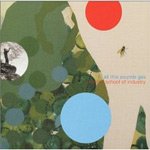
2001: Preston School of Industry - All This Sounds Gas

When Pavement released the just-okay Terror Twilight in 1999, it was easy to believe the jig was up. The band had progressed from chaotic fuzz machines to slick popsters, and while the Twilight songs were catchy, they had little life in them. Pavement announced their breakup a year later, and it seemed things had run their course. Pavement frontman Stephen Malkmus put out a self-titled debut in 2000, and the ensuing media blitz obscured Preston School of Industry, another post-Pavement band who released their first record six month later. The group’s leader was Scott Kannberg, a.k.a. Spiral Stairs, Pavement guitarist and songwriter.

The record in question, All This Sounds Gas, sounds great in 2009, and it must have sounded even better in 2001 to Pavement fans who feared all was lost. It’s certainly not a Pavement record -- there are few rough edges, and Kannberg’s voice is a little more melodic than Malkmus’ yelp -- but it has the let’s-make-a-record charm that made his old band’s best work so appealing. First track “Whalebones,” for example, is a slow burner with a distorted guitar line that sounds like it was taken from a Built To Spill B-side. It’s a perfectly solid lead-in to a perfectly solid record, and a good indication of things to come.

“Falling Away,” super catchy and breezy as hell, follows. Although it would have been better placed midway through the disc, it’s a pleasure to hear the track so early in the proceedings, as if Kannberg is confident he won’t need to pick up the pace later on. “A Treasure @ Silver Bank (This Dynasty’s For Real),” with its bright steel guitar and wood block percussion, is yet another winner; it reveals the reason you’ve been bobbing your head for the last eight minutes: Kannberg has a knack for emphasizing every downbeat, whether on electric guitar or what sounds like a J. Geils-circa-“Centerfold” organ. He knows what it takes to keep a song moving.

Some of the credit for All This Sounds Gas also goes to bassist Jon Erickson and drummer Andrew Borger, both of whom played with the Moore Brothers, another act anchored by melody and strong arrangements. Their clockwork rhythm section provides the perfect backdrop to Kannberg’s rugged guitars and relaxed vocals. In fact, the record works best when using the bass and drum’s momentum, so deeper cuts like “Doping For Gold” get where they’re going through pure gravity. The best songs on the record, such as the poppy “Solitaire,” pair that momentum with truly catchy instrumentation, and the results are wondrous. When this combination doesn’t happen, such as on the dark “History of the River,” the results are simply uninteresting.

Pavement’s mystique has only grown since the band broke up, and each Malkmus release is greeted -- sometimes deservedly, sometimes not -- with a flurry of Pitchfork news updates. Kannberg, however, deserves perhaps more attention for providing both his old band and Preston School of Industry with what every good act needs: focus.

1. Whalebones
2. Falling Away
3. A Treasure @ Silver Bank (This Dynasty’s For Real)
4. Encyclopedic Knowledge Of
5. History of the River
6. Doping For Gold
7. Solitaire
8. Blu Son
9. Monkey Heart and the Horses’ Leg
10. The Idea of Fires
11. Take a Stand/All This Sounds Gas

2008: Gore - Hart Gore + Mean Man's Dream

Though you may not know it, Holland has long been a land of heavy music and reverberating amps. Take a listen to the Waterpipes and Dykes series on the Distortion Records label and you’ll unveil a late-”60s sonic scene as fully earth-shaking as anything out of Haight-Ashbury or the Motor City. Though the Dutch psych bands borrowed their sounds heavily from the standard U.K./U.S. blues rock models, they had a propensity for taking those familiar modes and blasting them through the ceiling, something that I'm sure the the legality, rampant availability, high quality, and cheap price of weed, magic mushrooms, and other entheogens never hurt.

It shouldn’t be a surprise, then, that the Danish trio Gore were one of the heaviest bands of the 1980s. Aggressive and uncompromising for their time, they were kind of the missing link between late, Process of Weeding Out, instrumental-era Black Flag and the metallic tech-sludge of Saint Vitus or Melvins. “Baptized” in 1985 and playing their first show opening for The Swans on Feb 26, 1986, at Effenaar — a club that sat right next to Amsterdam’s largest and most famous club, The Paradiso — they played alongside, and sometimes shared members with, other heavy Dutch metal bands like Pandemonium and Disgust. This double-CD retrospective (once again lovingly packaged by Southern Lord) captures their two full-length albums, a few outtakes, and a couple live sets.

Hart Gore, their first album, polarized critics when it came out. Completely instrumental, Gore were taking a big chance, as instrumental math-metal and legions of Don Caballero fans were two things yet to exist. One of the strangest aspects of Gore's muteness on record was how politically vocal they were in their day-to-day lives. In fact, Hart Gore, though completely instrumental, contained a lyric sheet when it was released. More like political manifestos, the "lyrics" were rife with political angst, something which, on stage, they sublimated solely into their music. Gore's second album, Mean Man's Dream, was a more mature, precise outing, metered, mathy, and minimal. The contrast between the two records is best exemplified by their respective cover art: on Hart Gore, a picture of a fresh calf heart impaled on a sword; on Mean Man's Dream, a photo of a rusty knife sitting on an unclean table. In essence, while Hart Gore went straight to lacerating the jugular, Mean Man's Dream dared you to take the knife and do it to yourself.

Coming to America in the mid-’80s with the help of Henry Rollins, Gore were to embark on a West Coast U.S. tour, and had been tantalized with prospects of signing to SST. Unfortunately, Rollins had quit Black Flag just before picking them up from LAX, thereby putting a damper on their label deal. A pity, too, as they would’ve been an excellent fit; one could even see them snuggled cozily between Black Flag and Saccharine Trust on the Blasting Concept compilation. Instead, all they had to show for their only American experience was a short West Coast tour and a strong distaste for Greg Ginn's skunky American dope.

Eventually, their inability to compromise, both with convention and with each other, led to the group's demise. Today, Gore is not a household name, but perhaps if things had gone slightly differently, they would've been. Their influence is undoubtedly understated, and thanks go to Southern Lord for dusting off this chestnut and not letting the Gore legacy go down the memory hole.

Disc 1:

1. Extirpation
2. To the Gallows
3. After
4. Axe of Revenge
5. Out For Blood
6. USA is Calling
7. Death is Coming
8. Fear
9. In the Eye of the Sniper
10. He Knows You Are Alone
11. Extirpation (Live)
12. To the Gallows (Live)
13. After (Live)
14. Axe of Revenge (Live)
15. Out For Blood (Live)
16. USA is Calling (Live)
17. Death is Coming (Live)
18. Fear (Live)
19. In the Eye of the Sniper (Live)
20. He Knows You Are Alone (Live)
21. Death Has Come
22. The Hunt
23. Station to Station

Disc 2:

1. Mean Man’s Dream
2. Search
3. Love
4. Last Steps
5. Chainsaw
6. The Bank
7. Back Home
8. Loaded
9. Meat Machine
10. Out For Sex
11. Mean Man’s Dream (Live)
12. Search (Live)
13. Love (Live)
14. Last Steps (Live)
15. Chainsaw (Live)
16. The Bank (Live)
17. Back Home (Live)
18. Loaded (Live)
19. Meat Machine (Live)
20. Out For Sex (Live)

1968: Os Mutantes - Os Mutantes

An infectious energy and worldliness is immediately apparent upon hearing Os Mutantes’ most celebrated release, their self-titled debut. There’s an undeniable playfulness to every single one of its 11 tracks. Given that the band (comprised of singer Rita Lee and brothers Sérgio and Arnaldo Baptista) is commonly recognized for blending elements of bossa nova, psychedelic rock, and catchy pop, some would argue they could produce nothing other than uncorrupt, authentic bliss.

Yet there is undoubtedly a degree of awareness that goes into piecing together such distinct rhythms and musical concepts, so as not to be too safe or too over the top. Not to say that there aren’t moments of pure Mutantes flight. The dinner party at the end of “Panis Et Circenses” is one, brought to life with the sound of cups clinking together and spoken requests to "pass the salad." During such bouts of sonic experimentation, conflict is buried just beneath a surface shimmering with everything from angelic harmonies to church bells, flute solos to beating jungle drums.

After all, it was 1968. From every corner of the world, revolution boiled in the blood of the youth. This newborn ferocity -- a response to war, politics and general injustice -- quickly found its way into each region's music. In Brazil, it was no different. Circa 1967, the Tropicália movement stood as a force to fuel artistic innovation and experimentation throughout the country. Along with masters and leaders of the movement Caetano Veloso and Gilberto Gil, Os Mutantes were eventually threatened by Brazil’s right-wing military government, which feared their openness to Western influences.

As such, the playful and rejoicing characteristics of Os Mutantes are laced with experimental leaps, such as the heavily distorted guitar riffs layered over almost tribal-sounding vocals in “Bat Macumba.” These moments don’t bring anger or a sense of frustration to the music, yet being timely experiments in sound and creation, they certainly reveal the desire and struggle for change and evolution -- for anything other than what had been.

Meanwhile, the band’s experimental ventures are grounded by an occasional shout-out to their roots. Through the warm, earthy undertones of bossa nova, their distorting, mutating effects are given a softer and less intrusive presence. “A Minha Menina,” for example, is built on a foundation of homey, laid-back guitar strumming, while fuzzy guitar riffs float above, creating a dream-like, pensive state that inevitably alludes to the band’s ties with tropicalismo.

Os Mutantes translates quite simply into “The Mutants” -- embodiments of evolution and diversity. Change suddenly doesn’t sound so scary, drastic, or painful. Amidst everyday sounds -- the slurping from eating ice-cream, the clatter of dishes and silverware -- there is a place for change, for exploration. Distortion eventually finds its place under the wing of bossa nova lullabies and the band’s sensory approach to music. And it almost sounds natural.

1. Panis Et Circenses

2. A Minha Menina

3. O Relógio

4. Adeus Maria Fulô

5. Baby

6. Senhor F

7. Bat Macumba

8. Le Premier Bonheur du Jour

9. Trem Fantasma

10. Tempo No Tempo (Once Was A Time I Thought)

11. Ave Genghis Khan

1980: Bobb Trimble - Iron Curtain Innocence / Harvest of Dreams

It may not be any consolation to Bobb Trimble, but almost 30 years after micro-releasing two albums, Iron Curtain Innocence and Harvest of Dreams, interest in his brand of psychedelic, outsider soft-pop is at a high watermark. You can blame fervent crate-diggers and proactive fans of unearthed classics all you want, but most interesting albums get their eventual due, even if they were initially released -- and bought -- in paltry numbers.

There are any number of reasons why Iron Curtain Innocence and Harvest of Dreams didn't make a bigger splash at the beginning of the 1980s: Trimble's predilection for working with pre-teen backing musicians left a sour taste in the mouths of Worcester booking agents, not to mention the young members' parents, who twice pulled their kids from the band. Moreover, Trimble's music isn't traditionally accessible; his voice can grate on the ears. He shares the high-pitched, lonely territory of T. Rex's Marc Bolan, Rush's Geddy Lee, and Nick Gilder (the dude who sang "Hot Child in the City" back in the late ’70s). This "too weird" vocal factor may be unsettling for some, but really, enough popular voices have strayed left-of-center to invalidate most complaints. Maybe success for Trimble just wasn't in the stars.

Regardless, the past is the past. After a long period that saw big sums of cash changing hands for Trimble's original vinyl, Secretly Canadian has resurrected the man for a new generation of oddball music lovers. Iron Curtain Innocence starts our hazy trip with the perfect introductory one-two punch of "Glass Menagerie Fantasies" and "Night at the Asylum." The former is a woozy waltz that takes a page out of Gary "Dream Weaver" Wright's cosmic wuss-rock book, but with more ideas and less studio help. Things turn fun on "Night at the Asylum" as Trimble sings, clipped and playful, over a truly bizarre pop song that uses sound manipulation and sampled voices throughout. Elsewhere are healthy dashes of world-ending melancholy, mystically delivered confessions, a couple of late-album ballads, frenzied guitar lines, and manipulated recording techniques. All of this fails to pull Iron Curtain Innocence even near classic-album territory, but it's a record with plenty of curious moments nevertheless.

Harvest of Dreams fares better than its predecessor; after the strangeness of Iron Curtain Innocence, it's a straighter-shooting missive, though both albums are cut from the same kinky cloth. And despite the hike in creativity, Trimble's trademark fatalistic approach to songwriting remains. Highlighted is a mish-mash of styles: traveling county fair ("Premonitions – The Fantasy"), effects-laden triumphs ("Armour of the Shroud"), troubled rants ("Selling Me Short While Stringing Me Long), and backward ("Oh Baby") and awkward ("The World I Left Behind" is 2:11 of silence) pauses. "Armour of the Shroud" in particular is a superb, simple track, incorporating lots of echoed vocals and trebly guitar and keys before a coda that sounds recorded in a sewer. "Take Me Home Vienna" features The Kidds (Trimble's first pre-teen backing band) in a rather lovely ramble with sly guitar and a chorus sung by Bobb and the children to nice effect. It's a shame that Harvest of Dreams is the last proper album Trimble would make, because it sounds like he's nearing some semblance of cohesion while still maintaining that odd edge unique to him alone.

Interestingly enough, The Beatles are referenced by Trimble himself on the sleeve notes for both Iron Curtain Innocence and Harvest of Dreams. Aside from a quote by Harrison and a spiritual tribute to the memory of Lennon, he calls out the band directly with "Dear John, Paul, George and Ringo, If I'm a good boy and work real hard, may I please be the 5th Beatle someday? Your friend, Bobb." Musically, he mines some of the fab four's views on psychedelia -- particularly the Magical Mystery Tour era -- but his vision differs greatly from his idols. Dylan too can be heard as an inspiration (listen to the stolen strum and harmonica wheeze in "Premonitions Boy – The Reality"), but where Dylan is more concerned with displaying cleverness through obtuse wordplay and hidden meaning, Trimble seems hell-bent on exercising the demons swimming around his skull.

The closest big-name relative to Trimble's musical odyssey may be post-Syd Pink Floyd (or post-Syd Syd Barrett), but he shares equal affinities with fringe characters like Michael Yonkers and Jandek, if not in sound then in spirit. One minute I think Iron Curtain Innocence's "One Mile from Heaven" textbooks the sound of Luna ten years early, the next I think I'm insane for entertaining such a thought (though I'd be willing to bet that one-time Massachusetter Dean Wareham has some Trimble in his record collection). If the "straight" part of "Oh Baby" was cleaned up a bit, it could be slotted into a Jon Spencer album without too much difficulty (even if it is sung by a Kidd). But I should stop trying so hard; Trimble is too unique a cat to be realistically compared to anyone that came before him, and he doesn't particularly sound like anything that came after these two doomed-to-fail records.

Genius makes its own rules. Madness gets rules foisted upon it. After listening to Iron Curtain Innocence / Harvest of Dreams, it's hard to determine which camp Bobb Trimble resides, if either. Hearing his fantastic tales with inside knowledge of the crushing reality surrounding their release makes for an uneasy experience, but a compelling one all the same. Maybe I am too sensitive to these things. Maybe Trimble was simply a man who knew full well he wasn't made for the ’80s, but he put himself out there anyway. He has now become a precursor to thousands of cracked and tortured singer-songwriters, even if they've never realized it.

Iron Curtain Innocence:

1. Glass Menagerie Fantasies
2. Night at the Asylum
3. When the Raven Calls
4. Your Little Pawn
5. One Mile from Heaven (short version)
6. Killed by the Hands of an Unknown Rock Starr
7. Through My Eyes (Hopeless as Hell: D.O.A.)
8. One Mile from Heaven (long version)
9. Glass Menagerie Fantasies (demo version)
10. Night as the Asylum (demo version)
11. When the Raven Calls (demo version)

Harvest of Dreams:

1. Premonitions – The Fantasy
2. If Words Were All I Had
3. The World I Left Behind
4. Armour of the Shroud
5. Premonitions Boy – The Reality
6. Take Me Home Vienna
7. Selling Me Short While Stringing Me Long
8. Oh Baby
9. Paralyzed
10. Another Lonely Angel
11. Waves of Confusion in Puzzled Times (demo version)
12. Galilean Boy (demo version)
13. Life Is Like a Circle

1969: Gandalf - Gandalf

There are two general truths I hold to be self-evident. The first: there is no good reason why anyone should start a cover band, unless they need to support themselves by playing weddings, jazz brunches, or Bar Mitzvahs. Something that is already really good doesn’t need to be redone. The second: New Jersey is the armpit of America, and other than a few notable exceptions (The Boss, Palmolive, Princeton University), nothing all that smashing has ever come out of it. Surely there are those of you who will disagree. But even before Bruce Springsteen recognized Jersey pride as a kind of counterintuitive selling point, four teenagers from suburban Tenefly somehow managed to topple both of these "truths" in one fell swoop.

Gandalf, also known as The Rahgoos, were one of those garage line-ups that first saw the light of day in a high school detention hall, when guitarist Peter Sando met bassist Bob Muller in 1958. Though it's hard to imagine there being much of a market for a high school cover band over in the big city next door, New York has always been one of those places where just about anyone can find a home. For The Rahgoos, that home was the Night Owl, a cramped storefront-turned-mythic-rock-café where the likes of John Sebastian and his Lovin’ Spoonful and The Blues Magoos packed in to watch acoustic sets by James Taylor and The Flying Machine. The ragtag Night Owl family, including owner Joe Marra, toothless doorman “Jack the Rat,” Pepe the openly gay cook, and Annie, the four-letter-word-slinging head waitress, realized early on that The Rahgoos were much more than what they appeared to be on paper. Before long, the band linked up with Spoonful producers Charlie Koppelman and Don Rubin to sign a record deal with Capitol.

Though The Rahgoos dissolved before their record was ever released, what they left behind is probably one of the most visionary cover albums in the history of pop. Not “visionary” in the sense of re-invention (Easy Star All-Stars’ “Dub Side of the Moon” and “Radiodread” coming to mind), but “visionary” in the sense of re-investment, as though these songs -- songs we’ve already heard a hundred times before -- had suddenly become re-possessed by the ghosts of their true authors. The band changed their name to Gandalf and the Wizards in 1967; this moniker, discovered by drummer Davey Bauer while flipping through Tolkien’s The Hobbit between sets, gives us some idea of the fresh alpine air they would breathe into pop vocal standards like "Nature Boy," "Golden Earrings," and "Scarlet Ribbons".

Whenever I play Gandalf for friends, I like to ask them what color they see. Even if they haven’t seen the album’s orange sleeve, they almost invariably cite a color ranging between red and burnished gold. Gandalf is one of those albums that has an almost synesthetic effect on its listeners, filling every room which it's played with a kind of heavy, perfumed fog. Peter Sando’s wind-kissed, reverb-dripping tenor is perhaps most responsible for this effect. As though his psychic identification with these old love ballads were too strong to be confined within the songs themselves, Sando swoops up from under each melody and wrestles it into the air, blasting the chorus of “Golden Earrings” on track one into a wingspan over an autumnal mountain range.

Perhaps you have already guessed it: Gandalf is one sexy record. Fuzz guitar, Hammond B3, electric sitar, vibraphone, and chunky, equally reverb-saturated bass ground Sando’s voice in a kind of clipped, baroque accompaniment, voluptuous in its restraint. Spaciousness is definitely the defining feeling of the album, but all of its elements seem to be hanging on a single, taught string. Which is what makes Gandalf’s music all the more debilitating when that string finally breaks, and a song that started off as a whispered fairy-tale (“Nature Boy,” sung by Nat and Natalie King Cole in their day) gives way to a drum fill and a guitar howl.

While it may come as a bit of a surprise, not all of the songs on Gandalf are covers. The lovely “Can You Travel in the Dark Alone" and “I Watch the Moon,” the opener and closer of the second side, were penned by Peter Sando himself. I mention this as a closing note, but it shouldn't be taken as a fact that somehow “redeems” the record in terms of authorship and originality. Even without these two songs, Gandalf is about as genuine as an album can get -- its sound so distinctive and unified that it's hard to tell (or care) who wrote what. Sando and his buddies from Tenefly High School did more than just recast a bunch of old yarns within the psychedelic era; they made them theirs.

1. Golden Earrings
2. Hang on to a Dream
3. Never Too Far
4. Scarlet Ribbons
5. You Upset the Grace of Living
6. Can You Travel in the Dark Alone
7. Nature Boy
8. Tiffany Rings
9. Me About You
10. I Watch the Moon

2008: Wino - A Bottle Of Pills With a Bullet Chaser

Temporary Residence Limited, the now reputable purveyors of ‘post’-everything, was founded in Louisville, Kentucky in 1996. The first signing to the nascent label was Wino, a local noise-rock band with only a 7-inch to their name at the time. TRL went on to release several more 7-inches and one long-player from them, but the group disbanded in 1999, having undergone several personnel changes. After Wino’s dissolution, they seemingly faded into obscurity.

Recently, TRL released A Bottle Of Pills With a Bullet Chaser, the complete recorded output of the little band who, according to the press release, “inspired dozens of later Louisville bands.” Unfortunately, the amount and quality of the music presented here is largely unimpressive. Sure, in recent years, inexpensive home recording has skyrocketed in popularity, but even at the close of the century, having only created two hours worth of music in five years together (split among 36 songs) doesn’t quite merit a “Deluxe 2-disc set” or a compendium of any kind.

Wino didn’t really forge a sound of their own so much as assimilate aspects of popular bands of the ’90s. In nearly every song, singer Aaron Hodge’s wails and yells are muffled and buried deep in the mix, not unlike David Yow’s vocals on early Jesus Lizard albums. Most of the tracks are decent if not uninspired noise-rock songs, with overdriven bass lines, pounding drums, and cacophonous guitars. There are a few cuts that don’t adhere to the aesthetic at all; “Eon,” for instance, sounds nothing like any of the other 35 songs here, showing the group’s desire to expand creatively and push themselves. But immediately following it is “Fast Freddie,” a generic grungy punk number. Instead of hearing the results of a band following uninhibited creative impulse, we’re left with a whole lot of pretty basic guitar, drum, and bass work.

And it’s not like this band had a whole lot to say. Lyrically (from what I can discern), Hodge’s screams are about as profound as the brooding couplets scrawled into an angst-ridden high school student’s notebook cover. The absolute nadir of this collection can be heard on “Edward,” a track with (unintentionally) laughable vocals (at one point drenched in a chorus effect, the ’90s guitar staple), and lines as heinous as “Motherfucker, you’re so cool!/ Cause you drivin’ that BMW!/ Motherfucker!/ Motherfucker.”

It’s interesting to see just how far Temporary Residence Limited has come. There are many examples on A Bottle of Pills… that display the soft/loud dynamics and spidery guitar lines that the label would become known for. At best, the album serves as a curious document to contribute to the TRL archives and maybe even a collection that would have sufficed as a free (or maybe ‘pay-what-you-want’) download. Though this collection has a fair number of "good" tracks, there are far better noise rock bands from the ’90s more worthy of your two hours.

Disc 1:

1. Dutch Oven
2. Red Wings
3. Yam Hand
4. Dogs
5. Inspiration
6. Desperation
7. One-Eyed Willie
8. Glass Blower
9. A Minute Fifty-One
10. Burn Down The Brick Factory
11. *****
12. Attack Utopia
13. Eon
14. Fast Freddie
15. Make-Out Party

Disc 2:

1. Mountain River
2. Heaven
3. Winner Takes Nothing
4. Mensural
5. Johnny Deeper
6. Guns
7. What The Paper Said
8. Downtown
9. Truth Cigar
10. Spiked Heels And Leather
11. Blue Tree
12. Best Freind
13. Red Eye
14. Edward
15. Finish Line
16. Saturday
17. Searchin'
18. In The Light
19. Best Friend
20. Dead Bird Fight
21. My House

News

  • Recent
  • Popular