Robert Belfour
Red’ s Place; Clarksdale, MS

Fueled by a hankering for authenticity, my father and I drove across Mississippi a few weeks ago in search of something (anything) that wasn’t a fast food chain, a home or structure wrecked by Katrina, or something too foreboding for our Northeastern psyches. We had just left Greenville, MS, a blues town with a resolute urban blight that called to mind mid-’90s Johannesburg. After tentatively checking the local haunts for any music, we left the next morning for Clarksdale, the home of the crossroads and a slightly more welcoming music scene.
Wandering around the town, we ended up in a homemade rock ‘n’ roll museum owned by Theo Dasbach, a Dutch native transplanted to the Delta. His collection was impressive, and after a tour I asked him if he knew of anything worth seeing that night. He told me he’d call Red’s Place, his favorite in town. After a short conversation consisting mostly of Dasbach saying “you gotta tell me about these things, man!” he hung up the phone and told us that Robert Belfour was playing. He explained that Belfour was as talented and experienced as any of the greats but, partly due to his intense lack of promotion, had never hit it big.
After some later research, I found out that he was right; Robert “Wolfman” Belfour may be the most under-appreciated blues musician still alive. Belfour studied with legends like R.L. Burnside and is one of the last surviving masters of the original Hill Country blues (as opposed to the Delta blues). In an unfortunate and ironic accident, Belfour was mentioned in a recent Boston Globe article as Robert Belford, another small step in the great man’s push to the obscure reaches of blues history. Nonetheless, his use of eccentric tunings, forceful vocals, and long, grizzly vamps has earned him his nickname and a heroic place among his group of dedicated supporters.
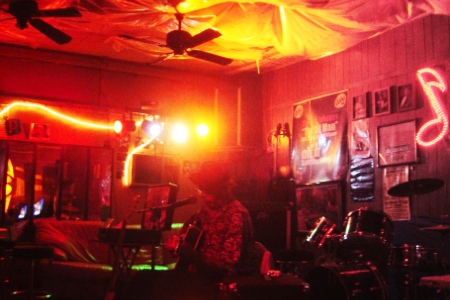
Figuring an hour and a half after the start time would be safe, we got to the outside of Red’s at 10:30 to find a rusted boiler and a closed door. I slowly opened the door to a dead-silent room of ten people and Red gazing just over my forehead. I handed him $10 and quietly took a seat at a table on the right side of the room. Belfour, fiddling with his guitar tuning, sat in a chair surrounded by an improvised merch table and a few amps. He pulled out a small bottle of gin, took a swig, and in a simultaneously heartbreaking and comedic way, shuddered violently. “I just can’t drink this stuff anymore!” he grimaced, and then asked Red for a Bud Light.
Watching Belfour tune his guitar was almost as engaging as listening to his music; his maddeningly percussive test strokes of strings that seemed impossibly out of tune would have made a great Stockhausen study. This continued for a few minutes and somehow segued into a introductory vamp, which I didn’t even realize had started until I saw Red bobbing his head from behind the bar.
Belfour took no time to demonstrate his virtuosity. His ability to separate parts, from the bassline to the drifting countermelodies, was astounding and nothing short of trance-inducing. After five or so minutes of this, he leaned in close to the microphone, closed his eyes, and howled four octaves lower than a wolf in the wild. Somehow, his vocals stole the spotlight from his guitar playing, cutting through the room with ineffable lamentations about life in a way that I couldn’t even pretend to relate to.
It was difficult to divine Belfour’s setlist, not only because many of the songs he played were mixed and matched, but also because there were only a few breaks between each piece, which averaged about 10 minutes each. This long form, deeply rhythmic style contrasts with the more concise Delta style, and at least in this setting filled with starry-eyed visitors, seemed more powerful than the local tradition.
After an hour of this soulful music, the small crowd began to saunter out into the cool, 85-degree, muggy evening, dropping money in the bucket on the way out. Belfour made sure to personally thank everyone and engaged in a conversation with two visitors from Portland. “Y’all have a safe trip back to Po’ land!” Belfour offered on their way out. The couple then proceeded to explain that they were from Portland, not Poland, to Belfour’s wry smile and raised eyebrow.

Mutek 2008
May 28 – June 1, 2008;

Driving 500 miles!? Haven’t you heard of peak-oil crisis? Oh wait, I’m going to Canada? It’s like America, but better, according to Michael Moore. They don’t have guns, I can break all the bones I want, and they don’t have that whole Puritan mentality in their public consciousness! That is basically my thought process before attending Mutek, which consisted of five days of partially government-funded electronic music goodness. With nearly 100 DJs, knob-tweakers, and audio engineers from 20 countries talking about production techniques, creating ambient soundscapes, and playing sets way past my bedtime, how could I refuse?
We arrive in Montreal, Quebec a few days into the festival, and we’re surprised to find most nearly everything is in French. Uh oh -- I thought Canada was like America, but people peppered their sentences with an occasional “aboot.” Kids who look like they are 16 are running around on the streets after midnight (I’m informed the drinking age is 18); I see signs for “Sexoteques” next to fusion Pho restaurants in commercial districts; and the majority of pan handlers are crust punks with signs asking for “4:20” (I later find out that Critical Mass is occurring). So this is the metropolis that birthed Vice Magazine... To top it off, the combined taxes on food purchases equals almost 10%! Canada, or Montreal rather, is not like a Rick Moranis movie. Be warned!
----
----
----
{Ben Frost (Theatre du Nouveau Monde)}
Unfortunately, I had eaten a large amount of poutine, French fries covered in gravy and topped off with cheese curds, before I settled into the seats here. The theater was completely covered in darkness, save for some occasional moments of brief soft light that covered the Australian-born composer Ben Frost. In some respects, this really enhanced the performance. It’s said that people who are deficient in one area of sensory perception have developed heightened senses in others; a blind person might have exceptional hearing, like Dare Devil, the blind Marvel superhero with super hearing, for example. In this case, the music was literally all that the audience had to focus on, Frost’s compositions gained an added layer of hypnotic intensity.
----
{Modeselektor & Pfadfinderei (Metropolis)}
Sometimes bodily injury is unavoidable and even a welcome part of the show-going experience, like a shirtless, 300-pound guy stage-diving onto your head at an Earth Crisis show, or falling off a stage during a Dan Deacon gig and cutting your leg on broken beer bottles. The next day, I noticed an intense pain in one of my knees from dancing so hard. All I have to say is, "Thanks Modeselektor, Hello Aleve!" This was the most all-out, totally in-my-face performance of the festival. The visuals from Pfadfinderei, a multimedia collective, perfectly complemented the Berlin duo’s nearly 2-hour-long set. The audience was bombarded by everything from neon punk elephants to a glowing hypnotic HAL-like orb. If you have any mortal enemies that have epilepsy, this is the event to invite them to.
----
{Fennesz (Theatre du Nouveau Monde)}
By the time Fennesz’s set began, my struggle with the poutine was over and I was feeling the boost of pure energy that only grease, fat, and an accumulated amount of Octane 7.0 (a Canadian equivalent of Red Bull), could provide. Fennesz was accompanied by video artist Lillevan, who was responsible for the visual landscapes that were projected over the duo and on the screen behind them. The visuals reflected a new-age-y water theme, which was appropriate for the set, as the music and visuals transitioned from the feelings of drowning to a slow elemental ripple.
----
{The Field (Metropolis) }
Axel Willner kept it simple during his North American debut, translating his studio project as The Field into a live instrumentation trio, which I had doubts about. I love 2007’s Here We Go Sublime; it’s just that it seems more suited to non-focused listening, something that gets put on before bed or when you’re behind on a deadline and staring at a blank MS Word document. I was wrong, and this is one of those times when I’m happy I’m wrong -- not, I’m wrong and I just walked ten blocks in the wrong direction.
----
{Radio Slave} (Metropolis) }}
Radio Slave isn’t so much of a DJ as a master of mind control. Just when the feeling in my feet returned and the dancing crowd slowed to a zombie-like sway, he would mix in a slow build-up that would result in much fist-pumping and lighter-waving (I’m not kidding). The audience also liked to clap their hands to the beat of the music, A LOT. Sometime around 3 AM, I ran out of dance moves and resorted to cheesy candy-raver moves (think the running man). At this point, a pair of high school-looking kids come over to me and ask me where the pills are. I shrug, and they walk over to the girl who is rubbing her face into one of the speakers. His set didn’t end until around 6 AM, at which point, like a drunken fairy tale, the spell was broken and we were released outdoors to the sounds of birds merrily chirping.
----
----
----
There’s nothing like traveling to shatter your pre-conceived notions of the world, pieced together from ’80s movies and Nickelodeon horror series. Would-be visitors, my only piece of advice is to check out Casa Del Popo -- it’s a venue and eatery run by members of Godspeed You! Black Emperor, and the sandwiches won’t punch you in the gut.
Casiotone for the Painfully Alone / Datagun / The Western Front
The Mill; Iowa City, IA

I woke up. It was Sunday, I think, but I felt unfamiliar in my surroundings and wasn't sure of anything. I could’ve been alone but wasn’t, instead accompanied by the kind of hangover that makes you reconsider your place in the universe. What. The. Fuck. Today was going to be a long day. I grumbled myself out of bed and onto the street and somehow wound up stumbling and stammering through a brutal six-hour coffee shop shift. In a cruel twist of fate, the gods of lattes and double-skim-mochas-to-go punished my Saturday night indiscretions with a steady stream of Sunday afternoon traffic. Lulls in this siege were nothing more than fleeting opportunities to sit in the office and cradle my head in my hands. It was bad.
Six o’clock rolled around, and while on a typical day I would be experiencing what’s colloquially known as a second wind, this was no ordinary day. Thus, seven hours into my day I was only getting my first wind. And were this a typical Sunday, I would probably sleepwalk through my grocery shopping and then go home, make dinner, and pass out with Sportscenter on, but this was no ordinary Sunday: we had Casiotone For The Painfully Alone coming to town on this day.
And thus, going through the motions, I found myself once again at the local watering hole, in this case the Mill; and though I felt like death, I found myself feeling better because I wasn’t alone. I was amongst friends who were far less hungover than I -- and that plus a Bloody Mary helped ease the pain. The Bloody Mary segued to beer to conversation to music, as local trio The Western Front began their set. Until very recently, this band wasn’t even a blip on my radar. I don’t know where they came from, but they’ve quickly become my favorite local band. Their setup is daunting for a three-piece, revolving around a multi-instrumentalist who plays drums, synths, samples, and just about everything else all at once. I found myself watching and thinking, “How is this band not signed to Barsuk and touring the country with Menomena now?”
Up next, Datagun, a trio of three of my closest mates, but I would be down with this band regardless. I think it’s fair to say that they’re still working everything out, but this night was the tightest I’ve heard them. Datagun is a clusterfuck of vocals and keyboards and some other shit, meeting at the place where pop meets noise and delivered by three dudes running around, switching instruments and singing into different microphones and each doing a little bit of everything. A turntable and a drum machine provide the panorama on which the screeching guitar and haunted vocals occur. You haven’t seen them yet if you haven’t come to Iowa City lately, but maybe you should. Or maybe someday they’ll visit your town, and you’ll get it, too.
Then Casiotone For The Painfully Alone took the stage, just one man and his digital setup on a night that featured a veritable bevy of digital setups. I was now in the perfect place, where my lack of sleep and beer consumption were meeting up and sparks were flying. I didn’t need to talk to anyone, finding myself beyond content to just stand and sway as I watched this surprisingly tall bearded man twiddle knobs and soothe my tattered state. I pulled the brim of my cap low over my eyes and lit up one last cigarette and allowed the fullest waves of synthesizer sound to wash over me.
Owen Ashworth was witty and affable, moreso than I expected, considering he’s made a career out of being Painfully Alone, or at least associated as such. and being in a one-man digital band made me assume for some reason that he would be reclusive and standoffish. Instead, he filled spaces between songs with tales of Swedish ‘pandas’ and being caught in electrical storms in Arkansas and so on. Highlights included “Bobby Malone Moves Home,” a blistering take on “Young Shields,” and “New Year’s Kiss.”
More than anything, I was left with the impression that, for a dude who pretty much just stands there and nonchalantly messes with some keyboards, he’s way radder live than on record. I’ve enjoyed his records, particularly Etiquette, but have never found myself getting totally lost and immersed in them like I did this performance. After he was done, my friend Andre and I stayed at the Mill long past everyone was gone and enjoyed more beers, rapping about this and that and how good it was to be able to host a show like that on a Sunday night. Around 2:00, well past the time it made sense for me to crash, I made the brisk walk home, over the river and across the train tracks. I was happy, just being blissfully alone.
Bonnaroo 2008
Manchester farm; Manchester, TN

Stamina and the general nature of humanity are two topics that wouldn't go away during my three days at Bonnaroo. Stamina is the easy one. Just how much can one endure at a fest like this? How many hours without sleep? How many different types of drugs, music, junk food, dancing, comedy, even just standing around can the body tolerate before going into total shutdown? I really wanted to make it to the late-night sets. I wish I could have grooved in the rain with My Morning Jacket at 3 AM or sat on the lawn in front of the What Stage watching Kanye West’s set just before dawn broke. But I just couldn’t do it.
Enter the nature of humanity. This topic is something my cautious ’Roo companion (we’ll just call him Malkmus) and I returned to repeatedly during our Tennessee experience. Does goodness define humanity with some shitty individuals thrown in, or are humans just miserable creatures with few shining exemplars of kindness and warmth? During those three days on the farm, I witnessed some of the most depraved and thoughtless acts I’ve ever seen. But I also met and talked with some genuinely fantastic people. So which is it? Can it be both ways?
----
{The Journey}
We left Maryland on Wednesday morning. Both Malkmus and I were in good spirits. Two old friends on a road trip, getting time to catch up away from the hassles of work and the time constraints of everyday life. Car loaded with non-perishable food, we took our time getting to Tennessee, meandering down the Skyline Drive and stopping for greasy meals recommended by that Roadfood book. It was a relaxed journey of bonhomie, as I recounted tales from last year’s Bonnaroo. We stopped for a night in a Motel 6 in Athens, Tennessee, getting in one last night of rest before heading out to the campground.

{The Author Steps In}
All right, I know none of you give a shit about what we ate, what we listened to in the car, or what we talked about. Who am I kidding? Cut to the chase! All right, for those of you who care only about the salacious details, the next few sections are for you!
----
{Drugs}
“Christ, no one smokes pot anymore!” That seemed to be the common complaint of the various festival-goers. True, drug dealers prowled the campground, peddling all kinds of shit, but as the scent of marijuana floated in the air, only the harder stuff appeared to be on offer. Mushrooms, acid, ecstasy, DMT, even opium mixed with readily available alcohol. The guy in the tent next to mine spent more time counting his money and pushing his wares than listening to music. Bonnaroo as business. Whereas pot can make a place into a communal den of peace, this abundant harder business really set the tone. The peace and love ambience I had experienced the year prior had been replaced by the frequent patrols of mounted police, squabbling over drugs and theft. In fact, this theme segues nicely into the next subheading.

{Violence}
Peace and love, man. Bullshit. When I realized my campsite would be a five-minute walk from Centeroo, I was ecstatic. On the popular message board Inforoo, members refer to a certain section of camping as BFE (I believe it’s Butt Fuck Egypt). The walk from BFE to the stages could be as long as 45 minutes. So when I pulled into Camp Darth Vadar and saw Bonnaroo’s signature Ferris Wheel just up ahead, I thanked my lucky stars and clicked my heels. Malkmus, a ’Roo Rookie (I know, horrible), was too busy sweating to care.
Once all the effort of setting up camp abated, I was able to survey my neighbors. First, the guy right next me, a truck driver from North Carolina, was a stand-up dude. Patient and kind, we spent a few hours jawing over the course of the weekend about trucks, steaks, and music. The others, now. Besides the drug dealer, we had Shauna and Dave nearby. Each evening was domestic violence night for these two. Among the best lines -- “Dave- I just want to get high.” “Shauna, you’re falling asleep.” “Go fuck Greg.” “I don’t love Greg.” “Shauna, get back in this tent. You’re naked.” The knock-down-drag-’em-fight eruption happened over heroin. Shauna wanted to shoot it. Dave wanted to sell it. I wanted them to shut up.
The worst offenders in our site were the ravers. Each morning at 5 AM, they pumped their car stereo to the max with the shittiest techno you could think of. For those of us who came back from the concerts at 2:30 AM, this dance party was less than appreciated. I blame my inability to stay up for some sets squarely on these motherfuckers. But whatever, at least they had fun.
The scariest incident, however, happened on Saturday evening. The truck driver and I sat out having a discussion when an undercover policeman took some kid down 15 yards away. I honestly think all the kid did was solicit him for pot. The cop pinned him to the ground with vigorous force and beat him. All the kid could do was apologize and scream. You get the picture.
----
{Nudity}
Besides the copious painted boobs, the only other thing of note occurred as I packed up my tent. A girl got out of her tent and bent over. No pants on.

{Rich vs. Poor}
Each year, Bonnaroo offers up general and VIP tickets. To be a VIP, all you have to do is spend some money. Since I had a media pass, I had to stay in the general campground but had access to a special “guest” area in the back. Some major differences: shade, free water, clean toilets. That isn’t to say the festival neglected the johns in the general area. It’s just the populace was so big, there weren’t enough pots to literally piss in. Malkmus claimed he heard “Mother of God” more than once from an unsuspecting potty entrant. But the dichotomy was real. Pay up and be treated better. I know it’s the way the world works with capitalism, supply and demand and blah blah, but this is Bonnaroo. This is a make-believe playground to retreat to and forget about the “real” world. But fecal matter is real and so is violence. Whenever I stepped back from the airy guest area of hammocks and free barbecue meat and into the general camping area, I couldn’t help thinking of pre-Jacobean costume dramas where the rich ate from the finest crystal and the groundlings fought in the street over a piece of bread. But hey, for a few bucks more you don’t even have to think about them.

{A Pause}
Now I feel better. There was plenty of good stuff as well. Last year, my girlfriend commented that she liked the fact that rather than SECURITY t-shirts, the staff sported the more friendly SAFETY designation. Each and every staff member I solicited for help or advice was outgoing and willing to assist. It was clear the Bonnaroo bosses wanted festival goers to feel welcomed. I’ll give them that. A large festival is also a plum opportunity to meet people from all over the country. Once you found the ones not interested in talking about shrooming, rolling, and drinking, you can hear some fun stories about music and other regions of the States.
----
{The Shows I Saw}
Okay, here is a blow-by-blow of what I saw. Last year, I was more gung-ho about seeing complete sets. This time I treated the festival as a smörgåsbord. The interesting thing is no one’s experience could possibly be the same. There was just too much to do, so many variables that even though American festivals are becoming more and more homogenized (Jack Johnson is headlining most), the individual can still make each day special. Here we go.
{MGMT}: I really dig this Bowie dance-pop duo. The short set comprised most of their Oracular Spectacular album. Though they suffered from the common bass-too-loud, vocals-too-low festival malaise, songs like “Weekend Wars” and “Electric Feel” felt even more electric than the album versions. Set closer “Kids” brought the crowd to thunderous applause.

{Battles}: The coolest thing about this set was the giant cymbal suspended what seemed to be two feet over the rest of the set. These guys have the tight math rock tempos down to a science, and keeping a crowd entertained with no discernible lyrics is a commendable feat. “Atlas” was a standout.
{Vampire Weekend}: It’s crazy to think the closer for Thursday night only has one album. But it’s a good album, and Vampire Weekend played it safe as they remained faithful to the LP versions. I started to get tired as the set wore on and bailed out. At least I got to hear “Cape Cod Kwassa Kwassa.”
{The Swell Season}: I stuck around for the entirety of this one. Holy shit! Glen Hansard and Marketa Irglova provided the set of the weekend. With songs primarily taken from the film Once, this set was touching and rocking. There were two or three times when I felt chills as Hansard’s tiny body shook to force out such big notes. Van Morrison covers “Into the Mystic” and “Astral Weeks” helped flesh out the set and a surprise inclusion of The Pixies’ “Levitate Me” helped keep even the snobbiest of hipsters entranced. Fantastic stuff!
{M.I.A}: Only got to catch about 40 minutes of M.I.A. (supposedly her "last gig ever.") Rather than greet the crowd, she came out bitching about too little bass and too little mic. I hate the sounds that party favors make on New Year's Eve. She seemed to blow on a big one every few minutes. Loud, incoherent, and sloppy, only her dance moves saved this one from being a total waste. By the way, I love Arular and Kala. The most telling moment is when cardboard cut-outs of M.I.A. and other generic CK models hit the crowds in a faux crowd surf. The crowd’s evil urges came to life as these guests were torn asunder. Art imitating life?
{Chris Rock}: Rock started off with an incisive topical set about the political environment that quickly devolved into a tired diatribe about differences between black and white, men and women. I heard all this stuff on the Richard Pryor box set. The most shocking aspect was the unapologetic way he urged black men to go for white women once they were rich enough. Something about the topic made me uncomfortable, especially in a crowd where 99.9999% were white. I don’t know, it felt unoriginal. But he did have some keen insights on jobs vs. careers. Malkmus especially liked the rim job jokes. But what the hell, he was opening for Metallica.
{Metallica}: I can’t take them seriously. After the melodramatic Ennio Morricone intro and the explosion into “Creeping Death,” I kept thinking about Lars crying over making a mint on his paintings in Some Kind of Monster. I made it through two songs. The crowd loved it. “Master of Puppets” and “The Unforgiven” sounded good from my tent.
{My Morning Jacket}: This set ran from midnight to almost 4 AM; I made it for about 70 minutes. These guys put on a good show, but it was raining and cold. They concentrated mainly on tracks from Z and Evil Urges during the first of two sets. Also, a whole host of R&B covers from James Brown, Bobby Womack, and Erykah Badu peppered the set. Great way to end the night. Too bad the ravers and their crappy music sapped me of the stamina to enjoy this good music. Fuck you.
{Louis C.K.}: Malkmus loved this guy. I couldn’t deal with the scat humor. So I left. He’s clearly talented.

{Against Me!}: Another kick-ass set. These guys pumped a lot of energy into 50 minutes. Tom Gabel can write trash metal tunes with a hook. I don’t normally go for this type of stuff, but these guys got me. I felt like I was watching a band, not a corporation like Metallica. Highlights: anything from New Wave.
{Iron & Wine}: I like the Shepherd’s Dog. I think it’s impossible to expect Sam Beam to keep pumping out hushed, acoustic weepers. But, although Woman King was a bold new direction for him and his backing band, the 10-minute jam workouts live did nothing for me. He didn’t even touch an acoustic guitar until the stunning closer of “The Trapeze Swinger.” Even “Upward Over the Mountain” adopted Beam’s new fascination of Afro-Cuban beats. Sounded good, but bored me a little.
{Sigur Rós}: I took a nap from 10 PM to midnight and then lined up for the 1 AM set of Sigur Rós. I love these guys. The set was amazing. They kicked it off with an inspired version of “Svefn-G-Englar.” As the soaring noise of the bowed guitar met the kick of the drum, the music transported me away from the druggies and the heat and the musty un-showered masses, and I imagined myself in a glacial wonderland taken from the band’s film Heima. They followed it with a beautiful rendition of “Vaka,” where only some technical difficulties marred its splendor. Everything else seemed to work. The backup strings of Amina and the marching band sounded great; Jonsi has a sweet voice. The band also got to showcase a few new songs from its upcoming album, Með suð à eyrum við spilum endalaust. Malkmus and I only made it for 70 minutes. I was really sad to walk away from this one.
{Kanye West}: Dear Kanye, thanks for changing your set time from 8 PM to 2:45 AM. I really wanted to see your show, you bastard. During his performances, Kanye likes to project critics’ denigrations above the stage. Then he just stands there and shakes his head. You’re more than welcome to include this one, Kanye.

{The End}
5:55 AM,. The rave starts again. I decide it’s time to get the hell out of Dodge. As I’m disbanding my camp (Malkmus is sleeping), all my drugged-out neighbors just stare as I sweat in the already sweltering morning. But a stoned girl walks into my camp. “Can I help you?” she asks. I am touched, but before I can answer, she turns to talk to someone else. Finally, she turns back and asks, “Anything else I can do?” I just smile and shake my head. At least the intention is there. She picks her away around my tent, unsteady on exhausted feet, and vanishes into the sea of tents behind us.
Jay Reatard
Harper’ s Ferry; Allston, MA

On April 17, the Silver Dollar in Toronto teetered on the brink of complete chaos when a fan hopped onstage between Jay Reatard and his band, causing Jay to tear off the line-crosser’s shirt and punch him in the face, sending the man reeling back into the surging crowd, and Jay announcing that the show was over as he walked off stage.
Three nights later, Jay Reatard played a show in Allston, MA, at Harper’s Ferry. I wondered if, in light of the debacle in Toronto, Jay might address the crowd, maybe make mention of the incident, or perhaps warn anyone drunk enough to saunter onstage that they would meet the same fate as the (now undoubtedly quite sore) gentlemen in Toronto.
But I forgot something important: this was a Jay Reatard show, which means April 20 would be no different than April 17 or April 21, right on down the line. The only evidence of a scrum a few nights before was a group of well-positioned security guards standing around the raised stage, wearing all black, arms folded, facial expressions menacing.
And so it went: Jay, bassist Stephen Pope, and drummer Billy Hayes took their places, Jay set the distortion levels on his pedals to “kill,” and launched into “Blood Visions,” the opening track on 2006’s album of the same name. The band would rip through song after song, with Jay stumbling around, periodically spitting, and singing in a much throatier, lower register than he does on record. After one song finished, he’d shout the title of the next song in queue, along with something like “let’s go!” for good measure. The band was loud, tight, and efficient, and they churned through the set list expertly. What you hear on record (the set list was culled from Blood Visions and some of the various 7-inches Jay has been releasing through Matador) is what you hear in concert, except that in a live setting, the aggressive songs turn into something close to belligerent, in the best possible way.
I got the feeling watching them that punk rock had found its new mouthpiece. Of course, most of that sentiment comes from the music itself: there’s no denying that Jay Reatard’s songs – short, powerful, melodic tracks that scream out of Jay’s flying-V like a derailed subway car – bring to mind the Urinals and Buzzcocks while sounding distinctly modern. But it’s in Jay’s stage philosophy that has garnered him heaps of attention and praise from critics and show-goers alike. Take this musing from a video on his MySpace page: “We just like to Blitzkrieg everyone and just play as many songs as we can as fast as possible with no breaks or bullshit. So I think... just the energy level can make out stand out.”
And so the April 20 show at Harper’s Ferry, while stunning, was just like any other Jay Reatard experience, and the events at the Silver Dollar a few nights before did nothing to alter Jay’s game plan. Ultimately I think Jay’s ability to shrug off near disasters is a good thing. After all, don’t we go to punk shows to get “Blitzkrieged” anyway?
Kaki King
Bowery Ballroom; New York, NY

The instant Kaki King started playing, I was mesmerized. It happened all in a brief moment: a loud, milky voice said, "Hey guys," and before I had a chance to react, the first song had begun. The music seemed without direction, as if it were playing inside my head. My friends were making their way up the stairs to the balcony, but I staggered, paralyzed, my neck craned in the opposite direction so as not to break my gaze from what was occurring on stage.
Barely even seeming to touch the strings, Kaki King constructed an otherworldly sound, a beautiful tone that was difficult to believe was generated by someone’s fingers. Audio and video had not come close to conveying that which was occurring in front of me. The intricacies of her performance can only be perceived live, and the awe of the first experience, I discovered, can be completely overwhelming. A few minutes later I remembered where I was and suddenly noticed that, aside from a few people at the bar in the back, the entire audience was silent.
Later, a drunk person would occasionally blurt out inappropriate encouragement or shout “Call me, Kaki!” met immediately with a chorus of “Shhhhhhhhhh.” “There’s always that one guy,” smirked Kaki, about halfway through the show. This seemed to indicate not that her concerts are always disturbed by some drunkard, but rather that her audiences are usually as remarkably quiet and respectful as they were that night. Though there were times this audience got excited and cheered for a particularly difficult piece of guitar playing, more often it felt like the entire audience was lost in the music, as unaware of their surroundings as I.
The very intensity that cast a trance over the concertgoers made this a particularly difficult show to review. While paying the most attention to documenting the performance, I felt the least involved, though my lapses in attention were rarely voluntary. Many times, I became entranced by the sonic experience, forgetting to do anything other than stare and listen. As the song completed minutes later, I was released and able to scribble down a few notes but mostly reluctant to verbalize what I had just been involved in.
In a way, Kaki King is cursed by her talent. Her technique is so astounding that nothing she does can be as remarkable as playing solo on her Ovation. Inclusion of other instruments and overdubs creates an uncertainty that detracts from the fact that helps make her first album so astounding: that the sounds were created by a single human being and guitar. This is not to say that I do not enjoy any of her subsequent albums, rather that I would have given them a fairer evaluation had they been released by someone else.
This dilemma seemed somehow less relevant in a live setting. The presence of the other musicians removed the vagueness from the songs’ construction. More importantly, Kaki has chosen a strong group of instrumentalists to support her, and their communicative synergy is obvious. While I occasionally caught myself wishing I had seen Kaki’s solo tour in support of Everybody Loves You, when her inclinations towards pop melodies were lesser, songs like “Life Being What It Is” and “Pull Me Out Alive” swelled to life, far surpassing their album versions. And while I was once convinced that no musician could appropriately match Kaki in concert, the drummer’s performance on “2 O’Clock,” in which he and Kaki matched perfect thirty-second notes for some time, was enough to convince me otherwise.
Despite beginning with six straight tracks from Dreaming of Revenge, the concert felt remarkably varied. Familiar songs were given new life by interesting performances. During the already-absurdly-fast “Magazine,” Kaki pushed herself to speeds unheard on the album, until her hands were nothing but a blur. While she was friendly and funny, Kaki rarely spoke, allowing several songs to flow together. Near the end of the show, the band played environmental music while Kaki read the opening to Frank Herbert’s Dune. “They’re making a Dune movie,” she explained, “and I want to be in it.” The concert closed with “You Don’t Have To Be Afraid,” in a performance so beautiful that it could easily have stood without an encore. Of course, Kaki took every advantage of the encore, returning with a live-sampling pedal-steel solo performance of “Gay Sons of Lesbian Mothers.” The band joined her once more to play an intense and lengthy version of “Doing The Wrong Thing,” after which I was sure the show was over. “We really love German Metal,” Kaki told the audience, before the band launched into an explosive cover of Bubonix’s “Fashion Tattoo.” It was the perfect ending to such a varied performance. If there had been one thing the audience was not quite sure that Kaki King was capable of, it was screaming, rocking, and playing twice as loud as the rest of the concert.
During the performance of “Magazine,” I began to wonder if this was the most incredible feat of guitar I had ever witnessed. As I stood outside on the sidewalk, I contemplated this again, just as Kaki King ran out of the venue and into her van. As her tiny body brushed by me, I noticed that she looked like she could have just has easily been one of the concert-goers now congregating outside and felt the same amazement that had originally drawn me to her music: those incredible sounds, the songs -- the entire experience -- had all somehow been born of that one human being.


